We Compared 6 Coop Solar Panels. Voltage Decides, Not Watts
We compared six coop solar panels on output voltage, connector and cable length, and explain why a 12 V panel will never charge a 5 V coop door.

By Sam Reddick Lead gear reviewer, Chicken Geek
Fact checked by Marta Voss
Published Prices and stock checked 7 min read
Almost everybody shops for a coop solar panel by wattage. They see a 10 W panel next to a 5 W panel for a few dollars more, buy the bigger one, and then find it plugs into nothing.
Wattage is not the deciding number here. Output voltage and connector are. An automatic coop door runs on 5 V or 6 V and takes power over USB or a small DC plug. A 12 V panel built for a leisure battery cannot charge one, however many watts it makes. That single fact splits this group cleanly in two, and it is the difference between a panel that works on day one and a panel that goes back in the box.
So we sorted these six by what they can actually feed. Four of them can keep an automatic door topped up. Two of them are 12 V panels for a battery, a fence energiser or a gate motor, and only one of those ships the charge controller you need to use it safely.
The second number worth checking before you buy is cable length, because the sun is on the ridge and the door is in the shade under the overhang.
Our picks at a glance
Every product below wins one specific situation. Pick the row that matches your flock, your yard and your budget rather than reading top to bottom.
-
Best Overall

Saillong 5W
Anyone with a USB-charged automatic coop door who wants the panel far enough from the door to actually sit in sunlight.
-
Best for a 6 V Door Opener
AsFrost 7W
Owners of an automatic door that charges at 6 V through a barrel plug rather than at 5 V over USB.
Check price on Amazon for AsFrost 6V High-Efficiency Solar Panel 7W for Most Chicken Coop Door on AmazonAbout $19.99 checked Aug 8, 2026
-
Best for a Shaded or North-Facing Coop
WININMETA 6W
Coops in tree shade, on a north-facing wall or in a climate with long grey spells, where a plain panel spends days collecting almost nothing.
-
Best for Mounting Straight onto Run Mesh
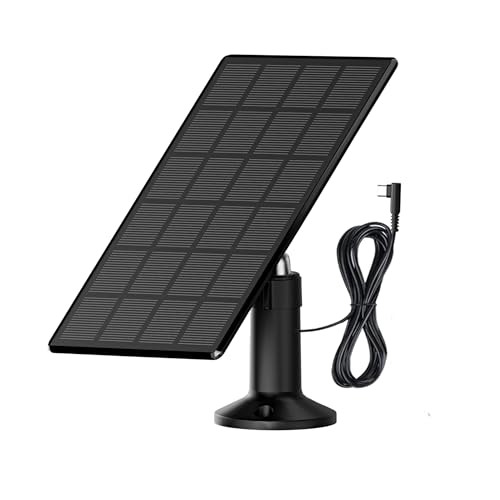
Pidemeo USB-C panel
Runs and coops built from welded mesh or metal panels, where there is no solid timber face to take a bracket.
-
Best for Powering More Than a Door

Renogy 100W kit
Keepers building an off-grid coop that has to run lights, a fan, a water heater element or a fence energiser, not just a door.
Check price on Amazon for Renogy 100W 12V Solar Panel Starter Kit with 30A PWM Controller on AmazonAbout $160 checked Aug 8, 2026
-
Best for a 12 V Fence Energiser or Gate

ECO-WORTHY 10W
Keeping a 12 V electric fence energiser battery or a gate opener battery topped up where the panel can sit right beside the load.
Compare every pick side by side
Swipe the table sideways to see every column on a phone.
| Product | Award | Price band | Rated Wattage | Panel Voltage | Output Connector | Cable Length | Weather Rating | Mounting And Extras | Best use case | Buy link |
|---|---|---|---|---|---|---|---|---|---|---|
| Saillong 5W | Best Overall | Under $30 | 5 W monocrystalline | 5 V | Micro USB and USB-C | 11.5 ft (about 3.5 m) | IP66 housing, stated operating range -40 F to 185 F | 360-degree adjustable bracket and expansion screws | Anyone with a USB-charged automatic coop door who wants the panel far eno… | Check price for Saillong 5W Solar Panel for Chicken Coop Door with Micro USB & USB-c Port; 11.5ft Cable Solar Panel Charger for Automatic Chicken Coop Door, 360° Adjustable Bracket, Waterproof on Amazon |
| AsFrost 7W | Best for a 6 V Door Opener | Under $30 | 7 W monocrystalline, 22 percent efficiency claimed | 6 V | Not stated, supplied as a power cord for coop doors | 9.8 ft | IP65, tempered cloth-textured glass, cold-proof material | 360-degree swivel wall mount and screws, panel 9.4 x 6.7 x 0.28 in, three mounting holes | Owners of an automatic door that charges at 6 V through a barrel plug rat… | Check price for AsFrost 6V High-Efficiency Solar Panel 7W for Most Chicken Coop Door on Amazon |
| WININMETA 6W | Best for a Shaded or North-Facing Coop | Under $30 | 6 W | Not stated | DC port, plus a DC to USB-C adapter cable | 9.8 ft (3 m) DC cable, plus a 6.5 ft USB charging cable | IP65, corrosion resistant | Built-in 8000 mAh battery with a claimed 60 days of backup power, screw kit included | Coops in tree shade, on a north-facing wall or in a climate with long gre… | Check price for 6W Solar Panel for Automatic Chicken Coop Door Compatible with Chicken Coop Door with DC/USB-C Port, Built-in 8000mAh Battery, with 9.8ft DC Cable & DC to USB-C Adapter Cable, IP65 Weatherproof on Amazon |
| Pidemeo USB-C panel | Best for Mounting Straight onto Run Mesh | Under $30 | Not stated, listing quotes a maximum charging current of 500 mA | 5 V output | USB-C | 10 ft (3 m) | IP65 housing with tempered glass | 360-degree rotating bracket, mounting kit for wood, wire mesh or metal. Maker claims it fully charges an 1800 mAh battery in a day | Runs and coops built from welded mesh or metal panels, where there is no… | Check price for Solar Panel for Automatic Chicken Coop Door – 360° Rotating Max 500mA High-Efficiency Monocrystalline Solar Power Kit, IP65 Waterproof Charger with 10ft USB-C Cable for Most Chicken Coop Openers on Amazon |
| Renogy 100W kit | Best for Powering More Than a Door | $120 to $250 | 100 W, 22.5 percent cell efficiency, stated average 500 Wh per day | 12 V | IP67-rated solar connectors into the included controller | Not stated | IP65 junction box, 2400 Pa wind and 5400 Pa snow load, UL 61730 and IEC 61215 certified | Wanderer 30 A PWM charge controller included, expandable to 400 W, works with AGM, gel, flooded and lithium batteries | Keepers building an off-grid coop that has to run lights, a fan, a water… | Check price for Renogy 100W 12V Solar Panel Starter Kit with 30A PWM Controller on Amazon |
| ECO-WORTHY 10W | Best for a 12 V Fence Energiser or Gate | Under $30 | 10 W monocrystalline, stated 40 Wh per day at 4 hours of full sun | 12 V, listing states charging of 12 V batteries | Extension cable to a charge controller or 12 V load, connector type not stated | 3.28 ft extension cable | Waterproof junction box, 2400 Pa wind and 5400 Pa snow load | Corrosion-resistant aluminium frame with pre-drilled mounting holes, no charge controller listed in the package | Keeping a 12 V electric fence energiser battery or a gate opener battery… | Check price for ECO-WORTHY 10W Solar Panel Battery Charger Portable for Charging 12V Battery or Vehicle Gate Opener,Electrical Fence Chicken Coop Lawn Tractor Boat on Amazon |
The full reviews
Each review below follows the same order: what it is, why it won its category, how it behaves in real use, and who should buy something else.
1 Best Overall
Saillong 5W Solar Panel for Chicken Coop Door with Micro USB & USB-c Port; 11.5ft Cable Solar Panel Charger for Automatic Chicken Coop Door, 360° Adjustable Bracket, Waterproof
The only panel here that carries both micro USB and USB-C at 5 V, which is what an automatic coop door actually accepts, and it ships the longest stated cable in the group at 11.5 ft for the lowest price.
What we liked
- Outputs 5 V, the voltage automatic coop door controllers charge at
- Both micro USB and USB-C fitted, so it matches older and newer doors
- 11.5 ft of cable, the longest stated in this group, so the panel can sit in real sun
- 360-degree bracket and expansion screws included, no extra hardware to buy
- Cheapest panel in this comparison at $14.99
What we did not
- 5 W is a door charger and nothing else, so it will not run a coop light or a fan
- The IP66 rating and the stated -40 F to 185 F range are manufacturer claims with no third-party certification named
- At 7.28 x 6.1 in the glass is small, so a covering of snow or leaves stops charging quickly
Key specifications
- Dimensions
- 7.28 x 6.1 x 1.38 in (L x W x H)
- Weight
- 0.83 pounds
- Colour
- Black
- Rated Wattage
- 5 W monocrystalline
- Panel Voltage
- 5 V
- Output Connector
- Micro USB and USB-C
- Cable Length
- 11.5 ft (about 3.5 m)
- Weather Rating
- IP66 housing, stated operating range -40 F to 185 F
- Mounting And Extras
- 360-degree adjustable bracket and expansion screws
Why the Saillong 5W wins this category
Because it answers the question that actually decides this purchase. A coop door controller charges at 5 V through a USB socket, and the Saillong 5W puts out 5 V on both micro USB and USB-C. Doors sold three years ago tend to use micro USB, doors sold now tend to use USB-C, and having both leads means you do not have to work out which one you own before ordering.
It is also the cheapest panel here at $14.99, and it still out-specs the $19.99 Pidemeo USB-C panel on stated wattage, cable length and housing rating.
Living with the Saillong 5W
The 11.5 ft cable is the practical detail. Your coop door sits under an overhang or on a shaded wall, and the sun is on the ridge. Nine feet of cable often means mounting the panel somewhere it only gets sun for part of the day. Eleven and a half feet usually gets you to the good spot.
The 360-degree bracket lets you angle the glass towards the midday sun rather than leaving it flat, which matters more than the wattage does. Mount it steep and where you can wipe it from the ground.
Where the Saillong 5W falls short
It does one job. At 5 W and 5 V it is a trickle charger for a door motor, and it will not power a light, a fan or anything else you might want in the coop. If your plan is a small solar system, this is not the start of one.
The weather claims are the seller's own. IP66 and an operating range of -40 F to 185 F are printed on the listing with no named standard behind them, while the Renogy 100W kit publishes UL 61730 and IEC 61215. That is a real difference in how much you are trusting the brand.
The panel is also physically small at 7.28 x 6.1 in, so it takes very little snow or leaf litter to cover the working area completely. In a snowy climate, plan to brush it.
Research based, not hands-on
Assessed on the published output voltage, connector types, cable length and housing rating, and compared against the charging inputs automatic coop doors accept.
- Best for
- Anyone with a USB-charged automatic coop door who wants the panel far enough from the door to actually sit in sunlight.
- Skip it if
- You want one panel to run a light, a fan or a water heater as well, because 5 V and 5 W will not do any of that.
- The limitation to plan around
- This charges one small door motor and nothing more. If you later add a coop light or a fan, you will be buying a 12 V panel, a battery and a controller anyway, and this panel will not form part of that system.
2 Best for a 6 V Door Opener
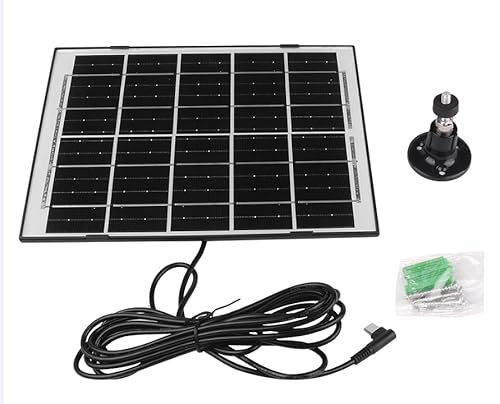
AsFrost 6V High-Efficiency Solar Panel 7W for Most Chicken Coop Door
A 6 V panel for the doors that take 6 V, which is the group the 5 V USB panels cannot serve, and it comes with a swivel mount and 9.8 ft of cable.
What we liked
- 6 V output matches door controllers that a 5 V USB panel cannot charge
- 7 W is the highest rating among the low-voltage door panels here
- 9.8 ft cable reaches from a sunny roof to a shaded door
- Tempered glass front and a 360-degree swivel wall mount with screws included
- Three mounting holes in the panel give you a fixing option if the bracket does not suit
What we did not
- The output connector is never stated, so you cannot confirm it fits your door before it arrives
- 6 V will not charge a door that expects 5 V over USB, and there is no adapter in the box
- IP65 and the 22 percent efficiency figure are manufacturer claims with no third-party standard named
About $19.99 checked Aug 8, 2026
Key specifications
- Dimensions
- 9.37 x 0.67 x 6.77 in (L x W x H)
- Rated Wattage
- 7 W monocrystalline, 22 percent efficiency claimed
- Panel Voltage
- 6 V
- Output Connector
- Not stated, supplied as a power cord for coop doors
- Cable Length
- 9.8 ft
- Weather Rating
- IP65, tempered cloth-textured glass, cold-proof material
- Mounting And Extras
- 360-degree swivel wall mount and screws, panel 9.4 x 6.7 x 0.28 in, three mounting holes
Why the AsFrost 7W wins this category
Not every automatic coop door charges over USB. A good number of them take 6 V through a small barrel plug, and for those doors every 5 V USB panel in this guide is the wrong product. The AsFrost 7W exists for that group.
At 7 W it also carries the highest rating of the low-voltage panels here, which in practice means it refills a door battery faster on a short winter day than a 5 W panel does. That only counts once the voltage is right.
Living with the AsFrost 7W
The 9.8 ft cable is enough to get the panel onto the sunny side of the roof from a door mounted under the overhang, though it is shorter than the 11.5 ft Saillong 5W gives you.
The panel body is 9.4 x 6.7 x 0.28 in, which is slim enough to sit flat against a wall, and the 360-degree swivel mount lets you tilt it towards the midday sun. There are also three mounting holes in the panel itself, so if the bracket does not suit your fence post or run frame, you can screw it directly to something.
The tempered glass front is worth having on a panel that will get hail, brushed snow and the occasional flung stone from a scratching hen.
Where the AsFrost 7W falls short
The connector is the real problem. The listing describes a power cord supplied for coop doors and never says what plug is on the end of it. Barrel plugs come in several sizes, and a 6 V panel with a barrel that does not fit your controller is a return. Compare the seller photograph against your own charging socket before you order.
The weather and efficiency claims are also unverified. IP65 and 22 percent cell efficiency appear as marketing figures with no third-party standard cited, unlike the Renogy 100W kit, which names UL 61730 and IEC 61215.
And it does not solve the general case. If your door wants 5 V over USB-C, this panel cannot help you at any wattage.
Research based, not hands-on
Assessed on the published 6 V output, wattage, cable length and mounting hardware, and compared against the 5 V USB panels it competes with on door compatibility.
- Best for
- Owners of an automatic door that charges at 6 V through a barrel plug rather than at 5 V over USB.
- Skip it if
- Your door charges from a USB cable, because 6 V is the wrong supply and the connector will not match.
- The limitation to plan around
- The listing supplies a power cord for coop doors but never names the connector type or size. Check the plug on your door controller against the seller's photograph before ordering, because a 6 V panel with the wrong barrel is no more use than a 12 V one.
3 Best for a Shaded or North-Facing Coop
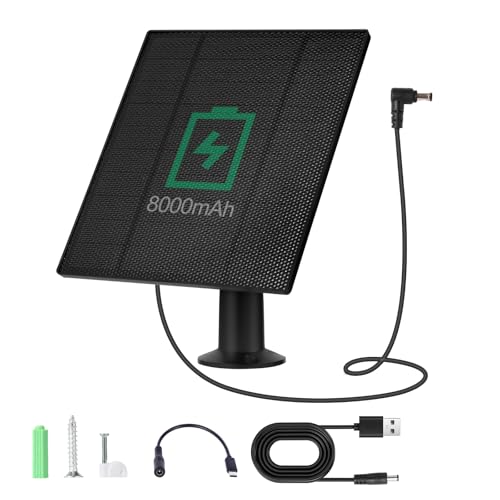
6W Solar Panel for Automatic Chicken Coop Door Compatible with Chicken Coop Door with DC/USB-C Port, Built-in 8000mAh Battery, with 9.8ft DC Cable & DC to USB-C Adapter Cable, IP65 Weatherproof
The only panel here with its own 8000 mAh battery, so it banks charge on the hours it does get sun and keeps feeding the door through grey days, and the DC to USB-C adapter covers both door types.
What we liked
- Built-in 8000 mAh cell stores charge instead of only working while the sun is on it
- DC port plus a DC to USB-C adapter cable, so it suits DC and USB-C doors
- 9.8 ft DC cable, plus a separate 6.5 ft USB charging cable
- IP65 corrosion resistant housing with a screw kit included
- Small footprint at 4 x 8 in, easy to fit on a narrow run frame or post
What we did not
- The claimed 60 days of backup depends on a door current draw the listing never states, so it cannot be checked
- Panel voltage is never published, so you cannot confirm compatibility from the specification alone
- The most expensive of the four low-voltage door panels here at $29.99
- A built-in lithium cell is a wear part, and its capacity falls in cold weather exactly when you need the buffer
Key specifications
- Dimensions
- 4 x 1 x 8 in (L x W x H)
- Colour
- Black
- Rated Wattage
- 6 W
- Panel Voltage
- Not stated
- Output Connector
- DC port, plus a DC to USB-C adapter cable
- Cable Length
- 9.8 ft (3 m) DC cable, plus a 6.5 ft USB charging cable
- Weather Rating
- IP65, corrosion resistant
- Mounting And Extras
- Built-in 8000 mAh battery with a claimed 60 days of backup power, screw kit included
Why the WININMETA 6W wins this category
Every other small panel here only works while the sun is actually on the glass. Under trees, on a north wall, or through a run of overcast days, that means long stretches of collecting nothing while the door battery drains.
The WININMETA 6W carries an 8000 mAh cell of its own. It banks whatever it gathers in the couple of bright hours it does get and feeds the door from that store afterwards. In a shaded position, a buffered panel beats a bigger unbuffered one.
Living with the WININMETA 6W
The connector arrangement is unusually helpful. It has a DC port and comes with a DC to USB-C adapter cable, so it covers both the barrel plug doors and the USB-C doors without you having to work out which camp you are in first.
You get a 9.8 ft DC cable plus a 6.5 ft USB charging cable, and the housing is IP65 and described as corrosion resistant, which matters on a wall that gets ammonia-laden air from a coop vent. At 4 x 8 in it is small enough to fit a narrow post or a run frame rail where a wider panel would not sit.
Where the WININMETA 6W falls short
The headline claim does not hold up to inspection. Sixty days of backup from 8000 mAh only means something if you know how much the door draws, and the listing never states it. Different door motors and controllers vary by a large factor. Treat that number as a marketing figure, not a specification.
Panel voltage is also never published, which is a strange gap on a product sold on compatibility. You are relying on the supplied adapter matching your door rather than on a number you can check.
At $29.99 it is the most expensive of the four low-voltage door panels here, twice the price of the Saillong 5W. And the cell that justifies that price is a consumable: lithium capacity falls with age and falls again in hard frost, so the buffer you buy in year one is not the buffer you have in year four.
Research based, not hands-on
Assessed on the published battery capacity, connector types, cable lengths and housing rating, and on how a stored-charge design behaves compared with a plain panel in low light.
- Best for
- Coops in tree shade, on a north-facing wall or in a climate with long grey spells, where a plain panel spends days collecting almost nothing.
- Skip it if
- Your coop roof gets clear sun for most of the day, because you are paying twice as much as the Saillong for a buffer you do not need.
- The limitation to plan around
- The battery is the reason to buy this and it is also the part that ages. Lithium cells lose capacity over years and lose usable output in hard frost, so plan on the backup shrinking rather than staying at its first-winter figure.
4 Best for Mounting Straight onto Run Mesh
Solar Panel for Automatic Chicken Coop Door – 360° Rotating Max 500mA High-Efficiency Monocrystalline Solar Power Kit, IP65 Waterproof Charger with 10ft USB-C Cable for Most Chicken Coop Openers
A 5 V USB-C panel whose mounting kit is made for wire mesh and metal as well as wood, which is the answer when your coop has no timber face worth screwing into.
What we liked
- Mounting kit covers wood, wire mesh and metal, not just a flat wooden wall
- 5 V USB-C output matches modern automatic coop door charging ports
- 360-degree rotating bracket lets you tilt the glass towards the midday sun
- 10 ft cable, enough to reach a sunny roof from a shaded door
- IP65 housing with a tempered glass front
What we did not
- No wattage is published at all, only a 500 mA maximum, which works out at roughly 2.5 W at 5 V
- The claim of a full 1800 mAh charge in a day assumes clear sun, so expect longer in winter or shade
- Costs $19.99 against the $14.99 Saillong while stating less wattage, less cable and a lower IP rating
Key specifications
- Dimensions
- 4.72 x 0.51 x 6.77 in (L x W x H)
- Colour
- Black
- Rated Wattage
- Not stated, listing quotes a maximum charging current of 500 mA
- Panel Voltage
- 5 V output
- Output Connector
- USB-C
- Cable Length
- 10 ft (3 m)
- Weather Rating
- IP65 housing with tempered glass
- Mounting And Extras
- 360-degree rotating bracket, mounting kit for wood, wire mesh or metal. Maker claims it fully charges an 1800 mAh battery in a day
Why the Pidemeo USB-C panel wins this category
Because of the mounting kit, which is the sort of thing nobody thinks about until they are standing outside with a drill. Plenty of runs are welded mesh on a metal frame, with no wooden face wide enough to take a bracket and screws. Most panel brackets assume timber.
The Pidemeo USB-C panel ships hardware for wood, wire mesh and metal. If your coop is a mesh run with a small house inside it, that is the difference between mounting the panel where the sun is and zip-tying it somewhere it half works.
Living with the Pidemeo USB-C panel
The output is 5 V over USB-C, which is what most automatic doors sold in the last few years charge at, so compatibility is straightforward. The cable is 10 ft, long enough to run from a sunlit corner of the run down to a door controller under the coop overhang.
The 360-degree rotating bracket earns its place. A flat panel collects snow and dust and stops working, and it also misses the low winter sun. Being able to angle the glass and then reach it with a cloth from the ground is worth more than a watt or two on paper.
The housing is IP65 with a tempered glass front, which is normal for this class.
Where the Pidemeo USB-C panel falls short
There is no published wattage. The listing gives a maximum charging current of 500 mA instead, which at the stated 5 V works out at roughly 2.5 W. That is half of what the Saillong 5W claims. It is enough to hold a door battery at full charge on ordinary days, and it is slow if you are trying to recover a flat battery in midwinter.
The claim that it fully charges an 1800 mAh battery in a day carries the same caveat: that is a clear sun figure. Under cloud or partial shade, plan on it taking considerably longer.
The price comparison is not flattering either. At $19.99 it costs $5 more than the Saillong 5W while stating a lower charging figure, 1.5 ft less cable and IP65 against IP66. Buy it for the mesh mounting, not for the specification.
Research based, not hands-on
Assessed on the published output voltage, connector, charging current, cable length and mounting hardware, and compared on price and specification against the other 5 V panels here.
- Best for
- Runs and coops built from welded mesh or metal panels, where there is no solid timber face to take a bracket.
- Skip it if
- You have a plain wooden coop wall to mount on, because the cheaper Saillong gives you more cable and a higher stated rating.
- The limitation to plan around
- The maximum charging current is 500 mA, which is about 2.5 W at 5 V. That is enough to keep a door battery topped up in decent sun, and it is not enough to recover a flat battery quickly in December.
5 Best for Powering More Than a Door
Renogy 100W 12V Solar Panel Starter Kit with 30A PWM Controller
The only complete system here, with a 30 A PWM charge controller, tray cables and mounting brackets in the box, and the only panel that names third-party certification. It is also 12 V, so it cannot charge a coop door.
What we liked
- Ships with a Wanderer 30 A PWM charge controller, so the battery is protected from day one
- UL 61730 and IEC 61215 certified, the only third-party standards named in this group
- 2400 Pa wind and 5400 Pa snow load ratings, and an IP65 junction box
- Stated 500 Wh a day at 100 W and 22.5 percent cell efficiency, enough for lights and a fan
- Expandable to 400 W and works with AGM, gel, flooded and lithium batteries
What we did not
- 12 V output cannot charge a 5 V or 6 V automatic coop door, whatever the wattage says
- You still have to buy the battery separately, which is a large extra cost on top of $159.99
- At 41.8 x 20.9 in and 14.1 pounds it needs a proper roof structure, not a coop lid
- Cable length is never stated, so plan the run before you commit to a mounting position
About $160 checked Aug 8, 2026
Key specifications
- Dimensions
- 41.8 x 1.38 x 20.9 in (L x W x H)
- Weight
- 14.1 pounds
- Colour
- with Monocrystalline 100 Watt Solar Panel, 30A LCD PWM Charge Controller, Adaptor Kit, Tray Cables, Mounting Z Brackets
- Rated Wattage
- 100 W, 22.5 percent cell efficiency, stated average 500 Wh per day
- Panel Voltage
- 12 V
- Output Connector
- IP67-rated solar connectors into the included controller
- Cable Length
- Not stated
- Weather Rating
- IP65 junction box, 2400 Pa wind and 5400 Pa snow load, UL 61730 and IEC 61215 certified
- Mounting And Extras
- Wanderer 30 A PWM charge controller included, expandable to 400 W, works with AGM, gel, flooded and lithium batteries
Why the Renogy 100W kit wins this category
Because it is the only product here that answers a bigger question than the door. Once you have 100 W of panel, a charge controller and a battery, the coop can run a light through winter, a fan through summer, a water heater element, or an electric fence energiser, all from the same store.
It is also the only panel in this comparison with third-party certification behind its weather claims. UL 61730 and IEC 61215 are standards somebody else tested against, alongside 2400 Pa wind and 5400 Pa snow load figures. Everything else here quotes an IP number and asks you to take the seller's word.
Living with the Renogy 100W kit
The kit is the point. You get the panel, a Wanderer 30 A PWM charge controller with an LCD, an adaptor kit, tray cables and Z mounting brackets. A bare panel plus a controller bought separately usually costs more and always takes longer to get working.
The controller matters more than people expect. Wire a 12 V panel straight to a battery and full sun keeps pushing current into a battery that is already full, which cooks it. The Wanderer stops that, and it works with AGM, gel, flooded and lithium chemistries, so you are not locked into one battery type.
The system expands to 400 W, so a coop that grows into a workshop or a poly tunnel does not need starting again.
Where the Renogy 100W kit falls short
The voltage is the thing to be clear about. This is a 12 V panel. It will not charge a 5 V or 6 V automatic coop door, and no adapter in the box changes that. If a door is your only load, this is the wrong purchase however impressive the specification looks.
The $159.99 price is also not the finished cost. There is no battery in the kit, and a 12 V deep cycle battery of useful size is a significant extra outlay, plus fusing and cable.
Physically it is a real solar panel: 41.8 x 20.9 in and 14.1 pounds. It needs a proper south-facing structure that can carry the weight and the snow load, not a coop lid. And cable length is never stated in the listing, so measure the run from the mounting point to the controller before you buy, because extension leads on the panel side cost voltage.
Research based, not hands-on
Assessed on the published wattage, certification standards, load ratings and included controller, and on what a 12 V system can and cannot power at a coop.
- Best for
- Keepers building an off-grid coop that has to run lights, a fan, a water heater element or a fence energiser, not just a door.
- Skip it if
- All you want is to keep an automatic coop door charged, because 12 V is the wrong voltage for that job at any size.
- The limitation to plan around
- This is a system, not an accessory. Budget for a 12 V battery, mounting rails and a cable run on top of the kit price, and give it a south-facing structure that can carry 14.1 pounds of glass and frame.
6 Best for a 12 V Fence Energiser or Gate
ECO-WORTHY 10W Solar Panel Battery Charger Portable for Charging 12V Battery or Vehicle Gate Opener,Electrical Fence Chicken Coop Lawn Tractor Boat
A small 12 V panel for topping up a 12 V battery on a fence energiser or a gate motor, in an aluminium frame with proper snow and wind load ratings. It is not a coop door charger and it has no charge controller.
What we liked
- 12 V output suits a fence energiser, a gate opener or a small 12 V battery
- Corrosion resistant aluminium frame with pre-drilled mounting holes
- Rated for 2400 Pa wind and 5400 Pa snow load, unusual at this size
- Waterproof junction box on the rear
- Stated 40 Wh a day at four hours of full sun
What we did not
- The 3.28 ft extension cable is far too short to reach a sunny roof from a coop wall
- No charge controller in the package, so wiring it straight to a battery risks overcharging it
- 12 V will not charge a 5 V or 6 V automatic coop door, so it is the wrong panel for the most common job
- The connector type is never stated, only that an extension cable is supplied
Key specifications
- Dimensions
- 13.3 x 8.1 x 0.7 in (L x W x H)
- Weight
- 1.98 pounds
- Colour
- blue-black
- Rated Wattage
- 10 W monocrystalline, stated 40 Wh per day at 4 hours of full sun
- Panel Voltage
- 12 V, listing states charging of 12 V batteries
- Output Connector
- Extension cable to a charge controller or 12 V load, connector type not stated
- Cable Length
- 3.28 ft extension cable
- Weather Rating
- Waterproof junction box, 2400 Pa wind and 5400 Pa snow load
- Mounting And Extras
- Corrosion-resistant aluminium frame with pre-drilled mounting holes, no charge controller listed in the package
Why the ECO-WORTHY 10W wins this category
There is a real job for a small 12 V panel around a poultry setup, and it is not the coop door. Electric fence energisers run from 12 V batteries. So do gate openers, and so do small lighting circuits. Those batteries drain slowly and a 10 W panel keeps them topped up without you carrying them indoors every few weeks.
For that job the build is better than the price suggests. It is a proper aluminium framed panel with a waterproof junction box, rated to 2400 Pa wind and 5400 Pa snow load, with pre-drilled mounting holes.
Living with the ECO-WORTHY 10W
At 13.3 x 8.1 x 0.7 in and just under 2 pounds, it mounts on a fence post, a gate pillar or the side of a run frame without needing a structure built for it. The aluminium frame is the right material for something living outdoors near an ammonia-rich coop vent.
The stated output is 40 Wh a day at four hours of full sun. That is a nameplate sum rather than a measured average, so treat it as the best case. In winter, or under cloud, expect a fraction of it.
It is the cheaper of the two 12 V options here at $25.99, against $159.99 for the Renogy 100W kit.
Where the ECO-WORTHY 10W falls short
The cable is the biggest practical problem. At 3.28 ft it is roughly a metre. The door panels in this guide give you between 9.8 ft and 11.5 ft. This one has to be mounted almost touching whatever it charges, which means you take the sun position the cable allows rather than the best one on the property.
There is no charge controller in the package. That is not a minor omission on a 12 V panel. Connected straight to a battery it keeps pushing current after the battery is full, which cooks the electrolyte and shortens battery life. Add a small controller to the order and treat it as part of the price.
And the voltage rules out the job most people are shopping for. A 10 W panel next to a 5 W panel looks like the better buy, right up to the point where you discover a 12 V panel cannot charge a 5 V coop door. Buy this for a fence, not for a door.
Research based, not hands-on
Assessed on the published 12 V output, daily energy figure, load ratings and the absence of a charge controller in the listed package contents.
- Best for
- Keeping a 12 V electric fence energiser battery or a gate opener battery topped up where the panel can sit right beside the load.
- Skip it if
- You are trying to power an automatic coop door, because a 5 V or 6 V door cannot take a 12 V supply at any wattage.
- The limitation to plan around
- The 3.28 ft cable dictates where this panel can go. It has to mount within about a metre of whatever it charges, so you get the position the cable allows rather than the position with the best sun.
How we compared these solar panels
We started with compatibility rather than performance, because a panel that cannot connect is not a slow panel, it is the wrong panel.
Every product was sorted by its published output voltage and connector. The Saillong 5W at 5 V with micro USB and USB-C, the Pidemeo USB-C panel at 5 V, the AsFrost 7W at 6 V, and the WININMETA 6W with a DC port plus a DC to USB-C adapter can all feed an automatic coop door. The ECO-WORTHY 10W and the Renogy 100W kit are 12 V panels meant for a 12 V battery, and the Renogy is the only one here that ships a charge controller in the box.
After that we compared cable length, weather rating, whether any third-party certification is named, and what mounting hardware is included. Ratings are recorded exactly as published, because a manufacturer's IP claim and a certified standard are not the same thing.
What actually matters in a coop solar panel
Output voltage and connector
This is the whole decision. Coop door controllers are low-voltage devices. They charge at 5 V or 6 V through a USB socket or a small barrel plug, and that is the socket you have to match.
Wattage tells you how fast a matched panel refills the battery. It tells you nothing about whether the plug fits. Buying by watts is how people end up with a 10 W panel and a door that never charged.
Cable length
The panel needs sun. The door needs to be on the coop. Those are rarely the same spot.
The spread here is large. Saillong gives 11.5 ft, Pidemeo 10 ft, AsFrost 9.8 ft, WININMETA 9.8 ft of DC cable, and the ECO-WORTHY only 3.28 ft, which will not reach anything useful from a roof. Measure the run before you buy, because a short lead forces the panel into a shaded position and quietly halves what it collects.
Mounting angle and keeping the glass clean
This is the lesson owners learn in January. A panel mounted flat collects snow, dust, pollen and wet leaves, and a covered panel produces almost nothing.
Mount it steep. A tilt sheds debris and catches the low winter sun better than a flat panel does. Mount it where you can reach it with a cloth from the ground, because the panel you have to fetch a ladder for is the panel that stays dirty.
Weather rating and who verified it
Every panel here claims to be weatherproof. Only one names a standard that somebody else checked.
The Renogy 100W kit publishes UL 61730 and IEC 61215, along with 2400 Pa wind and 5400 Pa snow load figures. The small door panels quote IP65 or IP66 housings as manufacturer claims with no third-party certification listed. That does not mean they leak, but it does mean you are trusting the seller.
Battery buffer for a shaded coop
A plain panel only charges while the sun is on it. A panel with its own cell keeps banking charge and feeds the door later.
The WININMETA 6W is the only one here with a built-in battery, at 8000 mAh. Its claim of 60 days of backup depends on how much the door actually draws, which the listing never states, so treat that number as a direction rather than a promise.
Panels that charge a door, and panels that charge a battery
It is worth being blunt about what these two groups do.
A 5 V or 6 V door panel is a trickle charger for one small motor. It will not run a coop light, it will not run a fan, and it will not charge anything else you own. That is not a fault, it is the job.
A 12 V panel is the start of a small power system. You need a battery and a charge controller, and once you have those you can run a light, a fan, a water heater element or a fence energiser. The ECO-WORTHY 10W at $25.99 is the cheaper way in, but it has no controller in the box and only 3.28 ft of cable. The Renogy 100W kit at $159.99 is the most expensive item here by a wide margin, and it is the only one that arrives complete.
Decide which system you are building before you look at any prices. Most keepers only ever need the first one.
Final recommendation
The Saillong 5W is the best buy for most coops. It is the cheapest panel here at $14.99, it carries both micro USB and USB-C so it fits nearly any door made in the last few years, and its 11.5 ft cable is the longest stated in the group, which is what lets you put it in real sun.
If your door takes 6 V through a barrel plug, the AsFrost 7W is the straightforward answer. If your coop sits under trees or faces north, the WININMETA 6W and its 8000 mAh cell keep feeding the door on days the sun barely appears. And if you want more than a door, skip the small panels entirely and buy the Renogy 100W kit, because it is the only option here that includes the charge controller a 12 V battery needs.
Questions people ask before buying
Will a bigger solar panel charge my coop door faster?
Only if the voltage matches first. A coop door controller takes 5 V or 6 V through a USB or small DC socket, and a 12 V panel simply will not connect to it. A 10 W 12 V panel is useless to a door that a 5 W 5 V panel keeps running all year. Check the voltage on the door's charging port, check the connector shape, and treat wattage as the last question rather than the first.
How do I know what voltage my automatic coop door needs?
Look at the charging socket on the door controller and at the charger it came with. Most doors that accept a solar panel take 5 V over micro USB or USB-C, some take 6 V through a barrel plug, and a few larger units run from a 12 V battery. The printed rating is usually on the controller housing or in the first page of the manual. If the door charges from a phone cable, it is 5 V and you want a 5 V panel.
Can I wire a 12 V panel straight to a battery?
Not safely without a charge controller. A 12 V panel in full sun pushes more than 12 V, and left connected it will keep pushing current into a full battery, which cooks the electrolyte and shortens battery life. Of the two 12 V options here only the Renogy 100W kit includes a controller. If you buy a bare 12 V panel, budget for a controller as part of the purchase rather than as an upgrade.
How long a cable do I actually need?
Longer than you think, because the panel wants the sunniest part of the roof and the door usually sits shaded under the overhang or on the north wall. Measure the run from where the panel will sit to the controller socket and add a couple of feet of slack for the mounting position you have not thought of yet. The panels here run from 3.28 ft to 11.5 ft, which is a big spread, and a short lead forces you to mount the panel somewhere worse.
Will a solar panel keep my coop door working through winter?
It depends on how much winter you get. Short days, a low sun angle and heavy cloud cut the energy a small panel collects to a fraction of its summer figure, and that is the same month you least want the door failing. A panel with a built-in battery buffer, or a controller you can top up indoors, is more dependable in a grey climate. In a sunny winter climate, a small 5 V panel on a clear south face is usually enough.
Where should I mount a coop solar panel?
Somewhere sunny, steep and reachable. Mount it at a decent tilt rather than flat, because a flat panel collects snow, dust, pollen and leaves and stops charging long before you notice. Aim it towards the midday sun, keep it clear of the shadow the coop roof casts in winter when the sun is low, and put it where you can wipe the glass from the ground. A panel you need a ladder to clean will not get cleaned.
Why you can trust this guide
- Written by
- Sam Reddick, Lead gear reviewer, Chicken Geek. Specialist areas: Coop design and predator proofing, Feeding and watering systems, Cold-weather flock management, Incubation and brooding.
- Fact checked by
- Marta Voss
- Published
- August 8, 2026 · Last updated August 8, 2026 · Products and links rechecked August 8, 2026
- How we picked
- Panels were sorted first by published output voltage and connector type against what automatic coop doors accept, then compared on cable length, weather rating and whether a third-party certification is named, wattage against the stated job, and what mounting hardware is in the box.
- Evidence used
- None of the 6 products on this page were sent to us or bought for a hands-on test. Every recommendation here is research based: manufacturer specifications, listed dimensions and materials, owner feedback at volume, and comparison against equipment our team has owned. Each review states this again above the buy button so you are never guessing which kind of evidence sits behind a pick.
- Editorial standards
- No brand pays for placement, and no manufacturer sees this page before it goes live. Read our editorial policy and testing method.
- Affiliate disclosure
- Chicken Geek is reader supported. We earn a commission from qualifying purchases made through links on this page, at no extra cost to you, and no brand has paid for a placement or an award here.
About the author

Lead gear reviewer, Chicken Geek
Sam has kept a backyard laying flock for eleven years, through two coop rebuilds, one very determined raccoon and several winters cold enough to freeze a waterer solid overnight. He writes the buying guides at Chicken Geek and is responsible for how products get compared.
- Eleven years keeping a mixed laying flock of 8 to 14 birds
- Has built, bought and replaced six different coops
- Runs the product comparison framework used across Chicken Geek
- Reads manufacturer manuals, spec sheets and warranty terms before every recommendation