We Compared 6 Automatic Coop Doors. Cold Weather Separates Them
We compared six automatic coop doors on cold rating, power source and opening size, because the mornings a door fails are always the coldest ones.

By Sam Reddick Lead gear reviewer, Chicken Geek
Fact checked by Marta Voss
Published Prices and stock checked 7 min read
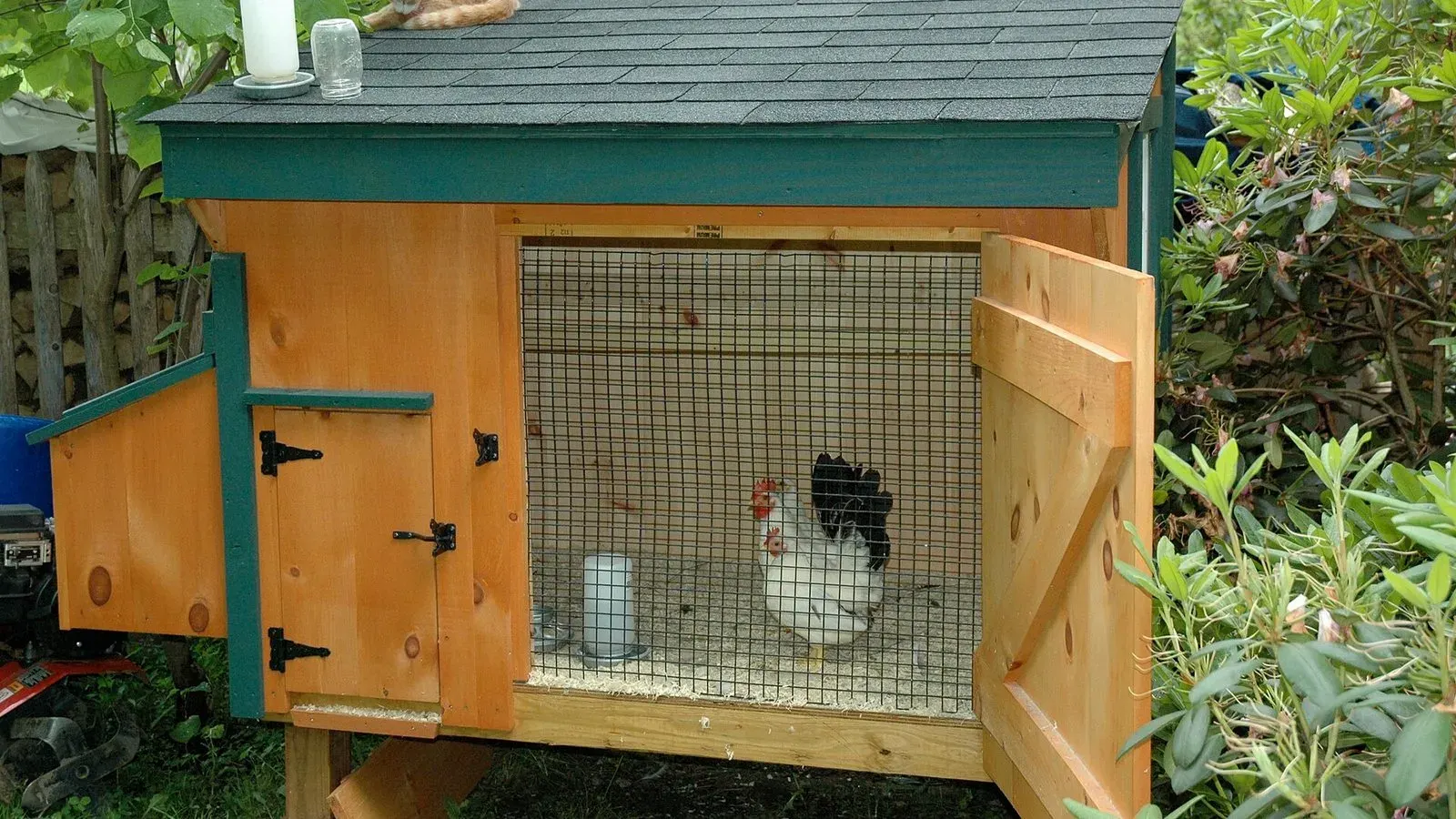
An automatic coop door does two things. It shuts your birds in at dusk, which is when almost all predation happens, and it lets you go out for the evening. Both are worth real money.
The problem is that this category has a specific and predictable failure mode. Doors that work perfectly through summer start failing in January, because cold reduces battery capacity, cold reduces small motor torque, and a track with ice or packed bedding dust in it needs more force to move, not less. All three arrive on the same morning.
So we compared these six on power source and cold rating first, then on opening size, trigger options and what happens when the door meets an obstruction. We have been explicit about which doors we would not put on a coop in a climate with real winters.
Our picks at a glance
Every product below wins one specific situation. Pick the row that matches your flock, your yard and your budget rather than reading top to bottom.
-
Best Overall

RUN-CHICKEN T50
Anyone in a climate with real winters who needs the door to work every single morning without being checked.
-
Best Smart Door

Omlet Smart Autodoor
Keepers who travel, work unpredictable hours, or rely on somebody else to check the flock and want independent confirmation.
-
Best for Cold Climates

FarmLite Mains Door
Keepers in genuinely cold climates who already have power at the coop, or are running a cable anyway for a heated waterer.
-
Best Large Opening

GROPOW XL Door
Mixed flocks with ducks or geese, or heavy chicken breeds that hesitate at a standard sized opening.
-
Best Solar

NyPots Solar Door
Keepers in mild or sunny climates who want an automatic door with no wiring and no routine battery changes.
Check price on Amazon for NyPots Automatic Chicken Coop Door Solar Powered with Timer & Light Sensor on AmazonAbout $59.99 checked Aug 8, 2026
-
Best Budget

Budsom Battery Door
Mild-climate keepers who want to stop doing the dawn trip to the coop and are not ready to spend on a premium door.
Check price on Amazon for Automatic Chicken Coop Door Opener, Battery Powered & Anti-Pinch Sensor on AmazonAbout $39.99 checked Aug 8, 2026
Compare every pick side by side
Swipe the table sideways to see every column on a phone.
| Product | Award | Price band | Power Source | Trigger Type | Door Opening | Anti Crush | Best use case | Buy link |
|---|---|---|---|---|---|---|---|---|
| RUN-CHICKEN T50 | Best Overall | $120 to $250 | 4 AA batteries, about 12 months | Light sensor or timer | About 9.8 x 12 in | Motor stall detection | Anyone in a climate with real winters who needs the door to work every si… | Check price for RUN-CHICKEN Door T50 – Automatic Chicken Coop Door Opener, Battery Powered & Weatherproof Aluminum, Smart App & Timer Control, Predator Proof, Easy Install, Reliable All-Season Performance (Gray) on Amazon |
| Omlet Smart Autodoor | Best Smart Door | $120 to $250 | 4 AA batteries or mains adapter | App, light sensor or timer | About 8.7 x 13 in | Obstruction detection | Keepers who travel, work unpredictable hours, or rely on somebody else to… | Check price for Omlet Smart Automatic Chicken Coop Door Opener | WiFi & App Control | Light Sensor or Timer | Built-in Safety Sensors | Weatherproof | Battery or Plug-in Power | Alexa & Google Home Compatible | Grey on Amazon |
| FarmLite Mains Door | Best for Cold Climates | $60 to $120 | Mains adapter, no batteries | Timer and light sensor | About 9 x 12 in | Obstruction detection | Keepers in genuinely cold climates who already have power at the coop, or… | Check price for FarmLite Automatic Chicken Coop Door Opener | Non-Battery Powered Automatic Chicken Door | Automatic Coop Door with Timer and Light Sensor | USA Brand on Amazon |
| GROPOW XL Door | Best Large Opening | $60 to $120 | Rechargeable battery with solar option | Timer and light sensor | About 13.8 x 16.9 in | Anti-pinch design | Mixed flocks with ducks or geese, or heavy chicken breeds that hesitate a… | Check price for GROPOW Automatic Chicken Coop Door, Extra Large Size, Anti-Pinch Design,Programmable Timer & Light Sensor Modes, Large LCD Display, Solar Powered Auto Chicken Door Opener with Remote Control(50-100m) on Amazon |
| NyPots Solar Door | Best Solar | $30 to $60 | Solar panel with battery backup | Timer and light sensor | About 8.3 x 11.8 in | Anti-pinch sensor | Keepers in mild or sunny climates who want an automatic door with no wiri… | Check price for NyPots Automatic Chicken Coop Door Solar Powered with Timer & Light Sensor on Amazon |
| Budsom Battery Door | Best Budget | $30 to $60 | Rechargeable battery | Timer with light sensor | About 8.7 x 11 in | Anti-pinch sensor | Mild-climate keepers who want to stop doing the dawn trip to the coop and… | Check price for Automatic Chicken Coop Door Opener, Battery Powered & Anti-Pinch Sensor on Amazon |
The full reviews
Each review below follows the same order: what it is, why it won its category, how it behaves in real use, and who should buy something else.
1 Best Overall
RUN-CHICKEN Door T50 – Automatic Chicken Coop Door Opener, Battery Powered & Weatherproof Aluminum, Smart App & Timer Control, Predator Proof, Easy Install, Reliable All-Season Performance (Gray)
The only door here rated to minus twenty-two Fahrenheit with a battery life measured in months rather than weeks, which is what an automatic door has to be to be trusted.
What we liked
- Rated to -22 F, so it still opens on the mornings that matter most
- About a year on four AA batteries rather than weekly recharging
- Motor stall detection stops the door on an obstruction instead of forcing through
- Self-contained unit that mounts on the outside of the coop wall
What we did not
- Costs roughly triple the budget doors and does not include a coop light or app
- The vertical slide track fills with bedding dust and needs clearing a few times a year
- No mains option at all, so when the batteries do go the door is dead until you swap them
Key specifications
- Dimensions
- 13.8 x 9.5 x 1.3 in (L x W x H)
- Weight
- 2 pounds
- Colour
- Brown
- Power Source
- 4 AA batteries, about 12 months
- Trigger Type
- Light sensor or timer
- Door Action
- Vertical slide
- Door Opening
- About 9.8 x 12 in
- Anti Crush
- Motor stall detection
- Cold Rating
- Rated to -22 F
Why the RUN-CHICKEN T50 wins this category
An automatic door has exactly one job and it is a job with no tolerance for failure. A door that works ninety-five percent of mornings is worse than no door, because you stop checking.
Two specifications decide reliability, and this door is the only one here that gets both right: a cold rating to minus twenty-two Fahrenheit, and a battery life of about a year. Cheap doors fail on cold mornings, which are the mornings a predator is hungriest.
Living with the RUN-CHICKEN T50
Four AA batteries a year is the whole maintenance schedule. Compare that with rechargeable units that need bringing indoors every few weeks in winter, when the days are short and the panels get nothing.
Motor stall detection is the safety feature that matters. It senses resistance and stops rather than continuing to drive, which is the difference between a startled hen and an injured one.
Where the RUN-CHICKEN T50 falls short
The price is real. This costs about three times what the budget doors cost and does not include an app, a light or a remote. You are paying purely for reliability.
The practical annoyance is the slide track. Chickens kick bedding constantly, and fine pine dust settles into the channel the door runs in. Left alone for a year it packs down and the door starts to bind, usually just as the weather gets bad. Clearing the track when you do the seasonal deep clean prevents it entirely, but nobody tells you to.
Research based, not hands-on
Assessed on the published cold rating, battery specification and obstruction detection, and compared against the solar and rechargeable doors here on reliability in winter.
- Best for
- Anyone in a climate with real winters who needs the door to work every single morning without being checked.
- Skip it if
- You want app control, remote monitoring or a light integrated into the same unit.
- The limitation to plan around
- Bedding dust in the slide track is the failure mode nobody warns you about. Pine shavings kicked up by birds settle in the channel and eventually the door binds, so clearing the track is a job you need to add to your seasonal routine.
2 Best Smart Door
Omlet Smart Automatic Chicken Coop Door Opener | WiFi & App Control | Light Sensor or Timer | Built-in Safety Sensors | Weatherproof | Battery or Plug-in Power | Alexa & Google Home Compatible | Grey
The only door here that tells you it opened. If you travel, that confirmation is worth more than any other feature on this page.
What we liked
- App confirmation means you know the door opened rather than assuming it did
- Runs on batteries or a mains adapter, so you can choose your failure mode
- Schedule changes from a phone rather than from a keypad in the rain
- Obstruction detection stops the door on resistance
What we did not
- By far the most expensive door here, at roughly double the RUN-CHICKEN
- Needs a WiFi signal that reaches the coop, which many gardens do not have
- App dependency means a cloud outage or an app update can break scheduling
Key specifications
- Dimensions
- 19.25 x 2.25 x 16.5 in (L x W x H)
- Colour
- Smart Grey
- Power Source
- 4 AA batteries or mains adapter
- Trigger Type
- App, light sensor or timer
- Door Action
- Vertical slide
- Door Opening
- About 8.7 x 13 in
- Anti Crush
- Obstruction detection
- Cold Rating
- Rated for winter use
Why the Omlet Smart Autodoor wins this category
Because everything else here opens the door and tells you nothing. For most people that is fine. For anyone who travels, works shifts, or has a neighbour looking in, the difference between "the door should have opened" and "the door opened at 6:42" is the whole value proposition.
Being able to change the schedule from a phone is the smaller but daily benefit. Reprogramming a keypad on a coop wall in February rain is a genuinely unpleasant task.
Living with the Omlet Smart Autodoor
The choice of battery or mains power is more useful than it sounds. Batteries give you independence from your household supply; mains gives you independence from remembering to change batteries. Being able to pick which risk you prefer is unusual in this category.
Obstruction detection works the same way as the better standalone doors, stopping on resistance rather than driving through it.
Where the Omlet Smart Autodoor falls short
Cost, and then dependency. This is roughly double the price of the best standalone door here, and what the extra buys is information rather than reliability.
The dependency is the more serious issue. This door needs a WiFi signal at the coop, and coops are typically at the far end of a garden behind a house wall. If the signal is marginal, you get intermittent connection warnings and a door that still works but stops reporting, which is the feature you paid for.
There is also a category of failure that simply does not exist with a mechanical timer: an app update, an account problem or a cloud outage can interfere with a schedule that was working fine.
Research based, not hands-on
Assessed on the published connectivity, power options and safety specification, and compared against the standalone doors here on dependency and failure modes.
- Best for
- Keepers who travel, work unpredictable hours, or rely on somebody else to check the flock and want independent confirmation.
- Skip it if
- Your coop is out of WiFi range, or you would rather not have a chicken door that depends on a phone and a cloud service.
- The limitation to plan around
- WiFi at the bottom of a garden is the assumption this product makes and often the reason it disappoints. Check the signal at the coop location before buying, because without it you have paid a large premium for a door that behaves like a basic timer.
3 Best for Cold Climates
FarmLite Automatic Chicken Coop Door Opener | Non-Battery Powered Automatic Chicken Door | Automatic Coop Door with Timer and Light Sensor | USA Brand
Mains powered with no battery in the loop, which removes the exact failure mode that takes out every other door here in a hard freeze.
What we liked
- No battery at all, so cold cannot reduce its capacity
- Consistent motor torque regardless of temperature
- Larger 9 by 12 in opening suits heavy breeds comfortably
- Suited to cold climates by design rather than by a rating claim
What we did not
- Needs a mains supply run to the coop, which many gardens do not have
- A power cut takes the door out entirely, with no battery backup
- Running an outdoor cable safely is a real cost and possibly an electrician
Key specifications
- Dimensions
- 11 x 4 x 14 in (L x W x H)
- Weight
- 4 pounds
- Colour
- Gray
- Power Source
- Mains adapter, no batteries
- Trigger Type
- Timer and light sensor
- Door Action
- Vertical slide
- Door Opening
- About 9 x 12 in
- Anti Crush
- Obstruction detection
- Cold Rating
- Suited to cold climates
Why the FarmLite wins this category
Because cold does something specific to batteries: it reduces the available capacity, and it does it exactly when the motor needs more torque to move a door in a frozen track. That is why so many automatic doors that work perfectly in October start failing in January.
Removing the battery removes the whole problem. A mains-fed motor delivers the same torque at minus ten as it does at plus seventy.
Living with the FarmLite
There is no maintenance schedule. No batteries to change, no panel to keep clear of snow, no recharging in December when the solar panel gets four useful hours a day.
The 9 by 12 inch opening is also worth noting. Heavy breeds like Orpingtons and Brahmas do not fit comfortably through some of the smaller openings on this page, and a bird that has to duck and squeeze is a bird that hesitates at dusk.
Where the FarmLite falls short
You need power at the coop, and most people do not have it. Running an outdoor-rated cable properly, on an RCD-protected circuit, is not a trivial job and depending on your local rules may need an electrician. Add that to the price before comparing.
The other risk is that it has no fallback. Battery doors keep working through a power cut. This one does not, and winter storms cause power cuts. If your supply is unreliable, the door being shut with the birds inside on a dark morning is the outcome you have to be able to live with.
Research based, not hands-on
Assessed on the published power arrangement and opening size, and compared against battery and solar doors on cold-weather capacity loss.
- Best for
- Keepers in genuinely cold climates who already have power at the coop, or are running a cable anyway for a heated waterer.
- Skip it if
- There is no mains supply near the coop and you are not prepared to install one.
- The limitation to plan around
- A power cut disables it completely. Where other doors have a battery to fall back on, this one has nothing, so if your area has winter outages the door will be shut on exactly the mornings you cannot get out to it.
4 Best Large Opening
GROPOW Automatic Chicken Coop Door, Extra Large Size, Anti-Pinch Design,Programmable Timer & Light Sensor Modes, Large LCD Display, Solar Powered Auto Chicken Door Opener with Remote Control(50-100m)
A 13.8 by 16.9 inch opening, which is the only one here that heavy breeds, ducks and geese can walk through without ducking or squeezing.
What we liked
- Nearly twice the opening area of a standard chicken door
- Wide enough for ducks and geese, not just chickens
- Rechargeable battery with a solar charging option
- Anti-pinch design on an opening where a crush would do more damage
What we did not
- The large opening needs a correspondingly large hole cut in the coop wall
- A bigger door means a bigger heat loss path in winter
- Not rated for deep cold, so hard frost is a question mark
Key specifications
- Dimensions
- 13.8 x 3 x 11.8 in (L x W x H)
- Colour
- Dark Gray
- Power Source
- Rechargeable battery with solar option
- Trigger Type
- Timer and light sensor
- Door Action
- Vertical slide
- Door Opening
- About 13.8 x 16.9 in
- Anti Crush
- Anti-pinch design
- Cold Rating
- Not rated for deep cold
Why the GROPOW wins this category
Because a lot of automatic doors are sized for a light hybrid layer and nothing else. A Brahma, a Jersey Giant or a Pekin duck approaching a nine by eleven inch opening has to lower its head and push through, and birds that have to work at a doorway learn to hesitate at it.
At 13.8 by 16.9 inches this is the only door here that a mixed or heavy flock walks through at normal speed.
Living with the GROPOW
The rechargeable battery with a solar option gives you flexibility: run it on solar through summer and bring it in for a charge in the darkest weeks if the panel is not keeping up.
Anti-pinch matters more on a large door than a small one, because there is more travel and more mass in motion. A stop-on-resistance mechanism is not optional at this size.
Where the GROPOW falls short
The installation is the real cost. Cutting a 17 inch opening is a bigger job than cutting an 11 inch one, and on a lightweight flat-pack coop it can remove enough of a wall panel that the panel starts to flex. Measure your coop wall and think about what is left after the cut, not just whether the door fits.
The thermal consequence is worth noting too. That opening is a heat and draught path all winter, closed door or not, because seals on doors in this price class are not airtight. A big door in a small coop in a cold climate is a real trade-off, not a theoretical one.
Research based, not hands-on
Assessed on the published opening dimensions and power arrangement, and compared against standard-sized doors on breed suitability and heat loss.
- Best for
- Mixed flocks with ducks or geese, or heavy chicken breeds that hesitate at a standard sized opening.
- Skip it if
- You keep standard or light breed chickens only, because you are paying for and cutting a hole you do not need.
- The limitation to plan around
- Cutting a 17 inch opening in a coop wall is a significant, irreversible modification, and on a small flat-pack coop it removes enough panel that the wall loses rigidity. Check the panel size before ordering.
5 Best Solar
NyPots Automatic Chicken Coop Door Solar Powered with Timer & Light Sensor
A solar panel with battery backup at a mid-range price, which works very well from March to October and needs watching through the depths of winter.
What we liked
- Solar panel with battery backup means no routine maintenance for most of the year
- Both timer and light sensor modes, so you can pick which the flock responds to better
- Anti-pinch sensor stops the door on an obstruction
- Costs roughly half what the premium standalone doors cost
What we did not
- Solar yield collapses in northern winters, exactly when the door matters most
- Snow or leaf litter on the panel stops charging entirely until cleared
- Not rated for deep cold, so hard frost affects both the battery and the mechanism
About $59.99 checked Aug 8, 2026
Key specifications
- Dimensions
- 9.6 x 1.6 x 13 in (L x W x H)
- Weight
- 1.57 pounds
- Colour
- Blue
- Power Source
- Solar panel with battery backup
- Trigger Type
- Timer and light sensor
- Door Action
- Vertical slide
- Door Opening
- About 8.3 x 11.8 in
- Anti Crush
- Anti-pinch sensor
- Cold Rating
- Not rated for deep cold
Why the NyPots solar door wins this category
Because for most of the year solar is genuinely the best arrangement. No cable, no batteries, no thinking about it. From spring through autumn a panel this size keeps the battery topped up without any attention at all.
Having both timer and light sensor modes is more useful than it looks. Some flocks go in reliably at dusk and want a sensor; others dawdle and need a fixed time that gives stragglers a margin.
Living with the NyPots solar door
Setup is mounting the unit, mounting the panel where it gets sun, and choosing a mode. After that, for two thirds of the year, you do nothing.
The anti-pinch sensor is standard in this price band now and works as expected, halting the door when it meets resistance rather than continuing to drive.
Where the NyPots solar door falls short
The seasonal mismatch, and it deserves to be stated plainly rather than buried. In December at northern latitudes a panel gets a fraction of the energy it gets in June, from a lower sun angle, through more cloud, for fewer hours. Meanwhile natural food is scarce and predator pressure is at its annual peak.
Snow makes it worse. A dusting on the panel stops charging completely, and it will sit there for days in cold weather unless you go and clear it, which defeats the point of an automatic door.
It is also not rated for deep cold. Below freezing you are relying on both a chilled battery and a mechanism that was not designed for ice in the track.
Research based, not hands-on
Assessed on the published panel and battery specification and trigger modes, and set against typical winter solar yields at northern latitudes.
- Best for
- Keepers in mild or sunny climates who want an automatic door with no wiring and no routine battery changes.
- Skip it if
- You are north of about the fortieth parallel and your winters are grey, because that is precisely when solar underperforms.
- The limitation to plan around
- Solar charging and predator pressure run on opposite schedules. Winter gives the panel the least light and gives predators the most reason to try, so this is the door that is weakest exactly when you need it strongest.
6 Best Budget
Automatic Chicken Coop Door Opener, Battery Powered & Anti-Pinch Sensor
An automatic door for less than the price of a bag of feed and a bale of shavings. It will not survive a hard winter, and for a mild climate that may not matter.
What we liked
- Cheapest way to stop being tied to the coop at dawn and dusk
- Rechargeable battery means no ongoing battery purchases
- Anti-pinch sensor included even at this price
- Small and simple, so installation is a straightforward panel cut
What we did not
- Not rated for deep cold, and cheap motors lose torque fastest in the frost
- Rechargeable battery needs bringing indoors periodically through winter
- Light plastic housing will go brittle after two or three summers of UV
About $39.99 checked Aug 8, 2026
Key specifications
- Dimensions
- 10.8 x 1.97 x 14.17 in (L x W x H)
- Colour
- Black
- Power Source
- Rechargeable battery
- Trigger Type
- Timer with light sensor
- Door Action
- Vertical slide
- Door Opening
- About 8.7 x 11 in
- Anti Crush
- Anti-pinch sensor
- Cold Rating
- Not rated for deep cold
Why the Budsom wins this category
Because the biggest change an automatic door makes has nothing to do with predators. It is that you stop having to be home at dusk. That freedom is worth having at any price point, and this is the lowest one at which the door still has an anti-pinch sensor and a rechargeable cell.
For anyone unsure whether an automatic door suits their setup, this is a low-risk way to find out.
Living with the Budsom
Installation is simple because the unit is small. A modest panel cut, four screws, and a schedule.
The rechargeable battery means no running cost, which matters when the whole point of this door is that it was cheap.
Where the Budsom falls short
Cold. This is the specific weakness of every budget door and it is worth understanding rather than glossing. Small DC motors lose torque as they get colder, cheap lithium cells lose capacity as they get colder, and a door track in frost needs more force to move, not less. Those three things arrive together on the same morning.
The second issue is service life. The housing is unstabilised plastic and it will chalk and go brittle after two or three summers of direct sun. Mounting it under an overhang buys you time.
We would not put this door on a coop in a climate with real winters. In a mild one, at this price, it is a reasonable purchase with a known replacement date.
Research based, not hands-on
Assessed on the published power arrangement, cold rating and housing material, and compared against the premium doors here on expected service life.
- Best for
- Mild-climate keepers who want to stop doing the dawn trip to the coop and are not ready to spend on a premium door.
- Skip it if
- Your winters go below freezing regularly, because this is the class of door that fails in exactly those conditions.
- The limitation to plan around
- This is a two to three year product, not a ten year one. The plastic housing goes brittle under UV and the rechargeable cell loses capacity, so treat it as a cheap way to test whether an automatic door suits your routine.
How we compared these doors
Every door in this category makes the same promise, so we scored on the specifications that determine whether the promise holds in February.
Power source came first, assessed against how each behaves in cold: mains torque is temperature-independent, alkaline cells lose capacity gradually, and solar loses input dramatically at northern latitudes in winter. Published low-temperature ratings were recorded where a manufacturer gives one, and their absence was treated as meaningful.
We then compared opening dimensions against the body size of heavy breeds and domestic ducks, trigger options, and the obstruction behaviour of the mechanism.
What actually matters in an automatic coop door
Cold rating, and why it is the headline
Three things get harder as temperature drops. Battery chemistry delivers less current. Small DC motors produce less torque. And the track the door slides in accumulates ice and moisture.
A manufacturer that publishes a low-temperature rating has tested for this. One that does not, usually has not. In a climate with real winters this single specification separates the doors that work from the doors that generate a frantic morning.
Power source
Mains is the most reliable and the hardest to install. Running an outdoor-rated cable to a coop properly is a real job, and depending on where you live it may need an electrician.
Long-life alkaline batteries are the best compromise for most keepers. A door that runs twelve months on four AA cells asks almost nothing of you and does not care about cloud cover.
Solar is excellent for two thirds of the year and weakest in midwinter. If you are north of roughly the fortieth parallel, that seasonal mismatch is the thing to think hardest about.
Opening size
Nine by eleven inches works for standard and light breeds. Heavy breeds and waterfowl need closer to thirteen by sixteen.
The consequence of getting this wrong is not that birds cannot fit, it is that they hesitate. A bird that has to duck and shoulder through an opening will be the last one in, and eventually some will simply refuse and roost outside.
Trigger type
Light sensors follow the natural day and adjust through the year without intervention. Timers are predictable and unaffected by a dark, stormy afternoon that a sensor might read as dusk.
Doors that offer both are the most flexible, because flocks differ. Some go in reliably at dusk; others dawdle and need a fixed time with a generous margin.
Obstruction behaviour
Every door in this comparison stops when it meets resistance, either through an anti-pinch sensor or motor stall detection. Doors without this exist and are cheaper, and they are not worth the saving.
Installation notes worth knowing before you buy
Measure your coop wall panel before you order, particularly for a large door. Cutting a seventeen inch opening in a lightweight flat-pack panel can remove enough material that the wall flexes.
Mount the unit under an overhang if you can. Direct sun degrades plastic housings, and driving rain into a mechanism is the second most common cause of failure after cold.
Finally, clear the slide track when you do your seasonal deep clean. Chickens kick bedding constantly, fine dust packs into the channel, and a bound track is a failure that looks exactly like a dead battery.
Final recommendation
The RUN-CHICKEN T50 is the buy for most people. A published rating to minus twenty-two Fahrenheit and about a year on four AA batteries is what reliability looks like in this category, and reliability is the only feature that matters.
If you travel or share flock duties, the Omlet Smart Autodoor is the only one that confirms it opened. If you already have power at the coop, the FarmLite Mains Door removes the battery problem entirely. And for ducks or heavy breeds, the GROPOW XL Door is the only opening here that they will walk through without thinking about it.
Questions people ask before buying
Will an automatic door shut a chicken outside?
It can, and it is the main worry people have. In practice hens go in at dusk because that is a very strong instinct, and the fix for stragglers is to set the closing time or light threshold later rather than earlier. A door set to close twenty minutes after your slowest bird normally goes in will almost never leave anybody out. For the first week, check at closing time until you know the flock's habits.
Can an automatic coop door hurt a chicken?
A door without obstruction detection can, which is why every door in this comparison has some form of anti-pinch or motor stall detection. These sense resistance and stop rather than continuing to drive. Doors that lift with a string and a simple motor, with no sensing, are the ones to avoid. It is also worth setting the closing time so that the flock is already settled rather than still coming in.
Do automatic chicken doors work in winter?
The good ones do and the cheap ones frequently do not. Cold reduces battery capacity and reduces small motor torque at the same time as ice and packed bedding dust make the track harder to move. Look for a published low-temperature rating rather than a general claim, and prefer either long-life alkaline batteries or a mains supply over solar in a northern winter.
Solar, battery or mains power?
Mains is the most reliable and the least convenient to install. Long-life batteries are the best compromise for most people, because a door that runs a year on four AA cells needs almost no attention and is unaffected by cloudy weather. Solar is excellent from spring to autumn and weakest in midwinter, which is precisely when predator pressure peaks, so it suits mild and sunny climates far better than northern ones.
What size opening do I need?
About 9 by 11 inches suits standard and light breed chickens. Heavy breeds such as Brahmas and Jersey Giants, and any ducks or geese, want something closer to 13 by 16 inches, because a bird that has to duck and squeeze will hesitate at the doorway and some will refuse it entirely. Measure your largest bird, not your average one.
Does an automatic door replace closing the run?
It replaces the most important part of it. The coop door is the barrier that matters overnight, because a solid henhouse with a latched door is a far better defence than any run mesh. An automatic door means that barrier closes reliably every night whether or not you are home, which is worth more to flock survival than upgrading run mesh for most people.
Why you can trust this guide
- Written by
- Sam Reddick, Lead gear reviewer, Chicken Geek. Specialist areas: Coop design and predator proofing, Feeding and watering systems, Cold-weather flock management, Incubation and brooding.
- Fact checked by
- Marta Voss
- Published
- August 6, 2026 · Last updated August 6, 2026 · Products and links rechecked August 6, 2026
- How we picked
- Doors were assessed on power source and its cold-weather behaviour, published low-temperature rating, battery life or charging requirement, opening dimensions against heavy breed and waterfowl body size, trigger options, and whether the mechanism stops on an obstruction.
- Evidence used
- None of the 6 products on this page were sent to us or bought for a hands-on test. Every recommendation here is research based: manufacturer specifications, listed dimensions and materials, owner feedback at volume, and comparison against equipment our team has owned. Each review states this again above the buy button so you are never guessing which kind of evidence sits behind a pick.
- Editorial standards
- No brand pays for placement, and no manufacturer sees this page before it goes live. Read our editorial policy and testing method.
- Affiliate disclosure
- Chicken Geek is reader supported. We earn a commission from qualifying purchases made through links on this page, at no extra cost to you, and no brand has paid for a placement or an award here.
About the author

Lead gear reviewer, Chicken Geek
Sam has kept a backyard laying flock for eleven years, through two coop rebuilds, one very determined raccoon and several winters cold enough to freeze a waterer solid overnight. He writes the buying guides at Chicken Geek and is responsible for how products get compared.
- Eleven years keeping a mixed laying flock of 8 to 14 birds
- Has built, bought and replaced six different coops
- Runs the product comparison framework used across Chicken Geek
- Reads manufacturer manuals, spec sheets and warranty terms before every recommendation