We Compared 6 Coop Lights. Only Two Fade Out Properly
We compared six coop lights on schedule control, dimming behaviour and winter reliability, and explain why the light has to go on in the morning.

By Marta Voss Editor and fact checker, Chicken Geek
Fact checked by Sam Reddick
Published Prices and stock checked 7 min read
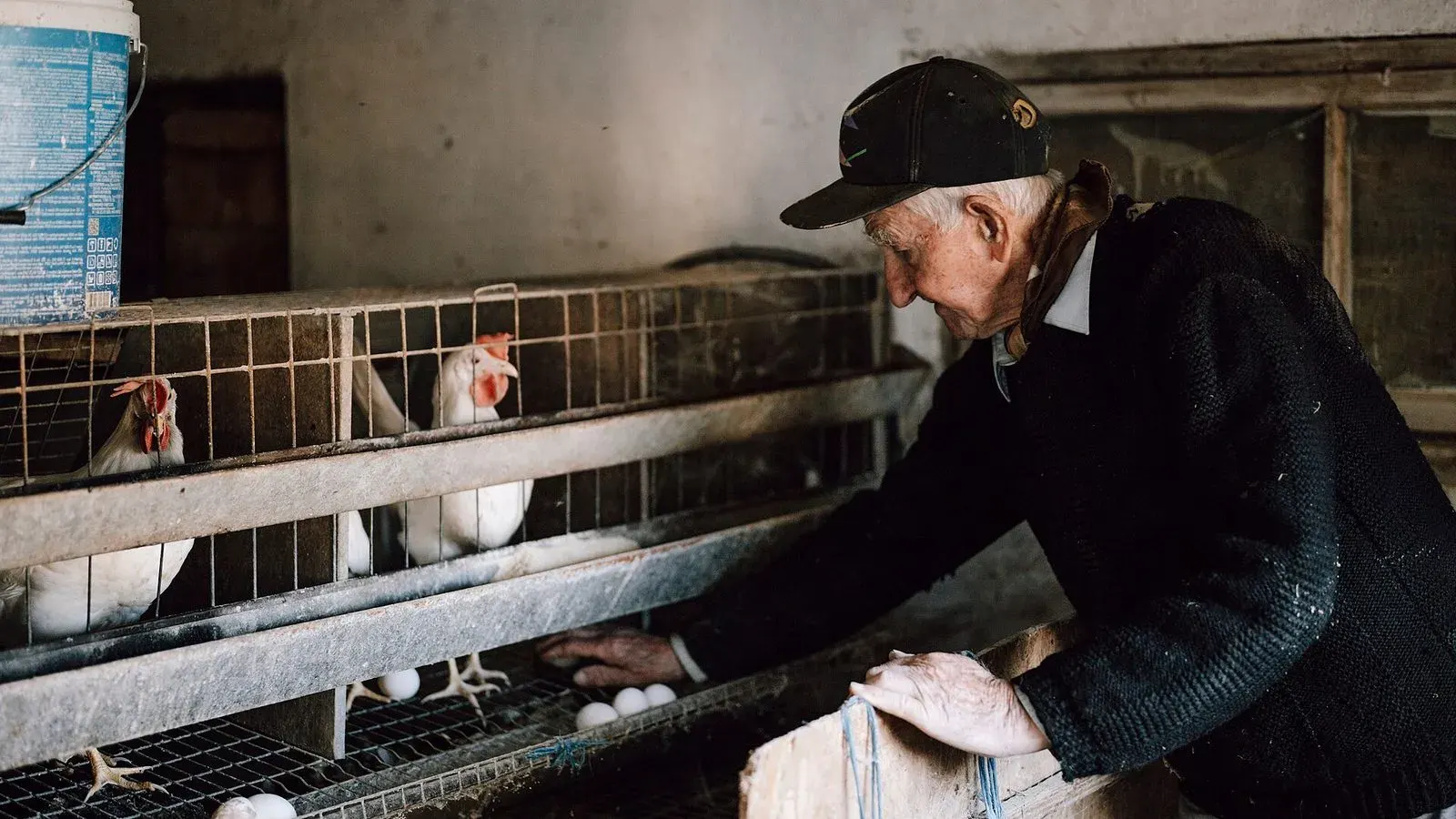
Coop lights get bought for two completely different reasons, and most buying advice runs them together. One is extending the laying day through winter, which needs a modest light on a reliable schedule for several hours. The other is being able to see what you are doing at 6am in January, which needs a bright light for four minutes.
Those are different products, and we have compared six with both jobs in mind and said clearly which is which.
The most important thing in this whole guide is free: put the extra light on in the morning, not the evening. A light that switches off after dark leaves hens stranded wherever they were standing, because chickens cannot see well enough to find the roost once it is dark. Morning light lengthens the day from the front and lets natural dusk do the settling.
Our picks at a glance
Every product below wins one specific situation. Pick the row that matches your flock, your yard and your budget rather than reading top to bottom.
-
Best Overall
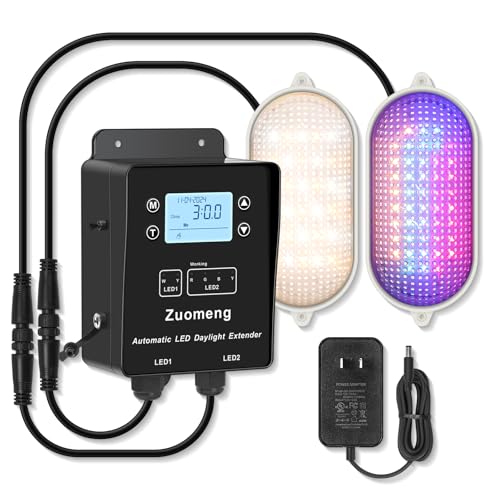
Zuomeng Daylight Extender
Keepers who want to extend winter laying properly, with morning light and a fade that does not strand birds off the roost.
-
Best Solar

TSJKPAYL Solar Timer
Coops with no mains power in a reasonably sunny climate, where the light is being used to extend the morning.
-
Best for Omlet Door Owners

Omlet Coop Light
Anyone who already owns an Omlet Autodoor and wants a coop light without adding a second battery and a second schedule.
-
Best for Chores
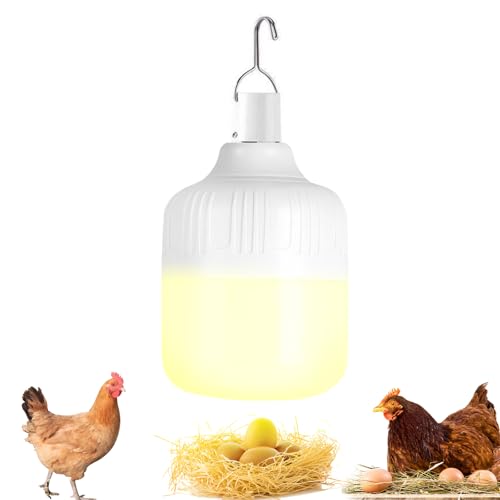
TSJKPAYL Rechargeable
Anyone doing morning and evening rounds in the dark half of the year who currently holds a phone torch in their teeth.
-
Best Budget Multi-Pack
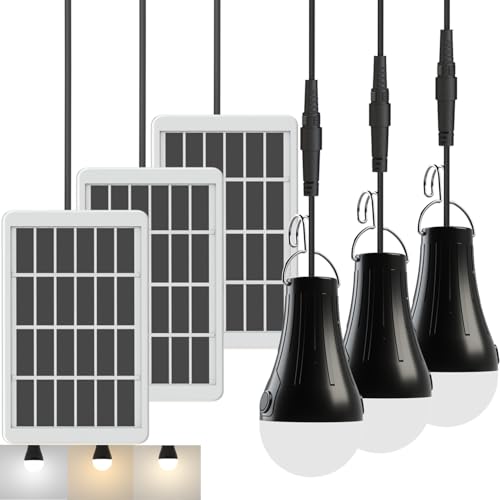
LOTOFIT Solar 3-Pack
Lighting several places at once so you can see during morning and evening chores through the dark half of the year.
Check price on Amazon for LOTOFIT Portable Solar Chicken Coop Light with Timer, 3-Pack Waterproof on AmazonAbout $25.89 checked Aug 8, 2026
-
Simplest Setup

Lampelc Solar Bulbs
Anyone who wants light in a coop with no power, no programming and no ongoing maintenance.
Check price on Amazon for Solar Light Bulbs, Rechargeable Lights for Indoor & Outdoor Use, 2 Pack on AmazonAbout $19.99 checked Aug 8, 2026
Compare every pick side by side
Swipe the table sideways to see every column on a phone.
| Product | Award | Price band | Power Source | Control Type | Brightness | Dimming | Best use case | Buy link |
|---|---|---|---|---|---|---|---|---|
| Zuomeng Daylight Extender | Best Overall | $60 to $120 | Rechargeable battery with adapter | Programmable timer with dawn simulation | Multi-level dimmable | Yes, gradual fade | Keepers who want to extend winter laying properly, with morning light and… | Check price for Automatic LED Daylight Extender, Zuomeng Upgraded Chicken Coop Light with Multi-Color Light (White/Red/Blue/Green) to Boost Egg Production & Support Chick Growth, Weather-Resistant (Patent Pending) on Amazon |
| TSJKPAYL Solar Timer | Best Solar | $30 to $60 | Solar with battery | Timer | 3-colour dimmable LED | Yes, three levels | Coops with no mains power in a reasonably sunny climate, where the light… | Check price for Solar Chicken Coop Light with Timer | 3-Color Dimmable LED, IP66 Waterproof & 16.4ft Cord | Hanging Ceiling Pendant Light for Poultry Farms, Coops(with Solar Panels, Carabiner) on Amazon |
| Omlet Coop Light | Best for Omlet Door Owners | $30 to $60 | Powered by the Omlet door battery pack | Linked to the Omlet Autodoor schedule | Low, gentle | Fades out on a timer | Anyone who already owns an Omlet Autodoor and wants a coop light without… | Check price for Omlet Coop Light for the Automatic Chicken Coop Door Opener | Gentle Hen House Lighting Encourages Flock to Roost | Poultry Chicken Coop Accessories | Light Only – Door Opener Sold Separately on Amazon |
| TSJKPAYL Rechargeable | Best for Chores | Under $30 | USB rechargeable | Manual switch | Warm 3000K, hanging lamp | No | Anyone doing morning and evening rounds in the dark half of the year who… | Check price for Rechargeable Chicken Coop Light- 3000K Warm Yellow Cordless Hanging Lamp, Rechargeable Battery with Hook, Easy Install No Wiring, Pendant Lights for Chicken Coop, Shed, Farm on Amazon |
| LOTOFIT Solar 3-Pack | Best Budget Multi-Pack | Under $30 | Solar | Timer | Low, task level | No | Lighting several places at once so you can see during morning and evening… | Check price for LOTOFIT Portable Solar Chicken Coop Light with Timer, 3-Pack Waterproof on Amazon |
| Lampelc Solar Bulbs | Simplest Setup | Under $30 | Solar | Pull cord | Low, task level | No | Anyone who wants light in a coop with no power, no programming and no ong… | Check price for Solar Light Bulbs, Rechargeable Lights for Indoor & Outdoor Use, 2 Pack on Amazon |
The full reviews
Each review below follows the same order: what it is, why it won its category, how it behaves in real use, and who should buy something else.
1 Best Overall
Automatic LED Daylight Extender, Zuomeng Upgraded Chicken Coop Light with Multi-Color Light (White/Red/Blue/Green) to Boost Egg Production & Support Chick Growth, Weather-Resistant (Patent Pending)
A programmable daylight extender with a gradual fade, which is the only design here that lets hens find the roost before the light goes out.
What we liked
- Gradual fade at the end of the cycle gives hens time to get to the roost
- Programmable schedule means you can add light in the morning where it belongs
- Rechargeable with a mains adapter option, so winter cloud does not stop it
- Multi-level dimming lets you use the minimum light that works
What we did not
- Costs roughly three times the simple solar timer lights
- Indoor coop use only, so it needs a genuinely dry mounting position
- The programming interface is fiddly and has to be set on the unit itself
Key specifications
- Dimensions
- 1 x 1 x 1 in (L x W x H)
- Colour
- White (most prominent color mentioned)
- Power Source
- Rechargeable battery with adapter
- Control Type
- Programmable timer with dawn simulation
- Brightness
- Multi-level dimmable
- Weather Rating
- Indoor coop use
- Runtime
- Season-long with mains top-up
- Dimming
- Yes, gradual fade
Why the Zuomeng wins this category
Because of one thing almost every cheap coop light gets wrong. Chickens have poor night vision and will not move once it is properly dark. A light on a simple timer that clicks off at 8pm leaves any bird still on the floor stranded there for the night, on cold ground, away from the flock.
A gradual fade gives them the ten or fifteen minutes of dusk they need to work out where they are and get up onto the roost.
Living with the Zuomeng
Being able to programme the schedule means you can put the extra light in the morning rather than the evening, which is where it belongs. Morning light lengthens the day from the front and lets natural dusk do the roosting.
The mains adapter option is the practical detail. Rechargeable lights that rely on a small panel run out in December, which is exactly the month you bought them for.
Where the Zuomeng falls short
Price. This costs about three times what a solar timer bulb costs, and if all you want is to see what you are doing at 6am, that is money wasted.
The programming interface is the daily irritation. Setting the schedule means standing in the coop pressing buttons on the unit rather than doing it from a phone or a wall switch, and if you change the schedule as the season progresses, which you should, that is a repeated chore in the cold.
It is also rated for coop interior use rather than for driving rain, so the mounting position needs to be genuinely dry, not just under an overhang.
Research based, not hands-on
Assessed on the published programming, dimming and power specification, and compared against fixed-timer lights on the roosting behaviour problem.
- Best for
- Keepers who want to extend winter laying properly, with morning light and a fade that does not strand birds off the roost.
- Skip it if
- You only want light to see by while doing chores, because this is more product than that job needs.
- The limitation to plan around
- A light that snaps off leaves hens wherever they are standing, and chickens cannot see well enough in the dark to find a roost. Most cheap coop lights do exactly that. This one fades, which is the whole point, but it means you must not simply switch it off at the wall.
2 Best Solar
Solar Chicken Coop Light with Timer | 3-Color Dimmable LED, IP66 Waterproof & 16.4ft Cord | Hanging Ceiling Pendant Light for Poultry Farms, Coops(with Solar Panels, Carabiner)
IP66 weatherproofing and three brightness levels for about thirty dollars, which makes it the only solar light here rated to survive being mounted where the weather actually is.
What we liked
- IP66 rating means the panel and fitting handle driving rain, not just damp
- Three dimmable levels, so you can run the lowest setting that works
- Timer control rather than a dusk sensor, which suits morning lighting
- No wiring at all, so it goes on a coop with no power nearby
What we did not
- Solar yield in December is a fraction of June, exactly when you need the light
- The timer turns it off abruptly, which can strand hens off the roost
- Panel needs clearing of snow and leaves or it simply stops charging
Key specifications
- Dimensions
- 19 x 15 x 10 in (L x W x H)
- Weight
- 1.763698096 pounds
- Colour
- Warm White, Daylight White
- Power Source
- Solar with battery
- Control Type
- Timer
- Brightness
- 3-colour dimmable LED
- Weather Rating
- IP66
- Runtime
- About 8 hours per charge
- Dimming
- Yes, three levels
Why the TSJKPAYL solar light wins this category
Weatherproofing, which sounds dull and separates the products that last from the ones that do not. Most solar coop lights are rated for damp, and a coop is not damp, it is outdoors. An IP66 rating means driving rain, which is what a panel on a coop roof actually gets.
Three dimming levels is the other useful part. You want the least light that triggers the response, not the most.
Living with the TSJKPAYL solar light
No wiring at all is the reason to choose solar. Most coops are at the bottom of a garden with no power, and running a cable is a real project.
Timer control rather than a dusk sensor is the right choice for how supplementary light should be used. You are trying to add hours at the front of the day, and a timer does that predictably where a dusk sensor does not.
Where the TSJKPAYL solar light falls short
The seasonal mismatch is unavoidable with solar and worth stating plainly: in December, at northern latitudes, a small panel gets a small fraction of the energy it gets in June. That is the month you bought a daylight extender for. Snow or wet leaves on the panel take it to zero.
The other issue is that the timer cuts the light rather than fading it. In a morning application that does not matter, because daylight is arriving anyway. In an evening application it strands birds, and you should simply not use it that way.
Research based, not hands-on
Assessed on the published IP rating, dimming levels and timer control, and set against typical winter solar yields at northern latitudes.
- Best for
- Coops with no mains power in a reasonably sunny climate, where the light is being used to extend the morning.
- Skip it if
- You are somewhere with grey winters, because the light will be least reliable in the month you bought it for.
- The limitation to plan around
- The timer switches it off rather than fading. Use it for morning light only, where natural daylight takes over, because an abrupt off in the evening leaves birds stranded on the coop floor overnight.
3 Best for Omlet Door Owners
Omlet Coop Light for the Automatic Chicken Coop Door Opener | Gentle Hen House Lighting Encourages Flock to Roost | Poultry Chicken Coop Accessories | Light Only – Door Opener Sold Separately
Runs off the Omlet Autodoor's own battery pack and follows its schedule, which means one system, one power source and no second thing to remember.
What we liked
- Shares the Autodoor's power and schedule, so there is nothing extra to charge or set
- Fades out on a timer rather than snapping off, so hens reach the roost
- Low, gentle output rather than the harsh white of most coop lights
- Coop rated and designed to sit inside a plastic Omlet coop
What we did not
- Only works with an Omlet Autodoor, which makes it useless to everyone else
- Draws from the door battery, shortening the interval between battery changes
- Low output means it is not bright enough to work by during chores
Key specifications
- Dimensions
- 4.56 x 4.17 x 2.05 in (L x W x H)
- Weight
- 0.3747858454 pounds
- Colour
- Gray
- Power Source
- Powered by the Omlet door battery pack
- Control Type
- Linked to the Omlet Autodoor schedule
- Brightness
- Low, gentle
- Weather Rating
- Coop rated
- Runtime
- Shares the door battery life
- Dimming
- Fades out on a timer
Why the Omlet Coop Light wins this category
Because the thing that goes wrong with coop accessories is that each one becomes another item with its own battery, its own schedule and its own way of failing quietly. Two independent timers in a coop will drift apart, and eventually the light is on when the door is shut.
A light that draws from the door's pack and follows the door's schedule removes that whole class of problem.
Living with the Omlet Coop Light
The fade is the behavioural detail that matters. It dims out over several minutes rather than cutting, so hens have the dusk period they need to find the roost.
The output is deliberately low and warm rather than bright and white, which is the correct choice for a coop. Bright light in a henhouse keeps birds active when they should be settling.
Where the Omlet Coop Light falls short
The compatibility limit is absolute. This is not a coop light that happens to work well with an Omlet door, it is an accessory for that door and nothing else. For the large majority of readers it is not an option at all.
The shared battery is the real functional criticism. The Autodoor's whole value is that it is reliable, and reliability comes from a battery that lasts a long time. Hanging a light off the same pack shortens that interval, and the failure it brings closer is the door failing to open, which is far more consequential than a light failing to come on.
It is also not bright enough to work by. If you want to see what you are doing during a winter evening check, this will not do it.
Research based, not hands-on
Assessed on the published compatibility, power arrangement and fade behaviour, and compared against standalone lights on system complexity.
- Best for
- Anyone who already owns an Omlet Autodoor and wants a coop light without adding a second battery and a second schedule.
- Skip it if
- You do not own an Omlet door, because it will not work at all.
- The limitation to plan around
- It shares the door's battery. Adding a light to the same pack shortens the interval between battery changes on the component you least want to run flat, which is the door itself.
4 Best for Chores
Rechargeable Chicken Coop Light- 3000K Warm Yellow Cordless Hanging Lamp, Rechargeable Battery with Hook, Easy Install No Wiring, Pendant Lights for Chicken Coop, Shed, Farm
A warm 3000K hanging lamp on a USB charge, bright enough to actually work by, which is a different job from extending daylight and a job nothing else here does well.
What we liked
- Genuinely bright enough to see what you are doing during a winter chore
- Warm 3000K light rather than the harsh blue-white of most cheap LEDs
- USB rechargeable, so it charges indoors rather than relying on a panel
- Hangs anywhere and can be taken down and moved
What we did not
- Manual switch only, so it does nothing automatically
- Charge lasts a few evenings rather than a season, so it needs bringing in regularly
- Coop rated but not for rain, so it must hang somewhere genuinely sheltered
Key specifications
- Dimensions
- 5.905511805 x 4.724409444 x 4.724409444 in (L x W x H)
- Colour
- 1
- Power Source
- USB rechargeable
- Control Type
- Manual switch
- Brightness
- Warm 3000K, hanging lamp
- Weather Rating
- Coop rated, not for rain
- Runtime
- Several evenings per charge
- Dimming
- No
Why the TSJKPAYL rechargeable lamp wins this category
Because there are two completely different reasons to want light in a coop, and almost every product on the market only addresses one of them. Extending the laying day needs a modest light on a schedule for hours. Doing a health check on a bird at 6pm in January needs a lot of light for four minutes.
This is the second product, and it is genuinely good at it. Most of the alternatives here would leave you squinting.
Living with the TSJKPAYL rechargeable lamp
USB charging is more practical than solar for a task light. It comes indoors, charges on a kitchen counter, and goes back out full, which means it is bright when you need it rather than dependent on whether December was sunny.
The 3000K colour is a considered choice. Cold blue-white LEDs are alerting; warm light disturbs settling birds far less if you need to go in after dusk.
Where the TSJKPAYL rechargeable lamp falls short
It does nothing on its own. There is no timer, no sensor and no schedule, so it cannot extend the photoperiod and it cannot be trusted to be off when the birds need to roost. If you leave it on and go inside, it stays on.
Charge life is the practical friction. A few evenings per charge means it becomes another thing to remember, and the evening you forget is the evening you needed it.
It also needs a properly sheltered spot. Coop rated is not rain rated, and hanging it where it catches driving rain through an open door will kill it.
Research based, not hands-on
Assessed on the published output, colour temperature and charging arrangement, and compared against the timer-driven lights here on function.
- Best for
- Anyone doing morning and evening rounds in the dark half of the year who currently holds a phone torch in their teeth.
- Skip it if
- You want automatic operation or a light that extends the laying photoperiod.
- The limitation to plan around
- There is no timer at all. This is a lamp you switch on and off, so it cannot extend daylight and it cannot be relied on to be off before the birds need to roost.
5 Best Budget Multi-Pack
LOTOFIT Portable Solar Chicken Coop Light with Timer, 3-Pack Waterproof
Three waterproof solar timer lights for about twenty-five dollars, which lets you light a coop, a run and a feed store for less than one premium unit costs.
What we liked
- Three units in the pack, enough for a coop, a run and a store
- Waterproof housing rather than damp-rated only
- Timer control on each unit independently
- Cheap enough that losing one to a winter is not a real loss
What we did not
- Output is low enough that it is task lighting, not a daylight extender
- No dimming and no fade, so it snaps off and can strand birds
- Small panels mean short run time in winter and none at all under snow
About $25.89 checked Aug 8, 2026
Key specifications
- Dimensions
- 2.36 x 2.36 x 5.7 in (L x W x H)
- Weight
- 0.17 pounds
- Colour
- Black
- Power Source
- Solar
- Control Type
- Timer
- Brightness
- Low, task level
- Weather Rating
- Waterproof
- Runtime
- About 6 to 8 hours per charge
- Dimming
- No
Why the LOTOFIT pack wins this category
Because coop lighting is rarely a single-location problem. You want to see the coop interior at 6am, the run at dusk, and the feed bin whenever you are scooping. Buying three separate lights normally costs more than a premium unit; buying this pack costs less than a bag of layer pellets.
They are also waterproof rather than merely damp rated, which is the specification that decides whether cheap solar lights survive a winter.
Living with the LOTOFIT pack
Installation is genuinely nothing. Each unit is self-contained with its own small panel, so you put them where you want light and set a timer.
Being cheap changes how you use them. You are willing to put one in the run, one in the coop and one over the feed bin, and if one dies you replace it without much thought.
Where the LOTOFIT pack falls short
The output is the honest limitation and it is the reason this cannot be the overall pick. Influencing a hen's laying cycle needs a genuine light level maintained for hours. These give you enough to see by and not much more, so buying them as a daylight extender will not produce the eggs you are hoping for.
The other problem is behavioural. There is no dimming and no fade: the timer expires and the light stops. Used in the evening in a coop, that leaves any bird still on the floor stuck there for the night. Set them for morning use, or set them to switch off well before the birds need to roost.
Research based, not hands-on
Assessed on the published output, timer control and pack size, and compared against the dedicated daylight extenders here on light level.
- Best for
- Lighting several places at once so you can see during morning and evening chores through the dark half of the year.
- Skip it if
- Your aim is to extend the laying photoperiod, because the output is too low to reliably do that.
- The limitation to plan around
- These are not bright enough to act as a daylight extender. The light level that influences a hen's laying cycle is considerably higher than the light level that lets you find a feeder, and this pack is the second thing rather than the first.
6 Simplest Setup
Solar Light Bulbs, Rechargeable Lights for Indoor & Outdoor Use, 2 Pack
A bulb on a wire with a pull cord and a solar panel on the end. Nothing to programme, nothing to charge, and nothing that can drift out of schedule.
What we liked
- Pull cord operation with nothing to programme or configure
- Panel and bulb separate, so the panel goes in the sun and the bulb goes in the coop
- Two in the pack, enough for a coop and a store
- No electronics to fail, so it either works or it does not
What we did not
- Entirely manual, so it does nothing while you are away or asleep
- Bulb is indoor rated even though the panel is weatherproof
- Five to six hours per charge falls a long way short on a winter day
About $19.99 checked Aug 8, 2026
Key specifications
- Dimensions
- 2.55 x 2.55 x 5.9 in (L x W x H)
- Weight
- 0.6 pounds
- Colour
- Solar Bulbs 2 Pack
- Power Source
- Solar
- Control Type
- Pull cord
- Brightness
- Low, task level
- Weather Rating
- Waterproof panel, indoor bulb
- Runtime
- About 5 to 6 hours per charge
- Dimming
- No
Why the Lampelc bulbs win this category
Because simplicity is a real feature in a coop. Everything in a henhouse gets covered in dust, splashed, pecked and frozen, and every additional component is another thing that fails in a way you will not notice for weeks.
A bulb, a wire, a pull cord and a panel has essentially nothing in it to go wrong, and the panel-separate-from-bulb arrangement solves the problem that kills most all-in-one solar lights: the panel needs sun and the coop interior does not have any.
Living with the Lampelc bulbs
Setup takes minutes. Hang the bulb inside, put the panel somewhere sunny, run the short lead between them.
Two in a pack means the coop and the feed store both get light, and there is no configuration step for either.
Where the Lampelc bulbs fall short
They are manual, and that is a hard functional ceiling. The main reason people buy coop lights is to add daylight at the front of a winter morning, before they are awake. A pull cord cannot do that.
Charge duration is the second issue. Five to six hours per full charge is fine in July and is not what a short, overcast December day delivers, so in the season you want light, the light is at its weakest.
And while the panel is weatherproof, the bulb is not. It needs to hang inside a dry coop rather than in a run or under an open eave.
Research based, not hands-on
Assessed on the published output, control method and charge duration, and compared against the timer-driven and programmable lights in this guide.
- Best for
- Anyone who wants light in a coop with no power, no programming and no ongoing maintenance.
- Skip it if
- You want the light to operate on a schedule, which is what extending the laying day requires.
- The limitation to plan around
- It is a manual pull cord, which means it can only ever do something while you are standing there. It cannot extend the morning before you get up, which is the main reason people buy coop lights.
How we compared these lights
We split the field into two functions and judged each product against the one it is actually for.
For daylight extension we looked at whether the schedule is programmable, whether output is high enough to influence laying, whether the light fades or cuts, and how the power source behaves in December. For task lighting we looked at brightness, colour temperature and how quickly the light is available when you want it.
Weatherproofing ratings were recorded exactly as published, because "damp rated" and "IP66" are very different things on a coop.
What actually matters in a coop light
Morning, not evening
This is the rule that matters most and it costs nothing to follow.
Hens cannot see in the dark. A light that goes out at 8pm leaves any bird still on the floor stuck there until dawn, sitting on cold litter, away from the flock's shared warmth. Do it repeatedly and you get birds sleeping in nest boxes, dirty eggs and cold-stressed hens.
Adding light from, say, 4:30am until natural sunrise lengthens the day from the front. The flock still experiences a normal dusk and roosts normally.
Fade, if you must light the evening
Some people have no practical way to run a morning schedule. If that is you, the light must fade over ten to fifteen minutes rather than switching off, so the birds get an artificial dusk they can respond to.
Only two lights in this comparison do that. Most simply cut.
Output, and knowing which job you are buying for
Extending the laying photoperiod needs a genuine light level sustained for hours. Seeing your way to the feed bin needs a bright light for a moment. Products optimised for one are usually poor at the other.
Buy for the job you have. If it is both, buy two, which is still cheaper than one premium unit doing half of each badly.
Power source and winter reliability
Solar is excellent for two thirds of the year and weakest in December. That seasonal curve runs directly opposite to when you want a daylight extender.
If your coop has no power and your winters are grey, a rechargeable unit you can bring indoors to charge is more dependable than one that relies on a panel outdoors.
Weatherproofing
Read the rating rather than the adjective. "Weather resistant" and "for coop use" are marketing. An IP rating is a specification. Panels live outdoors and get driving rain; bulbs live inside and usually do not.
Should you light your coop at all?
It is worth thinking about before spending anything.
A hen is born with all the ova she will ever have. Lighting through winter does not create extra eggs, it brings forward eggs she would otherwise have laid in later years. For a commercial hybrid bred to lay hard for two or three seasons, that is close to irrelevant. For heritage breeds kept for six or eight years, plenty of experienced keepers deliberately let the flock rest through the short days.
There is also a middle route: light the coop for the darkest eight weeks only, then stop. You get eggs through the worst of the shortage without running a 16 hour day from October to March.
Final recommendation
The Zuomeng Daylight Extender is the best buy for the main job. It is programmable, it can be run from mains so December does not defeat it, and it fades rather than cutting.
If there is no power at the coop and your climate is reasonably sunny, the TSJKPAYL Solar Timer is the sturdiest solar option here at IP66. If you already own an Omlet Autodoor, the Omlet Coop Light is the tidiest possible answer. And if what you actually want is to see what you are doing on a dark morning, buy the TSJKPAYL Rechargeable lamp and stop pretending a daylight extender will do that job.
Questions people ask before buying
Should I add light to the coop in the morning or the evening?
The morning, almost always. Chickens have very poor night vision and will not move once it is dark, so a light that switches off in the evening leaves any bird still on the floor stranded there overnight on cold ground. Adding light before dawn extends the day from the front and lets natural dusk put the flock on the roost as normal. If you must use evening light, it has to fade gradually rather than cut.
How many hours of light do hens need to keep laying?
Around 14 to 16 hours of total daylight is the usual figure for sustained laying. In midwinter at northern latitudes natural daylight can fall to nine hours, so you are adding four to six hours at the start of the morning. There is no benefit in going beyond 16 hours, and pushing further does not increase output, it just uses more electricity and gives the birds less rest.
Is it bad for hens to have supplementary light?
It is a trade rather than a harm. A hen has a finite number of ova, so lighting through winter brings forward eggs she would otherwise lay later, which can shorten the number of productive years. Many keepers deliberately give their flock a natural winter rest for that reason, particularly with heritage breeds. Commercial hybrids are bred to lay heavily for two or three years regardless, so the trade matters less with them.
What colour and brightness should a coop light be?
Warm white around 2700K to 3000K, and much dimmer than people expect. The light level needs to be enough to read by, not enough to floodlight the coop. Harsh cold-white light keeps birds alert when they should be settling, and excessive brightness has been linked to increased pecking. If you can comfortably read a feed label under it, it is bright enough.
Do solar coop lights work in winter?
Less well than in summer, and the gap is larger than most people expect. A small panel at northern latitudes in December receives a fraction of the energy it receives in June, from a lower sun angle, for fewer hours, through more cloud. Snow or wet leaves on the panel stop charging entirely. Solar is a good choice in a mild sunny climate and a poor one where winters are long and grey, which is exactly where daylight extension is most wanted.
Will a coop light attract predators?
There is no good evidence that a modest, warm coop light draws predators in, and any effect is small compared with the smell of birds and feed. The greater risk is behavioural: a light left on late keeps hens active and off the roost, and birds moving around after dark are more vulnerable than birds settled together. Keep the schedule to the morning and the question mostly disappears.
Why you can trust this guide
- Written by
- Marta Voss, Editor and fact checker, Chicken Geek. Specialist areas: Editorial fact checking, Chick brooding and starter nutrition, Small-flock husbandry, Feed labels and nutrition claims.
- Fact checked by
- Sam Reddick
- Published
- August 6, 2026 · Last updated August 6, 2026 · Products and links rechecked August 6, 2026
- How we picked
- Lights were compared on control type and whether the schedule is programmable, whether the light fades or cuts abruptly, output against the level needed to influence laying, power source and its winter reliability, and weatherproofing rating.
- Evidence used
- None of the 6 products on this page were sent to us or bought for a hands-on test. Every recommendation here is research based: manufacturer specifications, listed dimensions and materials, owner feedback at volume, and comparison against equipment our team has owned. Each review states this again above the buy button so you are never guessing which kind of evidence sits behind a pick.
- Editorial standards
- No brand pays for placement, and no manufacturer sees this page before it goes live. Read our editorial policy and testing method.
- Affiliate disclosure
- Chicken Geek is reader supported. We earn a commission from qualifying purchases made through links on this page, at no extra cost to you, and no brand has paid for a placement or an award here.
About the author

Editor and fact checker, Chicken Geek
Marta edits every guide on Chicken Geek and checks that each claim can be traced back to a manufacturer specification, a published standard or a stated first-hand observation. She keeps a small backyard flock of six hens and has raised chicks from day one for eight seasons.
- Eight seasons raising chicks from day-old to point of lay
- Checks every specification in a Chicken Geek guide against the manufacturer listing
- Removes any testing claim that cannot be backed up
- Keeps a flock of six hens in a suburban backyard