We Compared 6 Egg Skelters on Rotation, Capacity and Space
We compared six egg skelters and storage racks on rotation, capacity and footprint, the three things that decide whether first in, first out actually works.

By Marta Voss Editor and fact checker, Chicken Geek
Fact checked by Sam Reddick
Published Prices and stock checked 7 min read

A skelter only does one job, and it is not holding eggs. Any bowl holds eggs. A skelter tells you which egg is oldest, so you eat them in the order they were laid and nothing sits forgotten at the back of the counter for a month.
That job depends entirely on you loading the correct end. Fresh eggs go in at the top of the spiral, the oldest roll out at the bottom, and the moment you top up the wrong end the whole system quietly stops working with no warning at all. So we compared these six on how hard each design makes that mistake to make, and on how obvious it is when you have made it.
The other half of the question is whether eggs belong on a counter in the first place. An unwashed egg with its bloom intact holds up for several weeks at room temperature, which is the only reason countertop storage works. A washed egg does not, and belongs in the fridge. Your washing habit decides this more than any product does.
Our picks at a glance
Every product below wins one specific situation. Pick the row that matches your flock, your yard and your budget rather than reading top to bottom.
-
Best Overall

Toplife Egg Skelter
Households with four to eight hens who want rotation handled by the rack rather than by memory.
Check price on Amazon for Toplife Spiral Design Metal Egg Skelter Dispenser Rack, Storage Display Rack, Black on AmazonAbout $29.99 checked Aug 8, 2026
-
Best for Small Kitchens

QUTREY Black Skelter
Small kitchens with a tight counter or a low shelf, and flocks of three to six hens.
-
Best for Large Flocks

keomaisyto 3-Tier
Flocks of ten or more birds producing more eggs per day than a spiral rack can rotate.
Check price on Amazon for Egg Holder Countertop with 5 Dividers & DIY Nameplate to Separate Eggs on AmazonAbout $29.99 checked Aug 8, 2026
-
Best Value
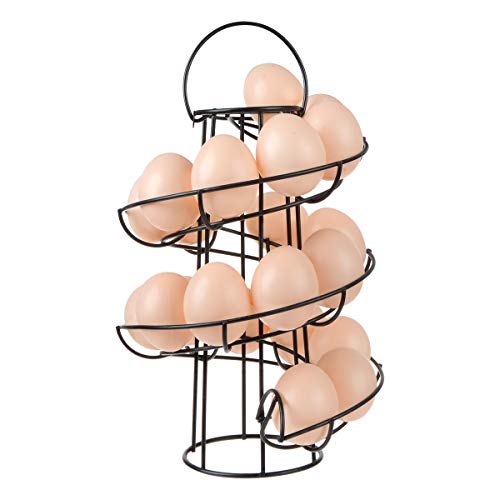
TENINYU Skelter Deluxe
A first skelter for a small flock, or a second rack to run alongside a larger one.
-
Best Collecting Basket

Banawey wooden base
Anyone collecting eggs daily who currently carries them in a shirt, a bucket or their hands.
Check price on Amazon for Chicken Egg Basket for Gathering Fresh Eggs, Wire Egg Collecting Basket on AmazonAbout $16.99 checked Aug 8, 2026
-
Best Budget

Yuoyar Wooden Stackable
Keepers who wash their eggs and need fridge storage, or anyone starting with two or three hens.
Check price on Amazon for Yuoyar Wooden Fresh Egg Holder Countertop Stackable egg storage on AmazonAbout $9.99 checked Aug 8, 2026
Compare every pick side by side
Swipe the table sideways to see every column on a phone.
| Product | Award | Price band | Capacity | Storage Type | Material | Rotation System | Best use case | Buy link |
|---|---|---|---|---|---|---|---|---|
| Toplife Egg Skelter | Best Overall | Under $30 | About 24 eggs | Spiral skelter | Powder-coated metal | Gravity fed, oldest first | Households with four to eight hens who want rotation handled by the rack… | Check price for Toplife Spiral Design Metal Egg Skelter Dispenser Rack, Storage Display Rack, Black on Amazon |
| QUTREY Black Skelter | Best for Small Kitchens | $30 to $60 | About 20 eggs on two rails | Spiral skelter | Powder-coated metal | Gravity fed, oldest first | Small kitchens with a tight counter or a low shelf, and flocks of three t… | Check price for QUTREY Black Metal Egg Holder Countertop, Fresh Egg Skelter, Spiral Design Egg Dispenser Rack with Storage Basket for Display Easter Eggs on Amazon |
| keomaisyto 3-Tier | Best for Large Flocks | Under $30 | Large, three tiers with dividers | Tiered rack | Metal with dividers | Manual, dividers separate batches | Flocks of ten or more birds producing more eggs per day than a spiral rac… | Check price for Egg Holder Countertop with 5 Dividers & DIY Nameplate to Separate Eggs on Amazon |
| TENINYU Skelter Deluxe | Best Value | Under $30 | About 20 eggs | Spiral skelter | Coated wire | Gravity fed, oldest first | A first skelter for a small flock, or a second rack to run alongside a la… | Check price for Egg Skelter Deluxe Modern Spiraling Dispenser Rack - Freestanding Wire Chicken Egg Storage Organizer Display Holder Basket for Countertop Kitchen,Black on Amazon |
| Banawey wooden base | Best Collecting Basket | Under $30 | About 24 eggs | Collecting basket | Thick wire with rust-resistant coating, welded joints, non-slip wooden base | None, carry basket | Anyone collecting eggs daily who currently carries them in a shirt, a buc… | Check price for Chicken Egg Basket for Gathering Fresh Eggs, Wire Egg Collecting Basket on Amazon |
| Yuoyar Wooden Stackable | Best Budget | Under $30 | About 12 eggs per tray | Stackable tray | Wood | Manual, stack by date | Keepers who wash their eggs and need fridge storage, or anyone starting w… | Check price for Yuoyar Wooden Fresh Egg Holder Countertop Stackable egg storage on Amazon |
The full reviews
Each review below follows the same order: what it is, why it won its category, how it behaves in real use, and who should buy something else.
1 Best Overall
Toplife Spiral Design Metal Egg Skelter Dispenser Rack, Storage Display Rack, Black
One continuous spiral for about 24 eggs, which means there is exactly one oldest egg on the rack at any moment and nothing to remember.
What we liked
- A single spiral rail, so first in, first out happens without you tracking anything
- About 24 eggs is roughly a week of laying for six productive hens
- Powder-coated metal wipes clean after an egg leaks on it
- 16.14 in tall, which still clears a standard 18 in wall cabinet gap
What we did not
- Loading the wrong end of the spiral silently reverses the rotation with no visual warning
- A 6.89 in square base carrying eggs up to 16.14 in makes it top-heavy when full
- Chips in the powder coat expose bare steel, which will rust in a steamy kitchen
About $29.99 checked Aug 8, 2026
Key specifications
- Dimensions
- 6.89 x 6.89 x 16.14 in (L x W x H)
- Weight
- 1.72 pounds
- Colour
- Black
- Capacity
- About 24 eggs
- Storage Type
- Spiral skelter
- Material
- Powder-coated metal
- Rotation System
- Gravity fed, oldest first
- Footprint
- About 8 in wide
Why the Toplife Egg Skelter wins this category
Because it leaves you with one decision instead of several. A single unbroken spiral holds about 24 eggs in one queue, so the oldest egg is always the one sitting at the exit. You do not label anything, you do not compare rails, and you do not have to remember what you did on Tuesday.
That matters more than capacity. Every rack here holds eggs. This one holds them in a readable order.
Living with the Toplife Egg Skelter
Twenty-four eggs is a well-judged number for a backyard flock. Six hens in season produce roughly 25 to 30 eggs a week, so the rack fills and empties on a weekly rhythm and no egg sits at the far end for a month.
The height is worth checking against your own kitchen. At 16.14 in it fits under the 18 in gap most US wall cabinets leave above a counter, which a taller tiered rack will not.
Powder-coated metal is the right material for something that will eventually have an egg break on it.
Where the Toplife Egg Skelter falls short
The failure mode is human and the design does nothing to catch it. Drop three fresh eggs into the near end because it is closer to the door, and the rack now tells you the newest egg is the oldest. There is no marking and no stop to prevent it. Decide on your loading end and tell everyone in the house.
Stability is the physical drawback. A 6.89 in square base supporting a column of eggs 16.14 in high is not tippy in normal use, but a knock at the top with a full spiral will cost you eggs.
The coating is the long-term one. Eggs knock the rail as they roll, and once the powder coat chips, the steel underneath is exposed to kitchen humidity.
Research based, not hands-on
Assessed on the published spiral geometry, capacity, dimensions and coating, and compared against multi-rail and tiered racks on how many rotation decisions each design leaves to the user.
- Best for
- Households with four to eight hens who want rotation handled by the rack rather than by memory.
- Skip it if
- You wash every egg as it comes in, because washed eggs need refrigeration rather than a countertop rack.
- The limitation to plan around
- The spiral enforces order, it does not enforce direction. Anyone in the house who drops a warm egg into the low end has quietly put the newest egg first in the queue, and the rack will look completely normal.
2 Best for Small Kitchens
QUTREY Black Metal Egg Holder Countertop, Fresh Egg Skelter, Spiral Design Egg Dispenser Rack with Storage Basket for Display Easter Eggs
About 20 eggs in 13 in of height and a 6.9 in square base, which is the smallest footprint here that still rotates eggs properly.
What we liked
- 13 in tall, so it fits under a wall cabinet and even on most open shelves
- A 6.9 in square base takes very little of a crowded counter
- Spiral rails still deliver gravity fed rotation rather than a pile of eggs
- Powder-coated metal cleans up after a leak with a cloth
What we did not
- Two rails means two oldest eggs, so you have to remember which rail was filled first
- About 20 eggs is under two days of collection from a flock of a dozen birds
- The upper rail sits high on a 6.9 in base, so a knock can roll eggs off the top
Key specifications
- Dimensions
- 6.9 x 6.9 x 13 in (L x W x H)
- Colour
- Black
- Capacity
- About 20 eggs on two rails
- Storage Type
- Spiral skelter
- Material
- Powder-coated metal
- Rotation System
- Gravity fed, oldest first
- Footprint
- Compact, two rails
Why the QUTREY Black Skelter wins this category
Because it fits where the others do not. At 13 in tall on a 6.9 in square base, it clears a wall cabinet with room to spare and it will sit on a narrow open shelf that a 16 in or 20 in rack cannot use.
It gets there without giving up the mechanism. These are still gravity fed spiral rails, so eggs walk down as you take from the bottom. Compared with the usual small-kitchen answer, which is a bowl, that is a real difference.
Living with the QUTREY Black Skelter
About 20 eggs is a sensible week for three to five hens, and the rack empties often enough that nothing lingers.
The powder-coated finish behaves the same way as the taller metal racks here. Eggs leak occasionally, and a coated rail is a wipe rather than a job.
Black metal also disappears against most counters, which sounds trivial until you remember this thing lives permanently in your line of sight.
Where the QUTREY Black Skelter falls short
The two rails are the catch, and it is the whole reason to think twice. A single spiral has one exit and one oldest egg. Two rails have two, so every time you load you are also deciding which rail is currently in front, and every time you cook you are deciding which rail to take from. Get that wrong once and half the rack is out of order.
Capacity is the other constraint. Twenty eggs is two days for twelve birds, so this is a small-flock rack whatever your counter looks like.
There is also the balance. The top rail sits well above a 6.9 in footprint, and a full upper rail nudged by a sleeve is eggs on the floor.
Research based, not hands-on
Assessed on the published dimensions, two-rail capacity and coating, and compared against single-spiral racks on rotation clarity and against tiered racks on counter footprint.
- Best for
- Small kitchens with a tight counter or a low shelf, and flocks of three to six hens.
- Skip it if
- You want the rack to do the remembering, because splitting eggs across two rails puts that back on you.
- The limitation to plan around
- The two-rail layout is what buys the compact height, and it costs you the single clear queue. There are always two eggs that could be the oldest, and only your memory says which.
3 Best for Large Flocks
Egg Holder Countertop with 5 Dividers & DIY Nameplate to Separate Eggs
Three tiers with five dividers and a nameplate you write on yourself, which is the only design here that can hold several days of laying as separate, labelled batches.
What we liked
- Three tiers hold far more than any single spiral in this comparison
- Five dividers let you keep each day or each batch physically separate
- The DIY nameplate means you can write dates rather than guess at them
- Metal construction wipes clean and does not soak up a leak
What we did not
- Rotation is entirely manual, so the dividers do nothing unless you label and move batches yourself
- At 20.8 in tall it will not fit under a standard 18 in wall cabinet gap
- A 15.7 x 9.44 in footprint takes a large piece of usable counter
- 7 pounds empty, so it is not something you lift aside to wipe underneath
About $29.99 checked Aug 8, 2026
Key specifications
- Dimensions
- 15.7 x 9.44 x 20.8 in (L x W x H)
- Weight
- 7.0106999316 pounds
- Colour
- Black
- Capacity
- Large, three tiers with dividers
- Storage Type
- Tiered rack
- Material
- Metal with dividers
- Rotation System
- Manual, dividers separate batches
- Footprint
- Wide, needs shelf depth
Why the keomaisyto 3-Tier wins this category
Because at a certain flock size a spiral simply runs out. A dozen hens can produce ten eggs a day, which fills a 20 egg skelter in two days and leaves you stacking the overflow in bowls. Three tiers with five dividers give you somewhere to put a whole week without mixing batches together.
The nameplate is the part that matters. Written dates turn a large rack into an auditable one, and for a flock producing eggs you also sell or give away, knowing the lay date is worth more than convenience.
Living with the keomaisyto 3-Tier
Dividers make the tiers useful rather than just large. You can run Monday and Tuesday side by side, empty Monday completely, then slide Tuesday across, which is closer to how a spiral behaves than an open shelf ever gets.
Metal is the right call at this size. A rack holding several days of eggs will eventually have one break on it, and a metal shelf is a wipe rather than a stain.
Where the keomaisyto 3-Tier falls short
The rotation is on you, and that deserves stating plainly. Gravity does nothing here. If you stop labelling for a fortnight, this becomes a very large shelf and old eggs will hide at the back exactly as they would in a cupboard.
The size is the other real cost. At 20.8 in tall it will not go under a wall cabinet, and 15.7 x 9.44 in of counter is a lot of space to give up permanently. It wants an island, an open shelf or a pantry rather than a normal run of worktop.
At 7 pounds empty and considerably more loaded, it also stays where you put it. Cleaning under it means unloading it first.
Research based, not hands-on
Assessed on the published tier count, divider arrangement, dimensions and weight, and compared against gravity fed spirals on how much of the rotation work falls to the user.
- Best for
- Flocks of ten or more birds producing more eggs per day than a spiral rack can rotate.
- Skip it if
- You want the rack to enforce order for you, because this one only records the order you give it.
- The limitation to plan around
- Nothing moves on its own. A spiral walks eggs toward the exit whether you think about it or not; this is a set of shelves with dividers, and it becomes a rotation system only when you write dates on it and take from the oldest section every time.
4 Best Value
Egg Skelter Deluxe Modern Spiraling Dispenser Rack - Freestanding Wire Chicken Egg Storage Organizer Display Holder Basket for Countertop Kitchen,Black
A gravity fed spiral for about 20 eggs at roughly half the price of the Toplife skelter, which makes proper rotation the cheap option rather than the upgrade.
What we liked
- Gravity fed spiral, so it rotates eggs the same way the pricier racks do
- About 20 eggs suits a flock of three to five hens on a weekly rhythm
- At 7.5 in tall it fits under any wall cabinet and on most shelves
- Coated wire is light enough to lift with one hand when you clean the counter
What we did not
- At 0.73 pounds empty the frame slides across a smooth counter when you pull an egg out
- Coated wire has thin contact points, and a chip in the coating is where rust starts
- About 20 eggs is roughly two days of collection from a flock of ten birds
Key specifications
- Dimensions
- 9.8 x 7.5 x 7.5 in (L x W x H)
- Weight
- 0.734375 pounds
- Colour
- Black
- Capacity
- About 20 eggs
- Storage Type
- Spiral skelter
- Material
- Coated wire
- Rotation System
- Gravity fed, oldest first
- Footprint
- About 8 in wide
Why the TENINYU Skelter Deluxe wins this category
Because it does the actual job for the least money. The mechanism that makes a skelter worth owning is the spiral, and this has one. Eggs go in at the top, roll down as you take from the bottom, and the oldest egg is always the one at the exit. That is the same behaviour as the rack costing twice as much.
At 9.8 x 7.5 x 7.5 in it is also the low-profile option, so it fits under cabinets and on shelves where the taller vertical skelters cannot go.
Living with the TENINYU Skelter Deluxe
Twenty eggs matches three to five hens well. You fill it over a week and empty it over a week, which is the rhythm that keeps rotation honest.
Being light has one genuine benefit. You can pick the whole thing up with one hand to wipe the counter under it, which the 7 pound tiered rack in this guide does not allow.
Coated wire also gives eggs less surface to sit against, so there is less to clean when one leaks.
Where the TENINYU Skelter Deluxe falls short
The lack of weight is the daily annoyance. At 0.73 pounds empty, taking an egg from the bottom of the spiral can drag the whole frame toward you on a smooth worktop. It wants to live against a wall or a backsplash, not free in the middle of an island.
Coated wire is also the more fragile finish here. Eggs roll along thin rails, contact is concentrated on narrow points, and once the coating chips through, that spot is bare wire in a humid room.
Capacity is the last limit. If you have ten birds, this is two days of laying, and you will need two of them or a bigger rack.
Research based, not hands-on
Assessed on the published spiral design, capacity, dimensions and weight, and compared against heavier powder-coated skelters on stability and on cost per egg held.
- Best for
- A first skelter for a small flock, or a second rack to run alongside a larger one.
- Skip it if
- You want something with weight and presence on the counter, because this is a light wire frame.
- The limitation to plan around
- The weight is the trade you are making. Under a pound empty means it moves when you do, so it needs a spot where it can sit against a backsplash or a wall rather than free on a smooth island.
5 Best Collecting Basket
Chicken Egg Basket for Gathering Fresh Eggs, Wire Egg Collecting Basket
A coated wire basket for about 24 eggs that solves the trip from the coop to the kitchen, which is the part a skelter cannot help with.
What we liked
- Holds about 24 eggs, so a full morning collection fits in one trip
- Coated wire lets coop dust and bedding fall through rather than collect
- At 6.7 x 6.7 x 7.1 in it carries easily in one hand with a run gate in the other
- Wipes clean and dries fast after a leak, unlike a cloth or wooden carrier
What we did not
- No rotation of any kind, so the newest eggs always sit on top of the oldest
- Eggs stack several deep in a 6.7 in basket, putting the load of a full basket on the shells underneath
- Open wire means a cracked egg runs straight through onto the counter or the floor
About $16.99 checked Aug 8, 2026
Key specifications
- Dimensions
- 6.7 x 6.7 x 7.1 in
- Colour
- Rustic Brown
- Capacity
- About 24 eggs
- Storage Type
- Collecting basket
- Material
- Thick wire with rust-resistant coating, welded joints, non-slip wooden base
- Rotation System
- None, carry basket
- Footprint
- About 8 in wide
- Stated Egg Capacity
- Up to 40 eggs
- Handle Type
- Metal carrying handle
- Pack Quantity
- 1
- Listing Note
- 40 eggs is the maker's claim for a 6.7 in wide basket, so that means stacking eggs several deep, not one layer. Patent pending per the listing.
Why the Banawey Wire Basket wins this category
Because collection is a separate problem from storage and most people solve it badly. Eggs get carried in a jumper, in a bucket, or two at a time in cupped hands, and that is where the majority of breakages happen.
A 24 egg basket takes a full morning's collection in one trip. Coated wire is the right material for the job: bedding, feather dust and coop grit drop straight through instead of building up in the bottom, and it rinses and dries in minutes.
Living with the Banawey Wire Basket
The size is judged for one hand. At 6.7 x 6.7 x 7.1 in you can carry it while opening a run gate, which sounds minor until you have tried to do it holding a bowl.
It also survives coop conditions. A wire basket left hanging in a shed does not go mouldy, does not absorb smells and does not need drying properly before it goes back in service.
Where the Banawey Wire Basket falls short
It has no rotation, and that is worth being blunt about, because a full basket of eggs on a counter looks exactly like storage. It is not. Every new egg goes on top of the older ones, so you always take the newest first, and the eggs at the bottom can sit for weeks while the basket appears to be turning over.
The depth is a physical problem too. Twenty-four eggs in a 6.7 in basket sit several layers deep, which puts the weight of the whole load onto the shells at the bottom.
Open wire has one more cost. When an egg does crack, there is no floor to catch it, so it runs through the basket onto whatever is underneath. Empty this into a skelter as soon as you are indoors.
Research based, not hands-on
Assessed on the published capacity, dimensions and open wire construction, and compared against spiral racks on rotation behaviour and against solid carriers on cleaning.
- Best for
- Anyone collecting eggs daily who currently carries them in a shirt, a bucket or their hands.
- Skip it if
- You want one item that both collects and stores, because a basket cannot rotate eggs.
- The limitation to plan around
- This is transport, not storage. Left on the counter it works as last in, first out, which is the exact opposite of what you want, so eggs need moving into a rack the moment you get inside.
6 Best Budget
Yuoyar Wooden Fresh Egg Holder Countertop Stackable egg storage
A wooden tray that holds about 12 eggs standing on end and stacks with more of the same, which is the cheapest way here to store eggs pointed end down.
What we liked
- Holds eggs upright, so the air cell stays at the top and the yolk stays centred
- Stackable, so you add capacity a tray at a time as the flock comes into lay
- A 4 x 12 in tray fits a fridge shelf or a narrow strip of counter
- At 0.86 pounds per tray it lifts and moves easily
What we did not
- Rotation depends entirely on you stacking trays in date order, since the trays carry no marking
- Bare wood is porous, so a leaking egg soaks in and cannot be scrubbed out
- Each tray is 6 in tall, so three stacked stand 18 in high and the bottom tray needs the stack lifted off to reach
About $9.99 checked Aug 8, 2026
Key specifications
- Dimensions
- 4 x 12 x 6 in (L x W x H)
- Weight
- 0.8598028218 pounds
- Colour
- Brown
- Capacity
- About 12 eggs per tray
- Storage Type
- Stackable tray
- Material
- Wood
- Rotation System
- Manual, stack by date
- Footprint
- About 4 x 12 in
Why the Yuoyar Wooden Stackable wins this category
On price and on one thing none of the spirals here do. Eggs sit upright in the tray rather than on their sides, which keeps the air cell at the blunt end uppermost and helps hold the yolk centred in the white. If you are storing eggs for more than a couple of weeks, that orientation is the correct one.
It is also the only design here that grows in small steps. Two hens need one tray. Six hens need three. You buy capacity as the flock comes into lay rather than guessing at it upfront.
Living with the Yuoyar Wooden Stackable
A 4 x 12 in tray is a shape that fits places a vertical skelter cannot: the door shelf of a fridge, the back of a narrow counter, a pantry shelf.
That fridge point matters more than it looks. If you wash your eggs, they need refrigeration, and no countertop spiral in this guide is any use to you. A flat stackable tray is.
Under a pound per tray, it also moves out of the way without a thought.
Where the Yuoyar Wooden Stackable falls short
Rotation is manual and it is the weakest here. There are no dates, no dividers and no markings, so the order lives entirely in your head and in how carefully you build the stack. New trays on top, take from the bottom, every time.
That routine has a physical cost. At 6 in per tray, three stacked stand 18 in high, and reaching the bottom tray means lifting two loaded trays off first. Most people stop doing that within a fortnight and start taking from the top instead.
Wood is the other drawback. It is porous, so an egg that leaks soaks into the grain and stays there. Coated metal wipes; this does not.
Research based, not hands-on
Assessed on the published tray capacity, dimensions, weight and wooden construction, and compared against spiral racks on rotation and against coated metal on cleaning after a leak.
- Best for
- Keepers who wash their eggs and need fridge storage, or anyone starting with two or three hens.
- Skip it if
- You want a rack that manages rotation for you, because stacked trays only record the order you build them in.
- The limitation to plan around
- The stack is the rotation system and it works in one direction only. New trays have to go on top and you have to take from the bottom, which means lifting the stack every time rather than reaching for the nearest egg.
How we compared these egg racks
Every rack was judged on one question before anything else: does the design tell you which egg is oldest, or does it leave that to your memory?
That splits the field immediately. A single continuous spiral has exactly one oldest egg and it is the one about to roll off the end, so there is nothing to remember. A two-rail spiral has two, and you have to know which rail you filled first. A tiered rack with dividers has as many as you have batches, and it only rotates if you actually write on the dividers. A gathering basket has no oldest egg at all, because the newest ones are sitting on top of it.
After that we compared capacity against a realistic weekly lay rate, the counter space each one occupies, whether the height clears a standard wall cabinet, and how easily the material cleans up after an egg leaks.
None of these were handled. The judgements here come from published dimensions, materials and mechanisms, and from how each design behaves against the way eggs get collected, stored and eaten in a working kitchen.
What actually matters in an egg skelter
The loading end, and why rotation fails
First in, first out is a habit, not a feature. The rack makes the habit easy or hard, and that is the whole of its contribution.
A spiral makes it easy because the geometry only allows one sensible answer. Eggs enter at the high end, gravity walks them down as you remove from the low end, and the rack refills itself into the right order without you thinking about it.
The failure is always the same. Someone comes in from the coop with three warm eggs, sees a gap at the near end, and drops them in there. Now there is no way to look at the rack and know what is old. Nothing beeps. Nothing looks wrong. You find out weeks later.
Designs that split eggs across two rails, or across tiers, double or triple the number of decisions you have to get right.
Capacity against your real lay rate
Count your birds and count backwards from a week. Six productive hens give roughly 25 to 30 eggs in a week during the season, so a 24 egg rack holds about seven days of laying for that flock.
More is not automatically better. A rack that never empties out is a rack where a few eggs at the far end never move, which is the exact problem the skelter was bought to solve. If you have a dozen birds, two smaller racks you empty and refill beat one large one that always has stock.
Footprint, height and the wall cabinet problem
Countertop racks live in the most contested space in the house, and the height matters more than people expect.
Standard US wall cabinets hang about 18 in above the counter. A rack that stands 16 in tall clears that, just. A rack that stands 20.8 in tall does not, and has to go on an island, an open shelf or a table instead. Check your own gap before you order anything vertical.
Footprint is the second number. A spiral on a base of about 7 in square gives you a lot of eggs for very little counter. A tiered rack that is 15.7 in wide and 9.44 in deep is a serious piece of furniture by comparison.
Material and the leak you will eventually have
Eggs crack, and sooner or later one lets go on the rack.
Powder-coated metal and coated wire wipe clean, and the only lasting problem is a chip in the coating, which is where rust will start in a humid kitchen. Bare wood is porous. A leak soaks in, and it does not scrub out. That does not make wood a bad choice, but it makes it a choice you should make deliberately.
How long eggs actually keep on the counter
This is the part that decides whether any of these racks suit your kitchen.
An egg leaves the hen with a bloom on it, a thin natural coating that seals the pores in the shell. With that bloom intact, an unwashed egg keeps well at normal room temperature for several weeks, which is why countertop storage is normal in much of the world and why skelters exist.
Wash the egg and the bloom goes with the dirt. From that point the shell is porous, the egg loses moisture and takes on whatever is around it, and it needs to be in the fridge. This is exactly why supermarket eggs in the US are sold chilled and must stay chilled.
So the rule is simple. Do not wash eggs you plan to keep on a counter. Wipe a dirty egg dry with a cloth or a brush, keep it near the front of your rotation, and wash only immediately before you cook it. If you prefer to wash everything as it comes in, buy a fridge tray rather than a skelter.
If an egg is visibly cracked, badly soiled, or you are cooking for someone very young, elderly or pregnant, refrigerate it and cook it thoroughly.
Loading a skelter so it actually rotates
Pick the loading end on the first day and write it down if you have to. Everyone in the house needs to know which end is new.
Put the rack where you cook, not where it looks best. A skelter on a shelf across the room stops getting used and the eggs stop moving.
Keep a second container for eggs that arrive while the rack is full, and empty that one first.
If your rack uses dividers or trays rather than a spiral, label them the day they go into use. A strip of masking tape with the date is the difference between a rotation system and a shelf.
Final recommendation
The Toplife Egg Skelter is the best all-round buy. One continuous spiral for about 24 eggs means there is only ever one oldest egg, the 16.14 in height clears a standard wall cabinet, and powder-coated metal wipes clean after a leak.
If counter space is short, the QUTREY Black Skelter does the same job in 13 in of height, at the cost of splitting your eggs across two rails. For a big flock, the keomaisyto 3-Tier has the capacity and the dividers to run batches, as long as you commit to labelling them. The TENINYU Skelter Deluxe is the sensible low-cost spiral, the Banawey Wire Basket is for the trip in from the coop rather than for storage, and the Yuoyar Wooden Stackable suits a fridge shelf where the bloom is no longer doing the work.
Questions people ask before buying
Which end of an egg skelter do I load?
Fresh eggs go in at the top, at the outside end of the spiral, and you always take from the bottom where the oldest egg is about to roll off. This is the entire point of the design and it is also the easiest thing to get wrong. If you drop a fresh egg into the low end because it is closer, that egg now leaves before eggs that were laid a week earlier, and the rack is telling you a lie every time you look at it. Pick your loading end on day one and never change it.
Do fresh eggs need to be refrigerated?
It depends entirely on whether they have been washed. An unwashed egg keeps its bloom, the natural coating the hen applies as she lays, and that coating seals the pores in the shell against bacteria and moisture loss. Unwashed eggs hold up for several weeks at normal room temperature, which is why countertop skelters exist at all. Washing strips the bloom, and from that point the egg needs refrigeration and should be treated like a supermarket egg. This is also why US store eggs are always chilled: they are washed before sale.
Should eggs be stored pointed end up or down?
Pointed end down. The air cell sits at the wide, blunt end of the egg, and keeping that end uppermost holds the air cell in place and helps keep the yolk centred in the white rather than drifting against the shell membrane. A yolk resting against the membrane is more likely to stick and break when you crack the egg. Most spiral skelters let eggs settle on their sides rather than on end, which is fine for a few weeks, but if you are holding eggs longer, a tray that stands them pointed end down is the better choice.
How many eggs should the rack hold?
Work out your weekly collection and buy for that, not for your peak. Six good layers give you roughly 25 to 30 eggs a week in season, so a 24 egg skelter is about one week of laying, which suits most households. A dozen birds fill that in three days and will need either a bigger rack or two racks. There is no benefit in buying much more capacity than you eat, because a rack that never empties defeats rotation just as effectively as loading the wrong end does.
Can I use a collecting basket as my storage rack?
You can, and it is a common mistake worth naming. A gathering basket has no rotation at all, so every new egg lands on top of the older ones and you always take from the top. That is last in, first out, the exact opposite of what you want, and it is how eggs end up sitting at the bottom of a basket for a month. Use a basket for the trip from the coop to the kitchen, then transfer eggs into a rack that rotates.
How do I tell if an egg has gone off?
Float it in a bowl of water. As an egg ages, moisture leaves through the shell and the air cell grows, so a fresh egg lies flat on the bottom, an older but usable egg stands on its point, and an egg that floats clear of the bottom should be thrown out. Crack any doubtful egg into a separate bowl before it goes near the pan, and trust your nose, because a bad egg is unmistakable. A rack that rotates properly means you rarely need this test in the first place.
Why you can trust this guide
- Written by
- Marta Voss, Editor and fact checker, Chicken Geek. Specialist areas: Editorial fact checking, Chick brooding and starter nutrition, Small-flock husbandry, Feed labels and nutrition claims.
- Fact checked by
- Sam Reddick
- Published
- August 6, 2026 · Last updated August 6, 2026 · Products and links rechecked August 6, 2026
- How we picked
- Racks were compared on whether the design enforces first in, first out or leaves it to memory, capacity against a realistic weekly lay rate, counter footprint and overall height, material and how easily it cleans after a leak, and whether eggs can sit pointed end down.
- Evidence used
- None of the 6 products on this page were sent to us or bought for a hands-on test. Every recommendation here is research based: manufacturer specifications, listed dimensions and materials, owner feedback at volume, and comparison against equipment our team has owned. Each review states this again above the buy button so you are never guessing which kind of evidence sits behind a pick.
- Editorial standards
- No brand pays for placement, and no manufacturer sees this page before it goes live. Read our editorial policy and testing method.
- Affiliate disclosure
- Chicken Geek is reader supported. We earn a commission from qualifying purchases made through links on this page, at no extra cost to you, and no brand has paid for a placement or an award here.
About the author

Editor and fact checker, Chicken Geek
Marta edits every guide on Chicken Geek and checks that each claim can be traced back to a manufacturer specification, a published standard or a stated first-hand observation. She keeps a small backyard flock of six hens and has raised chicks from day one for eight seasons.
- Eight seasons raising chicks from day-old to point of lay
- Checks every specification in a Chicken Geek guide against the manufacturer listing
- Removes any testing claim that cannot be backed up
- Keeps a flock of six hens in a suburban backyard