We Compared 6 Chicken Beddings on Absorbency, Dust and Cost
We compared hemp, pine shavings, sand and nest pads on absorbency, dust level and cost per litre, because a dry coop solves nearly every other problem.

By Marta Voss Editor and fact checker, Chicken Geek
Fact checked by Sam Reddick
Published Prices and stock checked 7 min read
Nearly every complaint people have about their coop is a moisture complaint in disguise. Smell is wet manure. Flies are wet manure. Ammonia that stings your eyes at the door is wet manure. Even frostbite is mostly a humidity problem rather than a temperature one.
So bedding gets judged here on how it handles water, and on how much dust it puts into the air of a closed building housing animals with unusually sensitive airways.
We compared six options across three genuinely different strategies. Hemp and pine absorb. Sand drains. Moulded pads solve the specific nest box problem. There is no single right answer, because a keeper cleaning out weekly in Arizona and a keeper running deep litter in Oregon need different things, and we have said which is which.
Our picks at a glance
Every product below wins one specific situation. Pick the row that matches your flock, your yard and your budget rather than reading top to bottom.
-
Best Overall
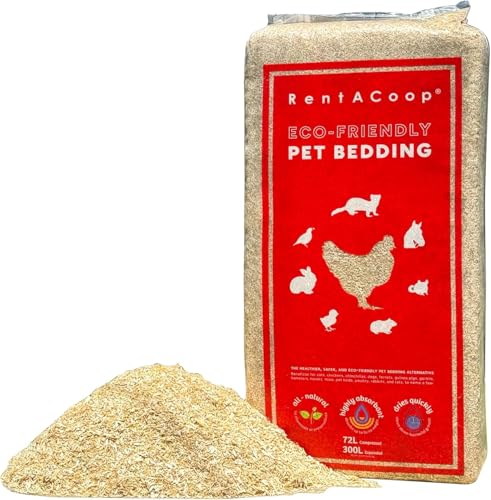
RentACoop 300L
Keepers running a deep litter system, or anyone whose coop has a persistent damp or ammonia problem.
Check price on Amazon for RentACoop Premium Hemp Bedding for Chickens, Rabbits, Horses - 300L (30lbs) on AmazonAbout $72.95 checked Aug 8, 2026
-
Best for Deep Litter

Dominion Hemp 285L
Keepers committed to a deep litter system who want the bedding to compost in place through the winter.
Check price on Amazon for Dominion Hemp Premium Hemp Bedding for Chicken Coops 285L - 30lbs, 1-Pack on AmazonAbout $58.95 checked Aug 8, 2026
-
Best Budget

BobbleT Pine Shavings
Keepers who clean the coop out weekly and want the lowest running cost per month.
-
Best for Wet Climates

Premium Chicken Sand
Covered runs and coop floors in high-rainfall climates where organic bedding turns into a wet mat within days.
-
Best Small Bag

Eaton Pet and Pasture
Small coops with three or four birds, or anyone wanting to try hemp bedding before buying a full bale.
Check price on Amazon for Eaton Pet and Pasture USA-Grown Hemp Bedding for Chickens & Rabbits, 8 Lbs on AmazonAbout $30.99 checked Aug 8, 2026
-
Best for Nest Boxes

Eaton Nesting Pads
Nest boxes in any coop where you are tired of refilling shavings that the hens immediately kick out.
Check price on Amazon for Eaton Pet and Pasture Nesting Pads for Laying Hens, 13 x 13 in, 10-Pack on AmazonAbout $27.99 checked Aug 8, 2026
Compare every pick side by side
Swipe the table sideways to see every column on a phone.
| Product | Award | Price band | Bedding Type | Coverage | Absorbency | Dust Level | Best use case | Buy link |
|---|---|---|---|---|---|---|---|---|
| RentACoop 300L | Best Overall | $60 to $120 | Hemp hurd | About 300 L expanded | Very high, roughly 4x its weight | Low | Keepers running a deep litter system, or anyone whose coop has a persiste… | Check price for RentACoop Premium Hemp Bedding for Chickens, Rabbits, Horses - 300L (30lbs) on Amazon |
| Dominion Hemp 285L | Best for Deep Litter | $30 to $60 | Hemp hurd | About 285 L expanded | Very high | Low | Keepers committed to a deep litter system who want the bedding to compost… | Check price for Dominion Hemp Premium Hemp Bedding for Chicken Coops 285L - 30lbs, 1-Pack on Amazon |
| BobbleT Pine Shavings | Best Budget | Under $30 | Kiln-dried radiata pine | About 5 lb | Moderate | Moderate | Keepers who clean the coop out weekly and want the lowest running cost pe… | Check price for 80 Ounces Premium 100% Natural Radiata Pine Shavings for Chicken Coop Bedding,5LB Wood Pine Shavings,Super Absorbent,Low Dust,Eliminating Bad Smells for Chicken Coops Nesting Boxes Brooder on Amazon |
| Premium Chicken Sand | Best for Wet Climates | Under $30 | Washed construction-grade sand | 50 lb | Low, it drains instead | Low once damp, higher when dry | Covered runs and coop floors in high-rainfall climates where organic bedd… | Check price for Premium Chicken Sand 50 lbs – Dust-Free, Odor-Control Bedding for Chicken Coops, Nesting Boxes, and Runs – Natural Poultry Litter on Amazon |
| Eaton Pet and Pasture | Best Small Bag | $30 to $60 | Hemp hurd | About 8 lb, small coop top-up | High | Low | Small coops with three or four birds, or anyone wanting to try hemp beddi… | Check price for Eaton Pet and Pasture USA-Grown Hemp Bedding for Chickens & Rabbits, 8 Lbs on Amazon |
| Eaton Nesting Pads | Best for Nest Boxes | Under $30 | Moulded aspen nest pads | 10 pads, 13 x 13 in | Moderate | Very low | Nest boxes in any coop where you are tired of refilling shavings that the… | Check price for Eaton Pet and Pasture Nesting Pads for Laying Hens, 13 x 13 in, 10-Pack on Amazon |
The full reviews
Each review below follows the same order: what it is, why it won its category, how it behaves in real use, and who should buy something else.
1 Best Overall
RentACoop Premium Hemp Bedding for Chickens, Rabbits, Horses - 300L (30lbs)
Hemp hurd absorbs roughly four times its own weight and produces almost no dust, which is the combination that keeps a coop dry and a flock's airways clear.
What we liked
- Absorbs around four times its weight, far more than pine shavings
- Very low dust, which matters because chickens have delicate respiratory systems
- Composts quickly, so the used bedding is genuinely useful in a garden
- 300 L expanded from one bale covers a medium coop for months
What we did not
- Costs roughly three times as much per bale as pine shavings
- Fine texture means hens scratch it out of nest boxes faster than shavings
- Availability is patchy and the price moves around noticeably
About $72.95 checked Aug 8, 2026
Key specifications
- Dimensions
- 16 x 10 x 30 in (L x W x H)
- Weight
- 29.5 pounds
- Colour
- Tan
- Bedding Type
- Hemp hurd
- Coverage
- About 300 L expanded
- Absorbency
- Very high, roughly 4x its weight
- Dust Level
- Low
- Compost Speed
- Fast
- Deep Litter
- Well suited
- Bag Size
- 300 L, 30 lb bale
- Hemp Form
- Extra-soft rounded hemp fibres
- Stated Absorbency
- Not stated as a figure, listed as super absorbent
- Dust Claim
- Low-dust, dust-free style formulation
- Origin Grown
- E.U. grown
- Stated Coverage
- Expands to about 10.6 cu ft, covers about 60 sq ft at 2 in depth
Why the RentACoop hemp wins this category
Because almost every problem people have with a coop is a moisture problem wearing a different hat. Smell is wet manure. Ammonia is wet manure. Flies are wet manure. Frostbite is largely humidity.
Hemp hurd holds around four times its weight in liquid, which is substantially more than pine shavings manage. Wet droppings hit it, the moisture is taken up and held away from the surface, and the coop stays dry between cleans.
Living with the RentACoop hemp
The dust difference is obvious the first time you open a bale. Pine shavings throw a visible cloud; hemp does not. Chickens have an unusually efficient and unusually vulnerable respiratory system, and dust is a genuine chronic irritant in a closed coop.
Composting is the other end of the story. Hemp breaks down quickly, so the used bedding goes on a garden bed rather than sitting in a heap for a year.
Where the RentACoop hemp falls short
Cost. A bale of hemp costs roughly three times a bale of pine shavings, and while it lasts longer, it does not last three times longer. Over a year you will spend more. The return is a drier coop, less ammonia and less dust, which is worth it to a lot of keepers and is not worth it to everyone.
The texture is the practical annoyance. Hemp hurd is fine and light, and hens scratch it out of nest boxes faster than they scratch out shavings, so nest boxes need topping up more often or a moulded pad instead.
Research based, not hands-on
Assessed on published absorbency, volume and dust characteristics, and compared against pine shavings and sand on moisture handling and cost per month.
- Best for
- Keepers running a deep litter system, or anyone whose coop has a persistent damp or ammonia problem.
- Skip it if
- Cost per month is the deciding factor, because pine shavings do an adequate job for a fraction of the price.
- The limitation to plan around
- The price gap against pine shavings is real and does not close. Hemp lasts longer and handles moisture better, but it is not cheaper over a season, and anyone hoping it will be should look at the numbers before committing.
2 Best for Deep Litter
Dominion Hemp Premium Hemp Bedding for Chicken Coops 285L - 30lbs, 1-Pack
A 285 litre bale at a lower price per litre than most hemp, which is what makes running a genuine deep litter system affordable rather than theoretical.
What we liked
- 285 L expanded from a 30 lb bale, one of the better price-per-litre figures for hemp
- Coarse enough hurd to stay aerated when turned, which deep litter depends on
- Very low dust, so turning the litter does not fill the coop with particles
- Composts fast enough that the deep litter actually breaks down in place
What we did not
- A 30 lb bale is bulky and awkward to store somewhere genuinely dry
- Still several times the price of pine shavings per bale
- Deep litter needs turning weekly, and this does not remove that job
About $58.95 checked Aug 8, 2026
Key specifications
- Dimensions
- 15 x 11 x 25 in (L x W x H)
- Weight
- 30 pounds
- Colour
- Beige
- Bedding Type
- Hemp hurd
- Coverage
- About 285 L expanded
- Absorbency
- Very high
- Dust Level
- Low
- Compost Speed
- Fast
- Deep Litter
- Well suited
- Bag Size
- 285 L, 30 lb, listed as 10+ cubic feet
- Hemp Form
- Made from hemp stalks, hurd or fibre not stated
- Stated Absorbency
- Up to 4x its weight
- Dust Claim
- Low dust
- Origin Grown
- USA-grown hemp
- Stated Coverage
- Not stated
Why the Dominion hemp wins this category
Because deep litter is a system, not a product, and the system only makes economic sense if the bedding is cheap enough per litre to lay four to six inches deep across the whole coop floor at the start of the season.
At 285 litres expanded, this bale gives one of the better price-per-litre figures in hemp, which is what moves deep litter from a nice idea to something you actually do.
Living with the Dominion hemp
Deep litter works by composting in place. Droppings fall onto carbon-rich bedding, you turn it weekly so oxygen gets in, and the pile breaks down and generates a little warmth as it goes.
The texture here is coarse enough to stay open when turned, which is the physical property that makes the whole thing work. Fine bedding packs down and stops breathing.
Dust is low, and that matters more with deep litter than with a weekly clean-out, because you are stirring the litter regularly and standing over it while you do.
Where the Dominion hemp falls short
Storage. A 30 lb compressed bale is a large object, and it has to be kept genuinely dry or it starts composting in the bag before it ever reaches the coop. Not everyone has a dry shed with a spare corner.
The bigger caveat is about deep litter itself rather than this bedding. It requires turning, and if you skip that for a few weeks the lower layer packs, goes anaerobic, and produces a smell considerably worse than a coop that gets cleaned out. Hemp helps because it aerates well; it does not do the turning for you.
Research based, not hands-on
Assessed on published volume, texture and absorbency, and compared against the other hemp products here on price per litre.
- Best for
- Keepers committed to a deep litter system who want the bedding to compost in place through the winter.
- Skip it if
- You clean the coop out completely every week, because deep litter economics are what justify the price here.
- The limitation to plan around
- Deep litter only works if you turn it. Hemp aerates well, but a layer left flat will pack down, go anaerobic and start smelling worse than a coop you simply cleaned out, and no bedding fixes that.
3 Best Budget
80 Ounces Premium 100% Natural Radiata Pine Shavings for Chicken Coop Bedding,5LB Wood Pine Shavings,Super Absorbent,Low Dust,Eliminating Bad Smells for Chicken Coops Nesting Boxes Brooder
Kiln-dried radiata pine at a fraction of the price of hemp. It absorbs less and dusts more, and for a coop that gets cleaned weekly that is a perfectly reasonable trade.
What we liked
- Cheapest bedding per litre in this comparison by a wide margin
- Kiln dried, which removes the moisture and much of the volatile content of raw pine
- Pine rather than cedar, so it lacks the oils that irritate poultry airways
- Available everywhere, so you are never caught without bedding
What we did not
- Absorbs noticeably less than hemp, so a coop needs cleaning more often
- Dusty enough to be visible when you tip a bag out
- Composts slowly, so used bedding needs a year in a heap before it goes on a bed
Key specifications
- Dimensions
- 16.5 x 8.8 x 4.3 in (L x W x H)
- Weight
- 5 pounds
- Colour
- white
- Bedding Type
- Kiln-dried radiata pine
- Coverage
- About 5 lb
- Absorbency
- Moderate
- Dust Level
- Moderate
- Compost Speed
- Slow to moderate
- Deep Litter
- Workable with frequent turning
Why the BobbleT pine wins this category
Price, and it is not close. Pine shavings cost a fraction of what hemp costs per litre, and for a keeper cleaning the coop out weekly the extra absorbency of hemp is largely wasted anyway, because the bedding is being removed before it reaches capacity.
Kiln drying matters. It drives off moisture and a good deal of the volatile content, which makes kiln-dried pine considerably less irritating than raw shavings from a mill.
Living with the BobbleT pine
It is pine and not cedar, which is the single most important thing to check when buying wood shavings for poultry. Cedar contains aromatic oils that are a known respiratory irritant to birds and small animals, and it is still sold as animal bedding.
Availability is a real practical advantage. Hemp goes out of stock and moves in price; pine shavings are on a shelf somewhere near you at all times.
Where the BobbleT pine falls short
Absorbency, which sets the cleaning schedule rather than being a quality issue on its own. Pine holds meaningfully less liquid than hemp, so a coop bedded with pine reaches the point of being damp and smelly sooner. If you clean weekly that is invisible. If you were hoping to clean monthly it is not.
Dust is the health consideration. Pine shavings produce a visible cloud when tipped, and that dust ends up in a closed coop with birds whose respiratory systems are efficient enough to be genuinely affected by it. Fill your container outdoors and carry it in rather than tipping a bag out with the flock inside.
Composting is slow. Used pine bedding needs a long spell in a heap before it is useful in a garden.
Research based, not hands-on
Assessed on published material, processing and volume, and compared against hemp and sand on absorbency, dust and cost per litre.
- Best for
- Keepers who clean the coop out weekly and want the lowest running cost per month.
- Skip it if
- You are running deep litter, or your coop has a persistent damp or ammonia problem.
- The limitation to plan around
- Pine shavings dust, and dust is a chronic respiratory irritant in a closed coop. Tipping a bag out inside the coop with the birds in it is the worst way to use them; fill outside and carry it in.
4 Best for Wet Climates
Premium Chicken Sand 50 lbs – Dust-Free, Odor-Control Bedding for Chicken Coops, Nesting Boxes, and Runs – Natural Poultry Litter
Washed construction-grade sand drains rather than absorbs, which is the opposite approach to every other bedding here and the right one in a run that never dries out.
What we liked
- Drains water straight through instead of holding it, so it never becomes a wet mat
- Droppings dry on the surface and can be sifted out like cat litter
- Does not rot or break down, so it is topped up rather than replaced
- Doubles as grit and as a dust bathing surface for the birds
What we did not
- Does not compost at all, so used sand is waste rather than a garden input
- Heavy, so 50 lb bags are a real job to move and spread
- Holds cold in winter and gets genuinely chilly underfoot in a coop
Key specifications
- Dimensions
- 0 x 0 x 0 in (L x W x H)
- Weight
- 50 pounds
- Colour
- Tan
- Bedding Type
- Washed construction-grade sand
- Coverage
- 50 lb
- Absorbency
- Low, it drains instead
- Dust Level
- Low once damp, higher when dry
- Compost Speed
- Does not compost
- Deep Litter
- Not suitable
- Bag Weight
- 50 lb
- Grain Type
- 100% natural chemical-free coarse sand, uniform granular size, grain size not stated
- Marketed Use
- Chicken coop, nesting box and run bedding
- Drainage Claim
- Claims moisture absorption to keep the coop or run dry, drainage rate not stated
- Dust Claim
- Described as a dust-free formula
- Processing
- Washed, screened and dried
- Odour Claim
- States reduced odour from less moisture build-up and better airflow
- Reusability
- States it is reusable and lasts longer than traditional bedding
- Listing Note
- Dust-free is the maker's wording, no dust figure or test is given
Why the Premium Chicken Sand wins this category
Because in a genuinely wet climate, absorbency is the wrong strategy. Organic bedding takes up water until it is saturated, and once saturated it is a cold wet mat that smells and grows mould. In a run that gets rain most weeks, that state arrives within days.
Sand does not absorb. Water goes through it and away, the surface dries in a few hours of wind, and droppings dry on top rather than dissolving into the substrate.
Living with the Premium Chicken Sand
The maintenance model is completely different and, once you adjust, easier. Droppings dry on the surface and are sifted out with a scoop, exactly like a large cat litter tray. There is no full clean-out, no bale to buy every month, and no heap to manage.
The birds get two side benefits: grit, which they need for digestion, and a dust bathing surface, which they will use constantly.
Where the Premium Chicken Sand falls short
Disposal. Everything else in this comparison ends up on a compost heap and then on a garden. Sand does not break down, so once it is genuinely fouled it is waste, and moving 50 lb bags of it out is heavier work than moving bedding in.
Cold is the second issue. Sand conducts heat away from a bird's feet in a way that dry organic bedding does not, so it is a much better choice for a run floor than for the sleeping area of an unheated coop in a cold climate.
And the grade is critical. Coarse washed sand works. Fine play sand packs, holds water, and creates a real respiratory dust problem, which is why so many people who try sand and hate it were using the wrong material.
Research based, not hands-on
Assessed on the published grade and volume, and compared against organic bedding on drainage, thermal behaviour and disposal.
- Best for
- Covered runs and coop floors in high-rainfall climates where organic bedding turns into a wet mat within days.
- Skip it if
- You want compostable bedding, or your coop is unheated and gets very cold, because sand pulls heat out of a bird's feet.
- The limitation to plan around
- It must be washed construction sand, not play sand. Fine play sand packs down, holds water and creates a genuine respiratory dust hazard, and it is the most common mistake people make when trying sand.
5 Best Small Bag
Eaton Pet and Pasture USA-Grown Hemp Bedding for Chickens & Rabbits, 8 Lbs
An 8 lb bag of USA-grown hemp, which is the right size for a small coop and the only sensible way to try hemp before committing to a 30 lb bale.
What we liked
- Small enough to store anywhere, unlike a 30 lb compressed bale
- USA grown with a traceable supply chain rather than an unlabelled import
- Same low-dust, high-absorbency properties as the larger hemp bales
- Cheap enough to trial hemp without a real commitment
What we did not
- Costs considerably more per litre than a full-size bale
- 8 lb covers a small coop briefly, so repeat purchases add up fast
- Not a sensible way to buy bedding for a flock of more than four or five birds
About $30.99 checked Aug 8, 2026
Key specifications
- Dimensions
- 0 x 0 x 0 in (L x W x H)
- Weight
- 6.25892361818 pounds
- Bedding Type
- Hemp hurd
- Coverage
- About 8 lb, small coop top-up
- Absorbency
- High
- Dust Level
- Low
- Compost Speed
- Fast
- Deep Litter
- Well suited
- Bag Size
- 8 lb, recyclable paper bag
- Hemp Form
- Hemp hurd, the soft inner core of the stalk
- Stated Absorbency
- Up to 2x the absorbency of pine shavings
- Dust Claim
- Low-dust
- Origin Grown
- USA-grown hemp, packaged in the USA
- Stated Coverage
- Not stated
Why the Eaton hemp wins this category
Because a 30 lb compressed bale is a commitment in two ways: money and storage. Plenty of people with a small coop and a small shed cannot easily take either, and the result is that they never try hemp at all.
An 8 lb bag removes both barriers. It fits on a shelf, it costs about the same as a takeaway, and it is enough to bed a small coop and find out whether the difference is one you care about.
Living with the Eaton hemp
The material behaves exactly like the big bales: low dust, high absorbency, quick composting. There is no compromise in the product, only in the quantity.
USA-grown with a stated origin is worth a mention in a category where a lot of bedding arrives with no information about what it is or where it came from.
Where the Eaton hemp falls short
Cost per litre, and it is not a small gap. Buying hemp in 8 lb bags rather than 30 lb bales costs substantially more for the same material, in the same way that buying rice in single-serve packets does.
That is fine as a trial and it is a poor long-term arrangement. Once you have decided hemp works for you, moving to a full bale is the obvious next step.
It is also genuinely small. For a flock of six or more birds, an 8 lb bag is a top-up rather than a bedding-out, and buying enough of them to bed a medium coop would be an expensive mistake.
Research based, not hands-on
Assessed on published weight, origin and material, and compared against the full-size hemp bales here on cost per litre.
- Best for
- Small coops with three or four birds, or anyone wanting to try hemp bedding before buying a full bale.
- Skip it if
- You have a medium or large coop, because buying hemp this way costs far more per litre.
- The limitation to plan around
- You are paying a substantial premium for the small pack size. Once you know hemp suits your coop, switching to a full bale saves a lot of money for exactly the same material.
6 Best for Nest Boxes
Eaton Pet and Pasture Nesting Pads for Laying Hens, 13 x 13 in, 10-Pack
Moulded aspen pads that stay in the box, which fixes the specific problem that loose bedding in a nest ends up on the coop floor within a day.
What we liked
- Stays in place, unlike loose shavings which hens scratch out immediately
- Very low dust, which matters most in a nest where a hen sits for an hour
- Ten pads cover a small flock's boxes for months
- Changing one takes seconds and produces no mess to sweep up
What we did not
- Costs considerably more per nest per month than loose shavings
- Fixed 13 by 13 in size, so it does not suit non-standard boxes
- Thinner than a good layer of shavings, so cold steel boxes still feel cold
About $27.99 checked Aug 8, 2026
Key specifications
- Dimensions
- 13.75 x 13.75 x 0.1 in (L x W x H)
- Colour
- Light Brown
- Bedding Type
- Moulded aspen nest pads
- Coverage
- 10 pads, 13 x 13 in
- Absorbency
- Moderate
- Dust Level
- Very low
- Compost Speed
- Moderate
- Deep Litter
- Nest boxes only
Why the Eaton nesting pads win this category
Because a nest box is the one place in a coop where bedding has a specific job and consistently fails to do it. Loose shavings get scratched, turned and pushed out by the hen before she settles, and within a day a good handful is on the floor and the box is half bare.
A moulded pad is one piece with a formed hollow. There is nothing to scratch out.
Living with the Eaton nesting pads
Changing a soiled pad takes about five seconds and produces nothing to sweep up. Compare that with scooping wet shavings out of a box with a trowel.
The dust point is worth making specifically for nest boxes. A hen sits still in one for the best part of an hour every day with her face close to the bedding, which is a far higher exposure than she gets standing on the coop floor. Low-dust material matters more here than anywhere else.
Where the Eaton nesting pads fall short
Cost per month is several times that of loose shavings. If kicked-out bedding does not actually bother you, that money is better spent elsewhere.
Sizing is the practical trap. At 13 by 13 inches these fit standard nest boxes, and they cannot be cut down because the moulded rim is what holds the shape. Measure before ordering.
And they are thin compared with a deep layer of shavings, so in a galvanised steel nest box in an unheated coop, they will not fix a hen who is refusing the box because it is cold.
Research based, not hands-on
Assessed on published dimensions, material and pack size, and compared against loose shavings on retention and cost per nest.
- Best for
- Nest boxes in any coop where you are tired of refilling shavings that the hens immediately kick out.
- Skip it if
- Your nest boxes are not close to 13 by 13 inches, because these cannot be trimmed.
- The limitation to plan around
- These are nest box liners and nothing else. They do not work as coop floor bedding, so they are an addition to your bedding budget rather than a replacement for it.
How we compared these beddings
We calculated cost per expanded litre for every product, which is the only fair way to compare a compressed hemp bale against a bag of shavings against a sack of sand.
We then scored each on published absorbency, dust characteristics, composting behaviour and how it performs in three distinct scenarios: a coop cleaned out weekly, a deep litter system run across a season, and a covered run in a high-rainfall climate. A bedding that wins one of those can easily lose another, which is why this guide has no single overall answer for everybody.
What actually matters in chicken bedding
Absorbency, or drainage
These are two opposite strategies and both work.
Absorbent bedding takes moisture up and holds it away from the surface. Hemp does this best, holding roughly four times its weight; pine shavings hold considerably less. The limit is capacity: once saturated, absorbent bedding is a wet mat.
Drainage takes the opposite approach. Sand lets water through and away, so it never saturates. In a climate where organic bedding never gets a chance to dry out, that is a better model.
Dust
Chickens have an extremely efficient respiratory system with air sacs extending through the body, and it makes them more vulnerable to airborne particulates than mammals of the same size.
Hemp is very low dust. Kiln-dried pine is moderate. Fine play sand is bad. The practical habit that matters more than the product: fill your bucket outside and carry it in, rather than tipping a bag out inside a closed coop with the birds present.
Species, and what to avoid
Never cedar. The aromatic oils are a documented respiratory irritant for birds.
Be careful with anything simply labelled "wood shavings" with no species named, and be wary of raw mill shavings, which carry more moisture and more volatile content than kiln-dried product.
Composting
Hemp composts quickly and used bedding goes onto a garden within months. Pine composts slowly and needs a year in a heap because of its carbon ratio. Sand does not compost at all and becomes waste.
If you garden, this is worth real money over a few years.
Matching bedding to your setup
Weekly clean-out, dry climate. Pine shavings. The extra absorbency of hemp is wasted when you remove the bedding before it reaches capacity.
Deep litter through winter. Hemp. You need something that aerates when turned, composts in place and does not pack down, and hemp does all three.
Wet climate, covered run. Sand, in coarse washed grade. Nothing organic stays dry in a run that gets rain most weeks.
Cold coop, unheated. Deep organic bedding rather than sand. Birds stand on the floor all night and sand pulls heat out of their feet.
Nest boxes, any setup. Moulded pads if loose bedding being kicked out annoys you, shavings if it does not.
Final recommendation
RentACoop Hemp is the best bedding for most coops. It absorbs about four times its weight, produces very little dust, composts quickly and keeps a coop dry between cleans. It costs about three times what pine does, and for most keepers the drier coop is worth it.
If you run deep litter, Dominion Hemp gives you a better price per litre at the volume that system needs. If the monthly cost is the deciding factor, BobbleT Pine Shavings are entirely adequate provided you clean weekly. And in a genuinely wet climate, Premium Chicken Sand in a covered run will outperform every organic bedding here.
Questions people ask before buying
Is cedar bedding safe for chickens?
No, and it is still widely sold as animal bedding, so it is worth checking the bag. Cedar contains aromatic oils, principally plicatic acid, that are a known respiratory irritant to birds and small mammals. Pine is the safe softwood alternative, and kiln-dried pine is better still because the drying process drives off much of the volatile content. If a bag just says "wood shavings" without naming the species, do not buy it for a coop.
How deep should chicken coop bedding be?
Two to four inches for a coop cleaned out weekly, and four to six inches if you are running deep litter through a season. Depth matters more than people expect, because a thin layer over a hard floor gives droppings nowhere to go and offers no insulation. In winter a deeper layer is genuinely warmer for the birds, since they stand on it all night.
What is the deep litter method?
Instead of removing bedding, you add fresh material on top and turn the layer regularly so that the droppings compost in place through the season. Done properly it produces a dry, faintly earthy layer that generates a little warmth and needs clearing out only once or twice a year. Done badly, meaning left flat and never turned, the lower layer packs, goes anaerobic and smells considerably worse than a coop cleaned out weekly.
Is sand good bedding for a chicken coop?
It is excellent in a covered run and in wet climates, and it has real drawbacks in a cold coop. Sand drains rather than absorbing, so it never becomes a saturated mat, and droppings dry on the surface and can be sifted out. But it conducts heat away from birds' feet, it does not compost so used sand is waste, and it must be coarse washed sand rather than fine play sand. Play sand packs down, holds water and creates a genuine dust hazard.
How often should I change coop bedding?
With a weekly clean-out system, spot clean the areas under the roosts every few days and replace the whole layer weekly or fortnightly depending on flock density. With deep litter, turn it weekly and add fresh material on top, clearing the coop out entirely once or twice a year. The reliable signal in either system is smell: a coop that smells of ammonia when you open it in the morning needs attention today, not on schedule.
Can I use straw as chicken bedding?
You can, and it is cheap, but it is the weakest common option. Straw stems are hollow, so straw absorbs relatively little and instead lets moisture sit underneath the layer where you cannot see it. Those hollow stems are also a favourite harbourage for mites. It works acceptably in nest boxes and in a dry, well-ventilated coop, and it is a poor choice in any coop with a damp problem.
Why you can trust this guide
- Written by
- Marta Voss, Editor and fact checker, Chicken Geek. Specialist areas: Editorial fact checking, Chick brooding and starter nutrition, Small-flock husbandry, Feed labels and nutrition claims.
- Fact checked by
- Sam Reddick
- Published
- August 6, 2026 · Last updated August 6, 2026 · Products and links rechecked August 6, 2026
- How we picked
- Beddings were compared on published absorbency, dust characteristics, expanded volume and cost per litre, then assessed against three use cases: weekly clean-out, deep litter and wet-climate runs. Nest box liners were compared separately on retention and cost per nest.
- Evidence used
- None of the 6 products on this page were sent to us or bought for a hands-on test. Every recommendation here is research based: manufacturer specifications, listed dimensions and materials, owner feedback at volume, and comparison against equipment our team has owned. Each review states this again above the buy button so you are never guessing which kind of evidence sits behind a pick.
- Editorial standards
- No brand pays for placement, and no manufacturer sees this page before it goes live. Read our editorial policy and testing method.
- Affiliate disclosure
- Chicken Geek is reader supported. We earn a commission from qualifying purchases made through links on this page, at no extra cost to you, and no brand has paid for a placement or an award here.
About the author

Editor and fact checker, Chicken Geek
Marta edits every guide on Chicken Geek and checks that each claim can be traced back to a manufacturer specification, a published standard or a stated first-hand observation. She keeps a small backyard flock of six hens and has raised chicks from day one for eight seasons.
- Eight seasons raising chicks from day-old to point of lay
- Checks every specification in a Chicken Geek guide against the manufacturer listing
- Removes any testing claim that cannot be backed up
- Keeps a flock of six hens in a suburban backyard