We Compared 6 Chicken Runs on Space, Roof Shape and Frame Quality
We compared six chicken runs on square feet per bird, roof shape, frame finish and headroom, the four things that decide whether a run stays usable for years.

By Sam Reddick Lead gear reviewer, Chicken Geek
Fact checked by Marta Voss
Published Prices and stock checked 7 min read
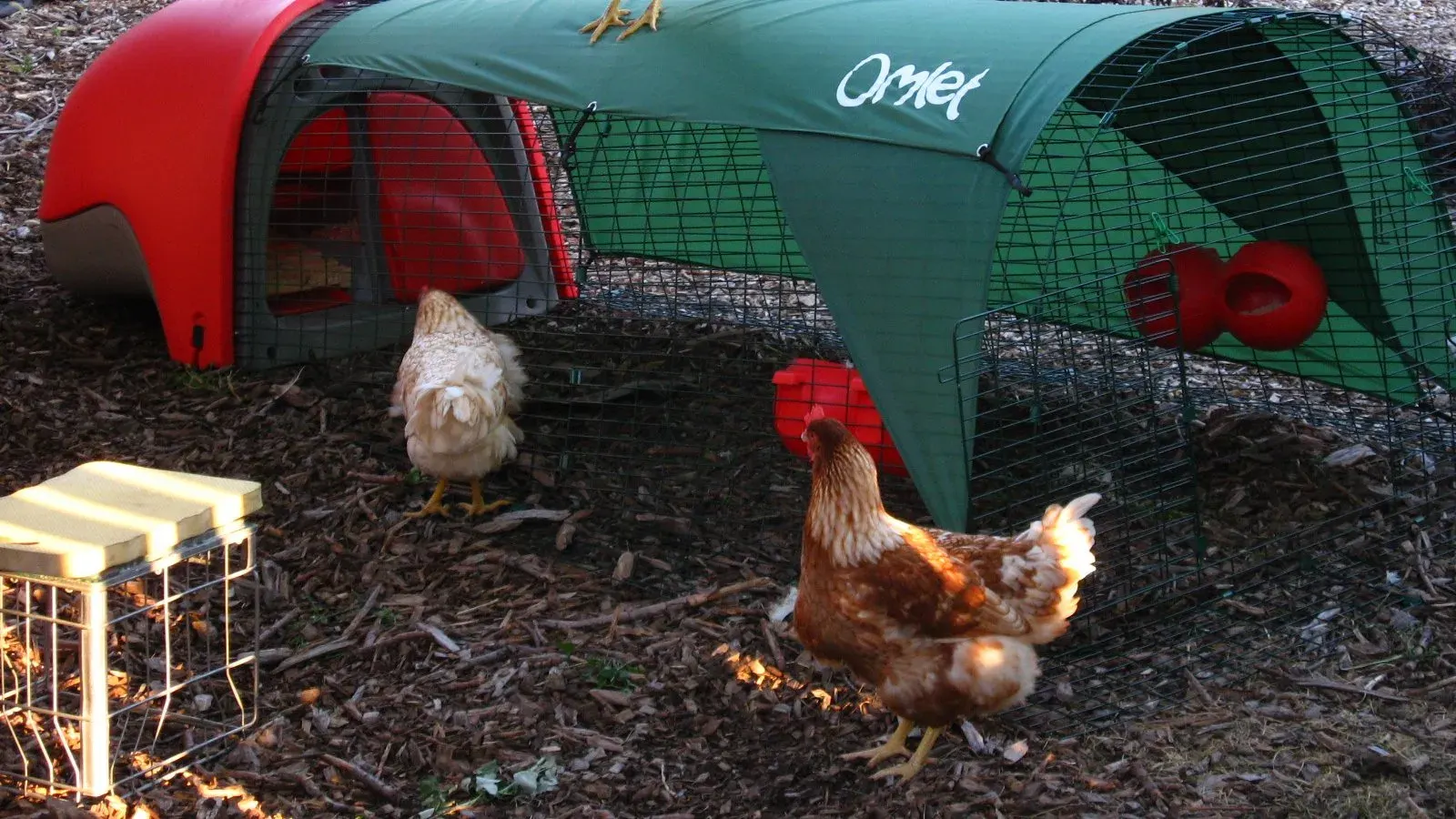
A run is the part of a chicken setup that gets used every hour of daylight, and it is usually the part people buy last and cheapest. That order is backwards. Your birds spend far more of their lives in the run than in the coop.
We compared six covered runs on four things. Square feet per bird, using the eight to ten square feet guideline. Roof shape, because the cover is what fails first and shape decides whether water pools on it. Frame finish, because galvanised steel and powder-coated mild steel age completely differently. And headroom, because a run you cannot stand up in stops getting cleaned within a couple of months.
Note before you read the picks: none of these is predator proof out of the box. Every one uses welded wire rather than hardware cloth, and none has any dig defence. That is normal for the category, and we have explained what to add.
Our picks at a glance
Every product below wins one specific situation. Pick the row that matches your flock, your yard and your budget rather than reading top to bottom.
-
Best Overall

Aoxun 10x6.4 ft Run
A typical backyard flock of eight to ten hens that needs a covered, walk-in daytime run at a sensible price.
-
Best Large Flock Run
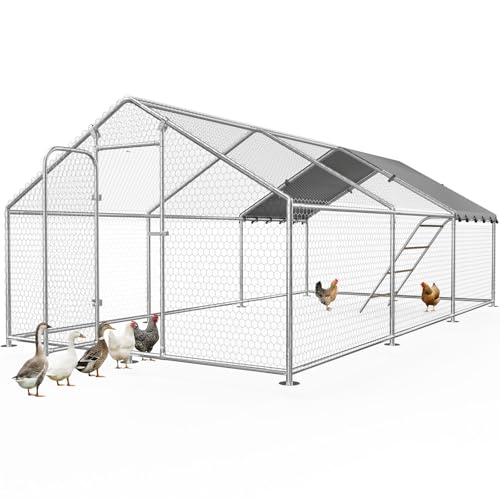
Xbrigh 20x10 ft Run
Flocks of fifteen to twenty-five birds on a smallholding or large garden where floor area matters more than footprint.
Check price on Amazon for 20x10 FT Extra Large Metal Chicken Coop, Walk-in Poultry Run Pen on AmazonAbout $199 checked Aug 8, 2026
-
Best Walk-In Value

LEVELEVE Walk-In Run
Keepers who want to be able to stand up inside their run and are working to a tight budget.
-
Best for Snow and Rain
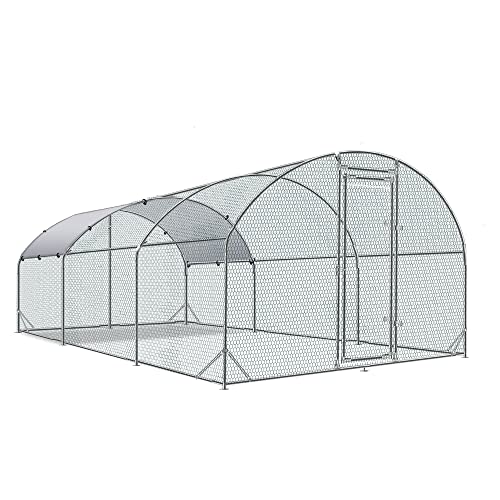
Betterhood Round Top
Keepers in snow country or high-rainfall areas who need a run cover that will still be intact after winter.
-
Best Compact Walk-In
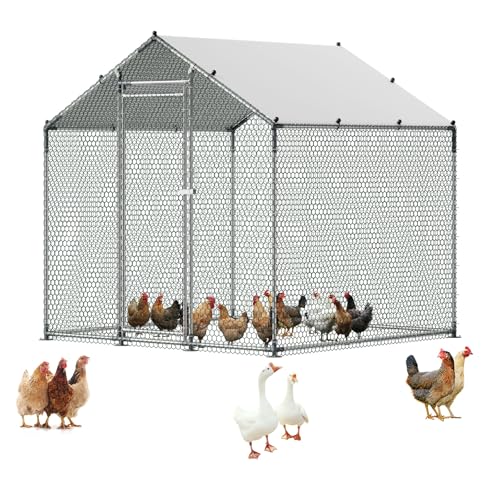
VEVOR 6.5 ft Cube Run
Small suburban flocks of five or six hens where the available space is a square corner rather than a long strip.
-
Best Starter Run

NUGRIART 83 in Run
Extending a small coop's daytime area for two or three birds, or as a temporary grow-out pen for young stock.
Compare every pick side by side
Swipe the table sideways to see every column on a phone.
| Product | Award | Price band | Footprint | Walk In Height | Frame | Bird Capacity | Best use case | Buy link |
|---|---|---|---|---|---|---|---|---|
| Aoxun 10x6.4 ft Run | Best Overall | $120 to $250 | About 10 x 6.4 ft | 6.4 ft peak | Galvanised steel tube | 8 to 10 standard hens | A typical backyard flock of eight to ten hens that needs a covered, walk-… | Check price for Aoxun Metal Chicken Coop, Outdoor Chicken Runs for Yard with Cover, Spire Roof Hen House Enclosure with Security Lock, Walk-in Cage Peak Hen House for Yard Farm (10x6.5x6.4 FT) on Amazon |
| Xbrigh 20x10 ft Run | Best Large Flock Run | $120 to $250 | About 20 x 10 ft | 6.4 ft peak | Galvanised steel tube | 20 to 25 standard hens | Flocks of fifteen to twenty-five birds on a smallholding or large garden… | Check price for 20x10 FT Extra Large Metal Chicken Coop, Walk-in Poultry Run Pen on Amazon |
| LEVELEVE Walk-In Run | Best Walk-In Value | $60 to $120 | About 9.8 x 6.6 ft | 6.6 ft | Galvanised steel tube | 8 to 10 standard hens | Keepers who want to be able to stand up inside their run and are working… | Check price for Large Walk-in Chicken Coop with Chicken Run, Galvanized Poultry Enclosure with Waterproof Anti-UV Cover and Security Lock, Ideal for Rabbit, Duck, Backyard and Farm Yard,9.8'x 6.6'x 6.6' on Amazon |
| Betterhood Round Top | Best for Snow and Rain | $120 to $250 | About 19 x 9 ft | 6.5 ft | Tri-supporting galvanised steel | 18 to 22 standard hens | Keepers in snow country or high-rainfall areas who need a run cover that… | Check price for Large Metal Chicken Coop Round Top Upgrade Tri-Supporting Wire Mesh Chicken Run,Chicken Pen with Water-Resident and Anti-UV Cover,Duck Rabbit House Outdoor(19'L x 9'W x 6.5'H) on Amazon |
| VEVOR 6.5 ft Cube Run | Best Compact Walk-In | $60 to $120 | About 6.6 x 6.6 ft | 6.6 ft | Galvanised steel tube | 5 to 7 standard hens | Small suburban flocks of five or six hens where the available space is a… | Check price for VEVOR Metal Chicken Coop, 6.56x6.56x6.56ft Large Walk-in Chicken Runs with Cover, Spire Roof Hen House Enclosure with Security Lock, Outdoor Duck Rabbit Cage Poultry Pen for Backyard, Farm, Yard on Amazon |
| NUGRIART 83 in Run | Best Starter Run | $60 to $120 | About 6.9 x 3.2 ft | 2.8 ft, not walk-in | Powder-coated steel | 2 to 3 standard hens | Extending a small coop's daytime area for two or three birds, or as a tem… | Check price for NUGRIART Metal Chicken Coop 83"×38" Chicken Run with Waterproof Cover Portable Poultry Cage Walk in Hen House Outdoor Backyard Farm Animal Enclosure Crate Pet Playpen Exercise Pen for Rabbit Duck on Amazon |
The full reviews
Each review below follows the same order: what it is, why it won its category, how it behaves in real use, and who should buy something else.
1 Best Overall
Aoxun Metal Chicken Coop, Outdoor Chicken Runs for Yard with Cover, Spire Roof Hen House Enclosure with Security Lock, Walk-in Cage Peak Hen House for Yard Farm (10x6.5x6.4 FT)
The right size for a typical backyard flock at a price that does not force a compromise on the frame, with a spire roof that sheds rain instead of collecting it.
What we liked
- Spire roof shape sheds rain and light snow instead of pooling it
- 64 sq ft suits eight to ten birds at proper run density
- Galvanised tube frame rather than powder-coated mild steel
- Fits a normal backyard without dominating it
What we did not
- Welded wire rather than hardware cloth, so raccoons can still reach through
- The PE cover is a two to three season consumable under UV
- Ground stakes hold it against wind but do nothing about digging
Key specifications
- Dimensions
- 120 x 77 x 76.8 in (L x W x H)
- Colour
- Silvery
- Footprint
- About 10 x 6.4 ft
- Walk In Height
- 6.4 ft peak
- Frame
- Galvanised steel tube
- Cover
- PE waterproof and anti-UV
- Mesh Type
- Welded wire
- Bird Capacity
- 8 to 10 standard hens
Why the Aoxun wins this category
Roof geometry, which sounds like a detail and is not. Flat-topped runs collect water in the middle of the cover, the weight stretches the fabric, and within a season the grommets tear and the whole cover has to be replaced.
A spire shape sends the water off the edges. Combined with 64 square feet, which fits eight to ten birds properly, and a galvanised rather than painted frame, this is the run that gets the important things right at a normal price.
Living with the Aoxun
Six and a half feet of headroom means you walk in. That single fact is why some runs stay clean for years and others quietly stop being raked.
Galvanising matters more than it looks. Powder-coated mild steel chips at the joints during assembly, and rust starts under the paint where you cannot see it until a leg fails.
Where the Aoxun falls short
The mesh is welded wire, not hardware cloth. That stops birds getting out and stops dogs getting in, and it does not stop a raccoon putting a paw through and taking a bird roosting against the side.
The cover is a consumable. Budget for a replacement every two to three seasons, or plan to fit a rigid panel roof later. And as with every run here, nothing addresses digging: the stakes are for wind.
Research based, not hands-on
Assessed on published frame specification, footprint and roof geometry, and compared against the flat-topped and round-topped runs in this comparison.
- Best for
- A typical backyard flock of eight to ten hens that needs a covered, walk-in daytime run at a sensible price.
- Skip it if
- Raccoons are your main predator problem, because the welded wire mesh is the wrong specification for that.
- The limitation to plan around
- A flat-topped run collects water and a pooled cover tears at the grommets. This one is shaped correctly, but the cover is still fabric, and fabric under UV has a life measured in seasons rather than years.
2 Best Large Flock Run
20x10 FT Extra Large Metal Chicken Coop, Walk-in Poultry Run Pen
Two hundred square feet under cover for under a dollar a square foot, which is the cheapest way to give twenty birds the space the guidelines say they need.
What we liked
- About 200 sq ft, enough for twenty to twenty-five birds at proper density
- Lowest cost per square foot of any run in this comparison
- Galvanised steel tube frame throughout
- Long enough that birds genuinely range inside it rather than milling around
What we did not
- Twenty feet by ten needs a large flat area most suburban gardens do not have
- A frame this size is a half-day assembly for two people
- The larger the cover, the more wind load it takes, and this one needs guying in exposed sites
About $199 checked Aug 8, 2026
Key specifications
- Dimensions
- 236.5 x 120.1 x 76.9 in (L x W x H)
- Colour
- Silver
- Footprint
- About 20 x 10 ft
- Walk In Height
- 6.4 ft peak
- Frame
- Galvanised steel tube
- Cover
- PE waterproof
- Mesh Type
- Welded wire
- Bird Capacity
- 20 to 25 standard hens
Why the Xbrigh wins this category
Arithmetic. At roughly 200 square feet this costs less per square foot than anything else here, and for a flock of twenty birds there is no cheaper way to meet the space guideline under cover.
Buying two smaller runs to reach the same area costs considerably more and gives you two sets of doors to manage.
Living with the Xbrigh
At twenty feet long, the birds actually range. In a short run a flock mills around near the door; in a long one they spread out, forage at one end and dust bathe at the other, and the behavioural difference is obvious within a day.
The galvanised tube frame is the same specification as the smaller runs here, which is worth noting because manufacturers often thin the frame as the size goes up.
Where the Xbrigh falls short
Site requirements. Twenty feet by ten is a serious footprint and it needs to be flat along its whole length, or the frame racks and the door stops closing.
Wind is the bigger practical issue. Two hundred square feet of cover is a sail, and in an exposed garden it will lift the whole frame in a gale unless it is guyed down at the corners. The kit ships with ground stakes for the legs, which is not the same thing, and the instructions do not mention guying at all.
Research based, not hands-on
Assessed on published footprint, frame specification and cover area, and compared against the smaller runs here on cost per square foot and wind exposure.
- Best for
- Flocks of fifteen to twenty-five birds on a smallholding or large garden where floor area matters more than footprint.
- Skip it if
- You have a standard suburban lawn, because twenty feet of run will consume most of it.
- The limitation to plan around
- Wind load scales with area, and 200 square feet of fabric cover in an exposed position behaves like a sail. In anywhere windy this needs guying down properly, which is a job the instructions do not cover.
3 Best Walk-In Value
Large Walk-in Chicken Coop with Chicken Run, Galvanized Poultry Enclosure with Waterproof Anti-UV Cover and Security Lock, Ideal for Rabbit, Duck, Backyard and Farm Yard,9.8'x 6.6'x 6.6'
Full standing headroom and 65 square feet for well under a hundred and fifty dollars, which makes it the cheapest run here you can work inside comfortably.
What we liked
- 6.6 ft of headroom throughout rather than only at the ridge
- Galvanised welded wire rather than plain steel mesh
- Around 65 sq ft covers eight to ten birds properly
- Cheapest genuine walk-in in this comparison
What we did not
- Straight-sided profile means the roof cover holds water unless you tension it hard
- No hardware cloth anywhere, so it is a containment run rather than a secure one
- The door frame is the flimsiest part and will need reinforcing if used daily
Key specifications
- Dimensions
- 117.6 x 78.72 x 78.72 in (L x W x H)
- Colour
- Silver
- Footprint
- About 9.8 x 6.6 ft
- Walk In Height
- 6.6 ft
- Frame
- Galvanised steel tube
- Cover
- Waterproof cover
- Mesh Type
- Galvanised welded wire
- Bird Capacity
- 8 to 10 standard hens
Why the LEVELEVE wins this category
Headroom for money. Plenty of runs claim to be walk-in and give you 6.6 feet only at the ridge, so you are stooping everywhere except a narrow line down the middle. This one keeps the height across the width.
At under a hundred and fifty dollars for 65 square feet of that, it is the cheapest run here you can genuinely work inside.
Living with the LEVELEVE
Being able to stand changes the job. Raking, moving feeders, catching a bird that needs checking: all of it happens at normal working height rather than on your knees.
The galvanised mesh is a real upgrade over plain steel wire, which starts rusting where it is cut and eventually leaves sharp ends at bird height.
Where the LEVELEVE falls short
The straight-sided profile makes the roof close to flat, and a flat fabric cover collects water. Once a pool forms, the weight stretches the fabric and the cover starts to sag permanently, which makes the next pool worse. Keeping it properly tensioned is an ongoing job rather than a one-time setup.
The door frame is the component we would watch. It is the lightest part of the structure and it is the part that gets used several times a day. Adding a couple of angle brackets at the hinge side when you build it is fifteen minutes well spent.
Research based, not hands-on
Assessed on published height, footprint, frame and mesh specification, and compared against the pitched-roof runs in this guide on cover behaviour.
- Best for
- Keepers who want to be able to stand up inside their run and are working to a tight budget.
- Skip it if
- You need real predator resistance out of the box, or you get heavy rain and cannot check the cover tension regularly.
- The limitation to plan around
- The door is the weak component. It is the part of a run used several times a day, and this frame is light enough that daily use will work the hinge fixings loose within a season unless you reinforce them.
4 Best for Snow and Rain
Large Metal Chicken Coop Round Top Upgrade Tri-Supporting Wire Mesh Chicken Run,Chicken Pen with Water-Resident and Anti-UV Cover,Duck Rabbit House Outdoor(19'L x 9'W x 6.5'H)
A round-top profile with tri-supporting bracing, which is the shape and structure that survives a wet winter without the cover pooling or the frame sagging.
What we liked
- Round-top profile sheds snow and rain more reliably than any other shape here
- Tri-supporting bracing spreads roof load across three points rather than one ridge
- About 170 sq ft handles a flock of fifteen or more
- Nineteen feet long, so birds range rather than mill about
What we did not
- The curved frame makes assembly noticeably fiddlier than a straight-sided run
- Welded wire only, with no hardware cloth on any face
- A curved profile is harder to attach a rigid roof panel to later if you want to upgrade
Key specifications
- Dimensions
- 228.1 x 108 x 78 in (L x W x H)
- Colour
- 19'L x 9'W x 6.5'H
- Footprint
- About 19 x 9 ft
- Walk In Height
- 6.5 ft
- Frame
- Tri-supporting galvanised steel
- Cover
- Round-top waterproof cover
- Mesh Type
- Welded wire
- Bird Capacity
- 18 to 22 standard hens
Why the Betterhood wins this category
Because in a wet or snowy climate the roof is what fails, not the frame. Water pools on flat covers, the pool stretches the fabric, and the stretched fabric holds a bigger pool next time. Snow is worse: a few inches of wet snow on a flat span is enough to bend a light tube frame permanently.
A round top does two things at once. It gives the snow nowhere to sit and it puts the frame members in a shape that resists downward load.
Living with the Betterhood
Tri-supporting bracing is the second half of the design. Rather than loading a single ridge, the roof load is spread across three lines, which is why this holds shape under weight when straight-sided frames of the same gauge do not.
At nineteen feet long with around 170 square feet, it houses a flock of fifteen comfortably and gives them the length to actually move.
Where the Betterhood falls short
Assembly is the immediate cost. Curved tube sections have to go together in the right order and in the right orientation, and getting it wrong means taking a section back apart. Budget more time than a straight-sided run of the same size.
The longer-term limitation is that the curve locks you into fabric. Many people eventually upgrade a run by screwing corrugated panels to the roof frame, which ends the cover replacement cycle for good. You cannot do that on a curve.
Research based, not hands-on
Assessed on the published frame geometry and bracing, cover area and footprint, and compared against the flat and pitched profiles in this comparison.
- Best for
- Keepers in snow country or high-rainfall areas who need a run cover that will still be intact after winter.
- Skip it if
- You want the option to fit corrugated roof panels later, because the curved frame does not take flat sheets.
- The limitation to plan around
- You are locked into fabric covers. The curve is what makes it shed weather well, and it is also what stops you ever fitting rigid roofing, so every few seasons you are buying another cover rather than upgrading permanently.
5 Best Compact Walk-In
VEVOR Metal Chicken Coop, 6.56x6.56x6.56ft Large Walk-in Chicken Runs with Cover, Spire Roof Hen House Enclosure with Security Lock, Outdoor Duck Rabbit Cage Poultry Pen for Backyard, Farm, Yard
A 6.5 foot cube that gives five to seven birds proper run space and full standing height in a footprint that fits an ordinary suburban garden corner.
What we liked
- Square footprint means birds can circle away from each other rather than reversing
- Full 6.6 ft height in a 43 sq ft footprint
- Galvanised steel frame throughout
- Small enough to site in a garden corner without dominating it
What we did not
- 43 sq ft caps the flock at five to seven birds at proper density
- Costs more per square foot than the larger runs here
- Welded wire only, with the same reach-through vulnerability as the rest of this class
Key specifications
- Dimensions
- 78.72 x 78.72 x 78.72 in (L x W x H)
- Weight
- 44.09 pounds
- Colour
- Silver - Spire Roof
- Footprint
- About 6.6 x 6.6 ft
- Walk In Height
- 6.6 ft
- Frame
- Galvanised steel tube
- Cover
- PE waterproof
- Mesh Type
- Welded wire
- Bird Capacity
- 5 to 7 standard hens
Why the VEVOR cube wins this category
Shape, and it matters more than the area figure suggests. A square run lets a bird being chased circle away. A long narrow run of the same area forces it to run in a straight line until it hits the end. For a small flock in a confined space, the square footprint produces a calmer group.
Full standing height in a 43 square foot footprint is the other reason: this fits places a long run does not.
Living with the VEVOR cube
Six and a half feet of headroom in a small run means it is genuinely easy to work in. You can hang a feeder, reposition a waterer and rake the floor without leaving the structure.
The galvanised frame is the same specification as the bigger runs from the same maker, which is not always true when a range scales down.
Where the VEVOR cube falls short
Cost per square foot is the highest of any walk-in run here. You are paying for the frame, the door and the cover, and those costs barely change with size, so a small run distributes them across fewer square feet.
The harder limitation is that it does not grow. Rectangular runs can often be extended with a second bay of frame; a cube cannot. If there is any chance your flock goes past seven birds, buy the larger run now rather than owning two separate structures later.
Research based, not hands-on
Assessed on the published footprint, height and frame specification, and compared against the longer rectangular runs here on shape and cost per square foot.
- Best for
- Small suburban flocks of five or six hens where the available space is a square corner rather than a long strip.
- Skip it if
- You have or intend to have more than seven birds, because there is no way to extend a cube frame.
- The limitation to plan around
- There is no growth path. A cube frame cannot be extended, so if the flock grows past seven you are buying a second run rather than adding a bay to this one.
6 Best Starter Run
NUGRIART Metal Chicken Coop 83"×38" Chicken Run with Waterproof Cover Portable Poultry Cage Walk in Hen House Outdoor Backyard Farm Animal Enclosure Crate Pet Playpen Exercise Pen for Rabbit Duck
A low, cheap, movable pen that gives two or three birds a covered patch of grass. It is a daytime extension, not a run you would ever leave birds in overnight.
What we liked
- Cheapest option here by a wide margin
- Light enough for one person to lift and reposition onto fresh grass
- Waterproof cover included rather than sold separately
- Small enough to fit alongside an existing coop without rearranging the garden
What we did not
- At 2.8 ft high you have to kneel and reach in for everything
- Powder-coated rather than galvanised steel, so chips at the joints will rust
- Light frame and welded wire make it unsuitable as overnight protection
Key specifications
- Dimensions
- 83 x 38 x 34 in (L x W x H)
- Colour
- Black
- Footprint
- About 6.9 x 3.2 ft
- Walk In Height
- 2.8 ft, not walk-in
- Frame
- Powder-coated steel
- Cover
- Waterproof cover
- Mesh Type
- Welded wire
- Bird Capacity
- 2 to 3 standard hens
Why the NUGRIART wins this category
Because sometimes the right purchase is a small, cheap, movable pen rather than a structure. Two or three birds, a coop that already exists, and a patch of lawn you want them on for the afternoon: this does that job for less than any walk-in run here, and for well under half what the large ones cost.
It is also light enough that one person moves it, which means the grass under it recovers.
Living with the NUGRIART
The waterproof cover is included, which is not universal at this price, and it means the pen is usable in rain rather than only on dry days.
Repositioning takes seconds. That is genuinely the best feature: birds get fresh forage, the lawn gets manure spread thinly instead of concentrated, and nothing goes bare.
Where the NUGRIART falls short
Height, and it shapes everything about ownership. At 34 inches you kneel for every task. Water a bird, catch a bird, rake the floor, retrieve an egg: all of it is done on your knees, reaching. Runs like this get cleaned diligently for about two months.
The finish is the other compromise. Powder-coated mild steel chips during assembly, and rust starts at the chips. Galvanised frames do not have that failure mode.
And the frame is light. In a garden with foxes or loose dogs, this pen is for supervised daytime use, not for leaving birds in unattended.
Research based, not hands-on
Assessed on the published height, footprint, frame finish and mesh specification, and compared against the walk-in runs in this guide on maintenance access.
- Best for
- Extending a small coop's daytime area for two or three birds, or as a temporary grow-out pen for young stock.
- Skip it if
- You need a run you can walk into, or somewhere birds will be left unattended overnight.
- The limitation to plan around
- At under three feet high, every task inside means kneeling and reaching. That is why runs like this stop getting cleaned properly after a couple of months, and it is the reason we would not use one as a primary enclosure.
How we compared these runs
We took every covered metal run currently listed, converted the stated dimensions into usable floor area, and calculated cost per square foot across the field. That single number reorders the category quite dramatically, because small runs carry the same fixed costs for frame, door and cover as large ones.
We then scored each on roof profile, frame finish, mesh specification and headroom, and looked at the failure reports for each construction type. Runs that were functionally identical relistings of one another were consolidated.
What actually matters in a chicken run
Square feet per bird
Eight to ten per standard hen, five for bantams. Work it out from the stated footprint rather than the bird count on the listing, which is almost always optimistic.
Shape matters alongside area. A square run of 40 square feet behaves better than a corridor of 40 square feet, because a bird being chased can circle away rather than being driven into a dead end.
Roof profile
This is the specification that decides how long your cover lasts, and almost nobody checks it.
Flat covers pool water. The pool stretches the fabric, the stretched fabric holds more water, and the cycle ends with torn grommets. Pitched and round-top profiles shed, and their covers routinely last twice as long. In snow country the shape is a structural question rather than a cosmetic one, because wet snow on a flat span will bend a light frame permanently.
Frame finish
Galvanised steel is coated through. Powder-coated mild steel is painted, and paint chips during assembly, usually at the joints where the tubes are hammered together. Rust starts at those chips and spreads underneath the coating where you cannot see it.
At the same price, galvanised is always the better buy.
Headroom
A run you can stand up in gets cleaned. A run you have to kneel in stops getting cleaned, usually around month three. This is not about comfort, it is about whether the maintenance actually happens over years.
Mesh, and what to add
Every run in this category ships with welded wire, typically one by two inches. That is a containment specification, not a security one.
The two upgrades that matter are half-inch hardware cloth over the lower three feet, and an 18 inch apron of the same mesh laid flat on the ground around the outside and pegged down. Together they cost a fraction of the run and change its predator resistance completely.
Ground, drainage and litter
The ground under a fixed run is the thing most people get wrong. Grass will not survive under standing birds at any sensible density, so plan for what replaces it from the start.
Coarse wood chips laid four to six inches deep is the most forgiving option. It drains, it composts slowly, it gives the birds something to scratch through, and it can be topped up rather than replaced. Coarse sand is the alternative where drainage is poor, though it needs raking rather than composting and does not break manure down.
Whatever you choose, get water away from the surface. Almost every complaint about smell and mud in a run is a drainage complaint wearing a different hat.
Final recommendation
The Aoxun 10x6.4 ft Run is the best buy for a typical backyard flock: 64 square feet, a spire roof that sheds water, a galvanised frame and a price that leaves budget for the hardware cloth upgrade.
For fifteen birds or more, the Xbrigh 20x10 ft Run is unbeatable on cost per square foot. In snow country the Betterhood Round Top is the shape that survives winter. And if the money is tight but you still want to stand up inside, the LEVELEVE Walk-In Run is the cheapest way to do that.
Questions people ask before buying
How much run space does each chicken need?
Eight to ten square feet per standard-size hen if the run is their only daytime space. Bantams need around five. Birds that free range for most of the day can manage with less, because the run becomes a shelter rather than their whole environment. Below about six square feet per bird in a permanent run you should expect boredom behaviours, and feather picking is the usual first sign.
Does a chicken run need a roof?
A cover makes a large practical difference even where predators are not a concern. It keeps the ground dry, which stops the run turning to mud in the weeks when the birds most need to be outside, and it excludes wild bird droppings, which are a main route for disease into a backyard flock. In hawk country a covered top is a straightforward safety requirement rather than a convenience.
Can I put a chicken run on grass?
Only if you move it. A fixed run on grass will be bare soil within one to two weeks and sour mud within a month, at any realistic stocking density. For a fixed run the usual answers are a deep litter of wood chips or straw that you top up and turn, or a base of coarse sand that drains. Both work far better than trying to keep grass alive under standing birds.
How do I stop a chicken run from smelling?
Smell in a run is almost always a drainage problem rather than a cleaning problem. Wet manure smells and dry manure does not. Fixing it means getting water away from the surface, usually with a deep layer of coarse wood chips that lets moisture drain through and gives the droppings something carbon-rich to break down into. Raking that layer weekly and topping it up seasonally is more effective than washing anything.
Are welded wire runs safe from predators?
Not on their own. Welded wire stops birds getting out and stops dogs getting in, and it does not stop a raccoon reaching through a one by two inch aperture to grab a bird resting against the side, nor anything digging under the frame. The standard upgrades are half-inch hardware cloth over the lower three feet, and an 18 inch apron of the same mesh laid flat on the ground around the perimeter.
How long do the covers on metal chicken runs last?
Two to three seasons for standard PE sheeting, and longer for covers described as anti-UV. Failure is usually not a tear from wind but progressive stretching, where water pools in a sagging area, the weight stretches it further, and eventually the grommets pull through. Roof shape matters more than material: pitched and round-top runs shed water and last noticeably longer than flat ones.
Why you can trust this guide
- Written by
- Sam Reddick, Lead gear reviewer, Chicken Geek. Specialist areas: Coop design and predator proofing, Feeding and watering systems, Cold-weather flock management, Incubation and brooding.
- Fact checked by
- Marta Voss
- Published
- August 6, 2026 · Last updated August 6, 2026 · Products and links rechecked August 6, 2026
- How we picked
- Runs were compared on floor area per bird against the 8 to 10 sq ft guideline, roof profile and how it handles pooled water or snow, frame finish, mesh specification and internal headroom. Cost per square foot was calculated across the whole field.
- Evidence used
- None of the 6 products on this page were sent to us or bought for a hands-on test. Every recommendation here is research based: manufacturer specifications, listed dimensions and materials, owner feedback at volume, and comparison against equipment our team has owned. Each review states this again above the buy button so you are never guessing which kind of evidence sits behind a pick.
- Editorial standards
- No brand pays for placement, and no manufacturer sees this page before it goes live. Read our editorial policy and testing method.
- Affiliate disclosure
- Chicken Geek is reader supported. We earn a commission from qualifying purchases made through links on this page, at no extra cost to you, and no brand has paid for a placement or an award here.
About the author

Lead gear reviewer, Chicken Geek
Sam has kept a backyard laying flock for eleven years, through two coop rebuilds, one very determined raccoon and several winters cold enough to freeze a waterer solid overnight. He writes the buying guides at Chicken Geek and is responsible for how products get compared.
- Eleven years keeping a mixed laying flock of 8 to 14 birds
- Has built, bought and replaced six different coops
- Runs the product comparison framework used across Chicken Geek
- Reads manufacturer manuals, spec sheets and warranty terms before every recommendation