We Compared 6 Hardware Cloth Rolls on Coating, Mesh and Gauge
We compared six hardware cloth rolls on coating method, mesh size and gauge, because when the zinc went on decides whether a roll rusts at every weld joint.

By Sam Reddick Lead gear reviewer, Chicken Geek
Fact checked by Marta Voss
Published Prices and stock checked 7 min read

Hardware cloth is the part of a coop that has to work every single night. It is the barrier between your flock and every raccoon, weasel, rat and snake in the neighbourhood, and most people buy it on price per foot and nothing else.
The specification that decides how long a roll lasts is not the gauge and it is not the mesh size. It is when the zinc went on. Welding burns coating off the steel, so mesh that was galvanised before welding has bare metal at every intersection, and every intersection is where rust starts. Mesh hot-dipped after welding has zinc over the welds as well as the wire. Three of the six rolls here state hot-dipped after welding on the listing. Two say only galvanised and never name a method, and we treat that silence as information rather than guessing what it means.
The rest of this guide covers the things that decide whether the mesh does its job at all: why half-inch openings stop a raccoon paw when one-inch chicken wire does not, where 19 gauge sits, and why an apron laid flat on the ground beats digging a trench.
Our picks at a glance
Every product below wins one specific situation. Pick the row that matches your flock, your yard and your budget rather than reading top to bottom.
-
Best Overall

Amagabeli 1/2 in 48x100
Anyone building or re-skinning a run who wants one roll to do the walls, the roof and the apron.
-
Best Value Full Roll
MeshFort Hot-Dipped
Anyone covering a whole run who wants the top coating specification without paying a brand premium for it.
-
Best for Vents and Windows

Gardeal 16 in x 50 ft
Screening the vents, windows and gaps on an existing coop without buying 400 square feet of mesh.
-
Best Looking

Yardbliss Black Mesh
Runs in a visible part of a garden, or anyone photographing their setup, who wants the mesh to recede.
-
Best for Small Repairs

YARDGARD 24 in x 25 ft
Keepers who already have a finished run and want a repair roll on hand before something goes wrong.
-
Best Budget

Hunka 1/2 in 48x100
Buyers covering a large area on a tight budget who need the physical specification more than the coating paperwork.
Check price on Amazon for Hunka 19 Gauge Hardware Cloth, 1/2 inch 48inch×100ft Chicken Wire Fence on AmazonAbout $79.37 checked Aug 8, 2026
Compare every pick side by side
Swipe the table sideways to see every column on a phone.
The full reviews
Each review below follows the same order: what it is, why it won its category, how it behaves in real use, and who should buy something else.
1 Best Overall
Amagabeli Hardware Cloth 1/2 inch 48 x 100 ft 19 Gauge Chicken Wire Fence Hot-Dipped Galvanized After Welding Welded Wire Fencing Mesh Roll Plant Support Gopher Snake Rodent Rabbit Poultry Netting
Half-inch mesh in 19 gauge steel, hot-dipped galvanised after welding, in a 400 square foot roll. It is the standard poultry specification with the one detail that decides how long it lasts stated plainly on the listing.
What we liked
- Coating is stated as hot-dipped after welding, so the weld joints carry zinc too
- Half-inch openings stop a raccoon paw and a weasel, which one-inch netting does not
- 19 gauge is heavy enough to resist an animal working at it with its hands
- 400 sq ft covers a small run and leaves enough for a ground apron
What we did not
- MeshFort states the same half-inch, 19 gauge, hot-dipped after welding specification in the same roll size at a lower recorded price
- A 100 ft roll of 19 gauge steel is heavy and springy, so unrolling it straight really needs two people
- 48 in width is the wrong shape for vents and patches, and every cut you make leaves bare steel
Key specifications
- Dimensions
- 48 x 10 x 10 in (L x W x H)
- Colour
- Silver
- Mesh Size
- 1/2 in
- Gauge
- 19 gauge
- Roll Size
- 48 in x 100 ft
- Coating
- Hot-dipped galvanised after welding
- Coverage
- 400 sq ft
Why the Amagabeli 1/2 in 48x100 wins this category
Because it does not leave you guessing about the thing that matters. The listing names hot-dipped galvanised after welding, which means the sheet went into the zinc after the wires were joined and the weld points are covered.
That is the difference between mesh that weathers evenly and mesh that grows a rust dot at every intersection three or four years in. Half-inch openings and 19 gauge wire are the easy part of the specification. The coating order is where products actually separate.
Living with the Amagabeli 1/2 in 48x100
At 48 inches by 100 feet you get 400 square feet, which is a genuinely useful quantity. A small run in mesh, the roof panel over it, and an 18 inch apron pegged flat around the base all come out of one roll, and buying it as one roll costs less per square foot than buying the same area in short lengths.
The width is the other quiet advantage. A 48 inch panel spans the height of most run walls in one piece, so there is no horizontal seam halfway up for something to work at.
Where the Amagabeli 1/2 in 48x100 falls short
Price is the honest one. The MeshFort roll states the same half-inch, 19 gauge, hot-dipped after welding specification in the same 48 in by 100 ft size at a lower recorded price, so you are paying a premium here for the more established brand rather than for a better product.
The roll is also awkward to handle alone. A hundred feet of 19 gauge steel is heavy, springy and wants to roll itself back up, and a second pair of hands makes the difference between straight panels and wavy ones.
The width also works against small jobs, since screening a vent means cutting into a 48 inch sheet and creating offcuts with bare edges.
Research based, not hands-on
Assessed on the stated coating method, mesh opening, gauge and roll dimensions, and compared against the other rolls in this guide on coverage and price per square foot.
- Best for
- Anyone building or re-skinning a run who wants one roll to do the walls, the roof and the apron.
- Skip it if
- You only need to screen two vents, because you would be paying for 400 sq ft to use about 6 of it.
- The limitation to plan around
- Every cut you make exposes bare steel that no coating method protects, so plan panels around factory edges and paint the cut ends on anything you want to last a decade.
2 Best Value Full Roll
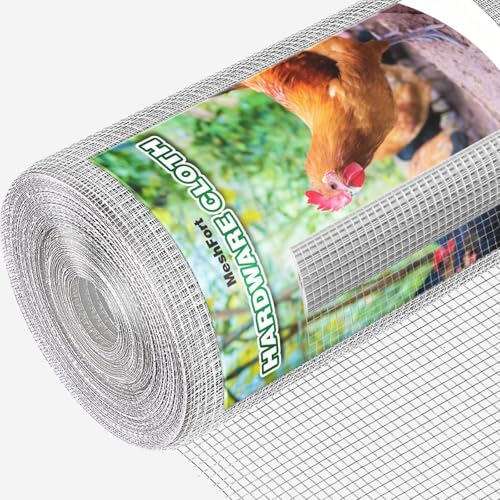
MeshFort Hardware Cloth 1/2 Inch 48 x 100 ft 19 Hot - Dipped Galvanized After Welding. Ideal for Chicken, Rabbit, Snake Cages and Fencing
The same half-inch, 19 gauge, hot-dipped galvanised after welding specification as our top pick, in the same 48 in by 100 ft size, at the lowest recorded price of any full roll here.
What we liked
- States hot-dipped galvanised after welding, the coating claim that matters most
- Works out around 20 cents per square foot at the price recorded, the best rate here
- 48 in width spans a run wall in one piece with no horizontal seam
- Half-inch mesh in 19 gauge is the accepted poultry standard, not a light garden mesh
What we did not
- Sold only as a 400 sq ft roll, so a single vent repair means buying far more than you need
- A smaller brand than the alternatives, so replacement rolls may not match if you extend later
- 100 ft of 19 gauge steel is heavy and springy, and unrolling it straight is a two person job
Key specifications
- Dimensions
- 49.2 x 9.84 x 9.83 in (L x W x H)
- Colour
- Silver
- Mesh Size
- 1/2 in
- Gauge
- 19 gauge
- Roll Size
- 48 in x 100 ft
- Coating
- Hot-dipped galvanised after welding
- Coverage
- 400 sq ft
Why the MeshFort Hot-Dipped roll wins this category
Because on paper it gives up nothing. Half-inch mesh, 19 gauge wire, 48 inches by 100 feet, and hot-dipped galvanised after welding written into the listing title. That is the same set of numbers as our overall pick, at the lowest price per square foot of any full roll on this page.
Value in this category usually means accepting a thinner wire or a vaguer coating claim. This does not ask you to do either.
Living with the MeshFort Hot-Dipped roll
Four hundred square feet is the right quantity for a build rather than a repair. Walls, a covered roof and a ground apron around the base come out of one roll, which is also the cheapest way to buy the mesh you need for the apron, the part most people skip because they are trying not to buy a second roll.
The 48 inch width is what makes the panels tidy. Most run walls are under four feet, so each bay is one uncut piece with factory edges top and bottom.
Where the MeshFort Hot-Dipped roll falls short
Size is the constraint. There is one option here and it is a big one, so if your job is two windows and a pop door vent you are buying 400 square feet to use a few, and storing the rest somewhere it will not sit in the wet.
Brand continuity is the second thing to think about. Smaller sellers come and go, and if you extend the run in two years you may not be able to buy a matching roll.
Handling is genuinely awkward. A full roll of 19 gauge steel has a lot of stored spring in it, and it will try to close back up on you while you staple.
Research based, not hands-on
Assessed on the stated coating method, mesh opening, gauge and roll dimensions, with price per square foot calculated against the other full rolls in this guide.
- Best for
- Anyone covering a whole run who wants the top coating specification without paying a brand premium for it.
- Skip it if
- You need mesh in small quantities or in a narrow width, because this comes in one large size only.
- The limitation to plan around
- The saving only exists at full roll scale. Buy this for a vent or a patch and the price per square foot you actually use is worse than a small roll.
3 Best for Vents and Windows
Gardeal 16in x 50ft 19 Gauge 1/2 Inch Hardware Cloth - Double Hot-Dipped Galvanized After Welding Steel Mesh - Duty Rust Proof Fencing for Gardens, Chicken Coops & Poultry Animal Netting Cage Screen
A 16 inch wide roll that is the right shape for the jobs a 48 inch roll is wrong for, with a double hot-dipped galvanised after welding coating stated on the listing.
What we liked
- 16 in width suits vents, windows and the bottom strip of a fence without cutting a wide roll down
- States double hot-dipped galvanised after welding, so the weld joints are covered
- 66 sq ft is a sensible quantity for screening the openings on one coop
- Narrow roll is light enough to handle and staple on your own
What we did not
- Works out around 36 cents per square foot, well above the 20 cents of a full roll
- 16 in width means a horizontal seam on any run wall, and seams are where panels get worked at
- 50 ft length runs out fast if you decide to skirt the whole perimeter
Key specifications
- Dimensions
- 600 x 0.032 x 16 in (L x W x H)
- Colour
- slivery
- Mesh Size
- 1/2 in
- Gauge
- 19 gauge
- Roll Size
- 16 in x 50 ft
- Coating
- Double hot-dipped galvanised after welding
- Coverage
- 66 sq ft
Why the Gardeal 16 in x 50 ft wins this category
Because most predator proofing jobs on an existing coop are narrow ones. A gable vent, a window, the gap under the eaves, the strip along the bottom of a fence where something has been digging. None of those want a 48 inch roll.
Buying the right width means you cut two edges instead of four, and every edge you do not cut is one less line of bare steel to rust. It also means less mesh sitting in the shed afterwards.
Living with the Gardeal 16 in x 50 ft
The coating claim is the strongest on this page in wording, double hot-dipped galvanised after welding, which puts it in the same top group as the two full rolls we recommend rather than in the vague galvanised group.
Weight makes a real difference on this kind of work. A narrow roll can be held against a window frame with one hand while you drive a staple with the other, where a full width roll needs someone else or a lot of clamps.
Where the Gardeal 16 in x 50 ft falls short
The price per square foot is the trade. At the figures recorded this is roughly 36 cents a square foot against about 20 cents for a full roll, so it is an expensive way to cover any large area.
The width also puts a hard ceiling on what it can do. A four foot run wall in 16 inch strips means two horizontal seams per bay, and a seam held with wire ties is the part a raccoon has the best chance with. Overlap by at least two inches and tie every few inches if you have no other option.
Fifty feet also disappears quickly on a perimeter apron, which is usually a bigger job than people expect.
Research based, not hands-on
Assessed on the stated coating method, mesh opening, gauge and roll dimensions, with price per square foot calculated against the wider rolls in this guide.
- Best for
- Screening the vents, windows and gaps on an existing coop without buying 400 square feet of mesh.
- Skip it if
- You are building a run from scratch, because covering walls in 16 inch strips creates seams and costs more per foot.
- The limitation to plan around
- The width decides the job. Anything taller than 16 inches needs two pieces overlapped and wired together, and that joint is the weakest part of the panel.
4 Best Looking
Yardbliss Black Hardware Cloth 1/2inx48inx100ft, 19GA, Chicken Wire Fencing Roll, Black Chicken Wire Mesh, Vinyl PVC Coated Welded Wire Mesh for Chicken Coop Barrier, Rabbit Snake Poultry Fences
Galvanised mesh with a black PVC coat over it, which makes a run visually disappear instead of reading as a bright silver grid across the garden.
What we liked
- Black vinyl reads as shadow from a distance, so the run stops dominating the view
- The vinyl layer adds a second barrier over the steel wherever it stays intact
- Full 48 in x 100 ft roll covers 400 sq ft, enough for walls, roof and apron
- Same half-inch, 19 gauge poultry specification as the bright rolls here
What we did not
- The listing names the PVC coat but never says when the galvanising was applied
- Vinyl hides the early surface rust you would spot on bright mesh at an annual check
- Every cut leaves a steel edge with no vinyl over it, so offcut edges corrode first
- At 34 pounds it is the heaviest roll here to move and hold in place
Key specifications
- Dimensions
- 7 x 7 x 44 in (L x W x H)
- Weight
- 34 pounds
- Colour
- Black
- Mesh Size
- 1/2 in
- Gauge
- 19 gauge
- Roll Size
- 48 in x 100 ft
- Coating
- Galvanised with black PVC coat
- Coverage
- 400 sq ft
Why the Yardbliss Black Mesh wins this category
Because bright galvanised mesh is the thing people notice about a coop. Silver wire catches light, draws the eye and turns a run into an obvious cage in the middle of a garden.
Black vinyl does the opposite. From ten feet away the mesh reads as shadow and you look through it at the birds instead of at the grid. If the run sits somewhere you look at every day, that is worth something, and the underlying specification is unchanged at half-inch mesh in 19 gauge.
Living with the Yardbliss Black Mesh
The full 48 inch by 100 foot roll is the useful size, covering 400 square feet, so one roll does walls, a covered roof and a ground apron on a small run.
Where the vinyl survives intact it also puts a layer between the steel and the weather. The place to be careful is at staples and screws, because a fixing driven hard through the coating opens a hole in it.
Where the Yardbliss Black Mesh falls short
The coating description is the gap. It says galvanised with a black PVC coat, and it never says whether the galvanising happened before or after welding. Three other rolls on this page do say. We are not going to assume the answer, so treat the base coating here as unknown.
Vinyl also takes away your early warning. On bright mesh you can see the first orange bloom at a weld and act on it. Under black PVC the same corrosion is invisible until the coating lifts, by which point it is well established.
Cutting is the third issue and it applies to every roll, more so here. Snips leave a bare steel end with no zinc and no vinyl, so the cut edges of a black panel are the first place it will go.
Research based, not hands-on
Assessed on the stated coating description, mesh opening, gauge, weight and roll dimensions, and compared against the bright galvanised rolls in this guide.
- Best for
- Runs in a visible part of a garden, or anyone photographing their setup, who wants the mesh to recede.
- Skip it if
- The coating method is your deciding factor, because this listing does not state when the zinc went on.
- The limitation to plan around
- You are buying a finish, not a better barrier. The PVC changes how the run looks and how quickly you notice a problem, and it does not change what the wire underneath was made from.
5 Best for Small Repairs
YARDGARD – 1/2 Inch Mesh Welded Wire Fence Hardware Cloth – 24 in. x 25 ft. 19‑Gauge Galvanized Steel – for Chicken Coops | Garden Protection | Bird and Rabbit Enclosures
A 24 in by 25 ft roll covering 50 square feet, which is the smallest quantity here and the sensible thing to keep in the shed for the night something opens a hole in your run.
What we liked
- 50 sq ft is enough for a patch, a vent screen or a short apron and no more
- 24 in width covers most single openings without a seam
- Small roll is light and easy to store flat until you need it
- Half-inch mesh in 19 gauge, so a repair is as strong as the original panel
What we did not
- Around 57 cents per square foot, close to three times the rate of a full roll
- The listing says galvanised without saying whether it was coated before or after welding
- A stated weight of 0.56 pounds for 50 sq ft of 19 gauge steel cannot be right, so read the rest of that spec sheet carefully
Key specifications
- Dimensions
- 5.43 x 5.43 x 24.01 in (L x W x H)
- Weight
- 0.56 pounds
- Colour
- Silver
- Mesh Size
- 1/2 in
- Gauge
- 19 gauge
- Roll Size
- 24 in x 25 ft
- Coating
- Galvanised, method not stated
- Coverage
- 50 sq ft
Why the YARDGARD 24 in x 25 ft wins this category
Because repairs happen at bad times. Something works a corner loose, a board rots away from the mesh, a vent screen tears, and the job needs doing before dark rather than after a delivery.
Fifty square feet at 24 inches wide is the right thing to have in the shed for that. It covers a full panel between two posts, a pop door surround or a stretch of apron where a fox has been trying, and it does it with the same half-inch, 19 gauge mesh the rest of the run is built from.
Living with the YARDGARD 24 in x 25 ft
A small roll is easy to work with alone. It does not fight you when you unroll it, it can be cut on a bench, and it stores flat behind a door instead of taking up a corner of the shed for years.
Twenty four inches is also a useful width for screening an opening in one uncut piece, or laying a two foot apron where digging has started.
Where the YARDGARD 24 in x 25 ft falls short
The price per square foot is the obvious trade. At about 57 cents against roughly 20 cents on a full roll, this is convenience pricing, and it is only worth paying on small quantities.
The coating wording is the more important gap. It says galvanised and stops there, with no mention of whether the zinc went on before or after the wires were welded. Three rolls on this page do name the method, so the silence is worth noticing rather than filling in.
The listed weight is also not credible. Fifty square feet of 19 gauge steel mesh does not weigh 0.56 pounds, which tells you the spec sheet has at least one error in it and the coating line deserves the same scepticism.
Research based, not hands-on
Assessed on the stated coating wording, mesh opening, gauge and roll dimensions, with price per square foot calculated against the full rolls in this guide.
- Best for
- Keepers who already have a finished run and want a repair roll on hand before something goes wrong.
- Skip it if
- You are covering any real area, because the price per square foot makes a whole run painfully expensive.
- The limitation to plan around
- Twenty five feet goes nowhere on a perimeter. This is a repair quantity, so buy it as a spare rather than as the mesh for a build.
6 Best Budget
Hunka 19 Gauge Hardware Cloth, 1/2 inch 48inch×100ft Chicken Wire Fence
A full 48 in by 100 ft roll of half-inch, 19 gauge mesh at a budget price, with one thing worth saying plainly. The MeshFort roll cost less at the prices we recorded and states a better coating method.
What we liked
- Full 400 sq ft roll, enough for the walls, roof and apron of a small run
- Half-inch mesh in 19 gauge, the same working specification as the pricier rolls here
- 48 in width spans most run walls in one piece with no horizontal seam
- Around 20 cents per square foot, in the cheapest group of rolls on this page
What we did not
- The listing says galvanised and never states whether the coating went on before or after welding
- MeshFort cost less at the prices recorded and does state hot-dipped after welding, so this is beaten on both counts
- Coating uncertainty matters most on a full run build, because you cannot re-skin it cheaply in four years
About $79.37 checked Aug 8, 2026
Key specifications
- Dimensions
- 48 x 9.5 x 9.5 in (L x W x H)
- Colour
- Silver
- Mesh Size
- 1/2 in
- Gauge
- 19 gauge
- Roll Size
- 48 in x 100 ft
- Coating
- Galvanised, method not stated
- Coverage
- 400 sq ft
Why the Hunka 1/2 in 48x100 wins this category
On the physical side it is the budget way to get a full roll. Four hundred square feet of half-inch, 19 gauge welded mesh in a 48 inch width is the specification that actually keeps raccoons and weasels out, and it lands in the cheapest group here at roughly 20 cents a square foot.
If the job is a large run and the budget is fixed, mesh of the correct opening size over the whole structure beats a better roll over half of it and chicken wire over the rest.
Living with the Hunka 1/2 in 48x100
The width and length are the practical strengths. A 48 inch panel covers a run wall without a horizontal seam, and one roll stretches to the walls, a covered top and an 18 inch ground apron on a small build, which is the combination that actually stops digging predators.
It handles like every other full roll: heavy, springy and much easier with a second person on the far end.
Where the Hunka 1/2 in 48x100 falls short
The coating claim is the weak point, and there is a blunter problem alongside it. At the prices we recorded, the MeshFort roll cost less than this one and states hot-dipped galvanised after welding, while this listing says only galvanised. Same mesh, same gauge, same roll size, lower price, clearer coating claim. We are not going to pretend the two are equals.
That leaves a narrow case for buying this. It makes sense when Hunka is discounted below MeshFort on the day you look, or when the MeshFort roll is out of stock and you need the area covered now.
The uncertainty also costs most in exactly the situation this roll is bought for. Coating you cannot verify matters more across 400 square feet of finished run than it does on a patch.
Research based, not hands-on
Assessed on the stated coating wording, mesh opening, gauge and roll dimensions, and compared directly against the identically sized rolls in this guide on price and coating claim.
- Best for
- Buyers covering a large area on a tight budget who need the physical specification more than the coating paperwork.
- Skip it if
- You are building something you want untouched for a decade, because the coating method here is unstated.
- The limitation to plan around
- Check the price against MeshFort before you order. These two rolls are the same size and gauge, and the only version of this that makes sense is the one where Hunka is genuinely the lower price on the day.
How we compared these hardware cloth rolls
Every roll on this page is half-inch mesh in 19 gauge steel, so the wire itself is not the variable. Coating, size and price per square foot are.
We recorded exactly what each listing says about coating rather than assuming. Three state hot-dipped galvanised after welding, one of those double dipped. One is galvanised and then coated in black PVC. Two say only galvanised and never name a method.
We did not hand out a corrosion resistance award, and that is deliberate. Three of these rolls share the top coating claim, so singling one of them out as the corrosion winner would misrepresent the table. Coating is a column you compare, not a prize.
Prices move, so we also worked in price per square foot at the figures recorded: about 20 cents for the big full rolls, 25 cents for the Amagabeli, 36 cents for the Gardeal and 57 cents for the YARDGARD.
What actually matters in hardware cloth
Coating, and the weld joint problem
Welded mesh is made by joining wires at every intersection with an electrical weld. That weld is hot enough to burn zinc away.
So the order of operations decides the outcome. Galvanise the wire, then weld it, and you get a sheet with a small ring of bare steel at every joint. Weld the sheet, then dip the whole thing in molten zinc, and the joints are covered like everything else. Both products are sold under the word galvanised.
You can see the difference on an old panel. Mesh that was coated before welding rusts in a regular grid pattern, a rust dot at every intersection, spreading outward along the wires. That is not weathering, it is the manufacturing route showing up three or four years later.
None of this is hidden. Sellers who dip after welding say so in the title, because it costs more to make and it is worth advertising. Which is why a listing that says only galvanised is telling you something by omission. It might still be dipped after welding. We cannot claim it is, so we have not.
Mesh size, and what half an inch keeps out
Half an inch is the number because of what a raccoon can do with its hands. Through a one-inch opening it can reach in, take hold of a bird against the wire and pull. Keepers who lose birds this way find the coop still closed in the morning with nothing obviously broken.
Half-inch openings stop that paw. They also stop a weasel, which will pass through one inch without slowing down, and they stop most young rats.
Quarter-inch mesh excludes mice too, and it is heavier, costs more and is stiffer to shape. Half an inch is the sensible standard.
Gauge, and why 19 is the number
Gauge is wire thickness, and lower numbers mean thicker wire. All six rolls here are 19 gauge, which is the accepted poultry standard: heavy enough to resist a raccoon working at it with its fingers, light enough to cut with snips and bend around a frame.
Heavier 16 gauge exists and is stronger, at real cost in weight and workability. For a backyard coop the wire is rarely the weak point. Fixings are. A panel fails at the staples long before the mesh does.
Roll size, and buying the right shape of the same thing
A 48 in by 100 ft roll covers 400 square feet and is the efficient way to buy for a run build. A 16 in by 50 ft roll is 66 square feet and is the right shape for vents, windows and the strip along the bottom of a fence. A 24 in by 25 ft roll is 50 square feet and is a repair kit.
Buying the wrong shape costs you twice. You pay more per square foot on a small roll, and you create a pile of offcuts with cut edges on a big one.
Fitting it: the apron beats the trench
The most common predator entry is not through the mesh, it is under it. Foxes, dogs, raccoons and skunks all dig at the base of a wall.
The standard advice is to bury a vertical skirt of mesh a foot or so down. It works and it is a lot of digging, and it puts steel permanently in wet soil, which is the worst place for it.
The apron is easier and, in practice, better. Take an 18 to 24 inch strip of the same hardware cloth, lay it flat on the ground running outward from the base of the run, and peg it down with landscape staples. Grass grows through it within a season and it disappears. A digging animal starts where the barrier meets the ground, hits horizontal wire, and almost none of them work out that backing up two feet solves the problem.
Fix panels with screws and washers or fencing staples every three to four inches, and fold the mesh around a corner post rather than butting two panels together.
Cutting, and the rust you create yourself
Every cut you make exposes bare steel. Snips shear through the zinc, and no coating protects an edge that did not exist when the roll was dipped.
This is why old runs go first at the edges and the corners. Face factory edges outward and downward where the weather hits, keep offcuts somewhere dry, and run a cold galvanising compound or exterior metal paint along the cut ends of anything you want to still be there in ten years.
Wear gloves. Cut wire ends are sharp and they will find you.
Final recommendation
The Amagabeli 1/2 in 48x100 is the best all-round buy. It is the standard poultry specification done properly: half-inch mesh, 19 gauge, and hot-dipped galvanised after welding stated plainly on the listing, in the 400 square foot size that suits a run build.
If the price difference matters, the MeshFort Hot-Dipped roll states the same coating method and the same dimensions at a lower recorded price, which makes it the value pick rather than a compromise. For vents, windows and the bottom strip of a fence, the Gardeal 16 in x 50 ft is the right shape and states a double hot-dipped after welding coating. For a patch on a run you already own, the YARDGARD 24 in x 25 ft is the smallest sensible quantity. If you want the mesh to disappear, take the Yardbliss Black Mesh, with the caveat that vinyl hides rust as well as it hides wire.
Questions people ask before buying
What size hardware cloth do I need for a chicken coop?
Half-inch mesh for anything a predator can reach. A raccoon can push a paw through a one-inch opening, feel a sleeping bird and pull pieces of it back out through the wire, and a weasel or a young rat can pass through one inch completely. Half an inch stops the paw and stops the weasel. Quarter-inch mesh is better again against mice, but it is heavier, more expensive and harder to work with, so half an inch is the size almost every keeper settles on.
What does hot-dipped galvanised after welding actually mean?
It means the finished sheet of welded mesh was dipped in molten zinc after the wires were joined, so the weld points are coated along with everything else. The alternative is welding wire that was galvanised first, which burns the coating off at every intersection and leaves bare steel exactly where water sits. Both are sold as galvanised. Only one of them has zinc on the joints, which is why a listing that names the method is worth more than one that does not.
Is 19 gauge hardware cloth strong enough for a chicken run?
Yes, 19 gauge is the poultry standard and every roll in this guide uses it. It resists a raccoon working at it with its hands and it will not tear the way plastic netting does. It is not armour. A determined dog throwing its weight at a panel can distort the mesh, and the usual failure is not the wire at all, it is the staple line or the frame letting go. Fix with screws and washers or fencing staples every three to four inches and the wire will outlast the timber.
Do I have to bury hardware cloth around a run?
No, and an apron is easier and works better. Lay 18 to 24 inches of mesh flat on the ground running outwards from the base of the run, peg it down and let the grass grow through it. A digging predator starts at the wall, hits horizontal wire, and almost none of them think to back off and start again two feet out. A buried vertical barrier means a trench, and it puts the steel permanently in wet soil where it corrodes fastest.
Can I use chicken wire instead of hardware cloth?
Only to keep chickens somewhere, never to keep predators out. Chicken wire is thin hexagonal netting designed to contain birds, and a raccoon can tear it, a dog can push through it and a weasel walks through the holes. Hardware cloth is welded steel mesh in a much heavier gauge. Use chicken wire for a temporary daytime fence if you like, and use half-inch hardware cloth on every window, vent, door and run panel that is up after dark.
Does cutting hardware cloth make it rust?
Yes, at the cut itself, and this happens no matter how good the original coating was. Snips shear straight through the zinc and leave bare steel on every cut end, which is why an old panel often shows rust along its edges long before the field of the mesh goes. Plan cuts so the factory edge faces the weather where you can, keep offcuts out of the wet, and brush a cold galvanising compound or exterior paint along cut edges on anything you want to last a decade.
Why you can trust this guide
- Written by
- Sam Reddick, Lead gear reviewer, Chicken Geek. Specialist areas: Coop design and predator proofing, Feeding and watering systems, Cold-weather flock management, Incubation and brooding.
- Fact checked by
- Marta Voss
- Published
- August 6, 2026 · Last updated August 6, 2026 · Products and links rechecked August 6, 2026
- How we picked
- Rolls were compared on the coating method each listing actually states, mesh opening against known predator access, wire gauge, roll width and length against the job in hand, total coverage and price per square foot at the prices recorded.
- Evidence used
- None of the 6 products on this page were sent to us or bought for a hands-on test. Every recommendation here is research based: manufacturer specifications, listed dimensions and materials, owner feedback at volume, and comparison against equipment our team has owned. Each review states this again above the buy button so you are never guessing which kind of evidence sits behind a pick.
- Editorial standards
- No brand pays for placement, and no manufacturer sees this page before it goes live. Read our editorial policy and testing method.
- Affiliate disclosure
- Chicken Geek is reader supported. We earn a commission from qualifying purchases made through links on this page, at no extra cost to you, and no brand has paid for a placement or an award here.
About the author

Lead gear reviewer, Chicken Geek
Sam has kept a backyard laying flock for eleven years, through two coop rebuilds, one very determined raccoon and several winters cold enough to freeze a waterer solid overnight. He writes the buying guides at Chicken Geek and is responsible for how products get compared.
- Eleven years keeping a mixed laying flock of 8 to 14 birds
- Has built, bought and replaced six different coops
- Runs the product comparison framework used across Chicken Geek
- Reads manufacturer manuals, spec sheets and warranty terms before every recommendation