We Compared 6 Diatomaceous Earth Bags on Cost per Pound
We compared six food-grade diatomaceous earth bags for chickens on cost per pound, composition and what the listings do and do not claim.

By Sam Reddick Lead gear reviewer, Chicken Geek
Fact checked by Marta Voss
Published Prices and stock checked 7 min read
Diatomaceous earth is used by the scoop, not by the spoonful. You tip it into a dust bath, you shake it through coop litter, you top the bath up after rain. A small bag disappears in a fortnight.
That makes cost per pound the number that decides this category, and it is the number nobody works out at the checkout. The spread here is enormous. Red Lake Earth is about $1.82 a pound. The Harris 2 lb bag is about $8.49 a pound. That is more than four times the rate for powder doing the same job in a dust bath, and the sticker prices are only $19.51 apart, which is exactly why people get caught.
We also need to be straight with you about what this stuff does. Not one of these six listings claims to kill mites or lice, and we are not going to add the claim for them. Diatomaceous earth is a drying dust. It does nothing once it is damp, and the evidence for it as parasite control in poultry is thin and mixed. An active infestation needs a poultry-labelled product, and a bird losing condition needs a vet.
Used as a dust bath ingredient and a litter conditioner, though, it earns its place. Here is which bag to buy.
Our picks at a glance
Every product below wins one specific situation. Pick the row that matches your flock, your yard and your budget rather than reading top to bottom.
-
Best Overall

Red Lake Earth 20 lb
A keeper refilling a dust bath through the year who wants the lowest running cost per pound and does not need a pure powder.
-
Best for Dusting a Coop
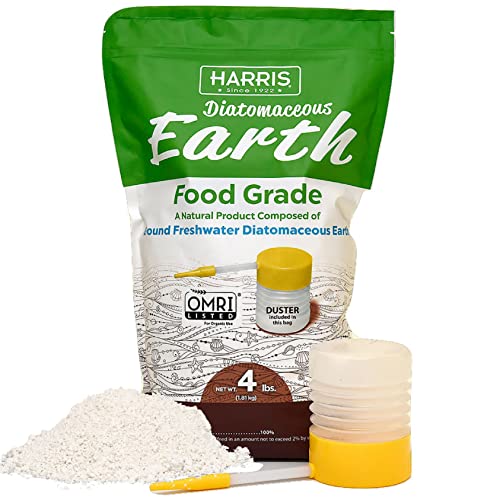
Harris 4 lb + duster
A keeper who wants to dust perch ends, nest box corners and coop crevices with some control rather than scattering powder by hand.
Check price on Amazon for HARRIS Diatomaceous Earth Food Grade, 4lb with Powder Duster Included in The Bag on AmazonAbout $19.68 checked Aug 8, 2026
-
Best Ready-Made Dust Bath

Fresh Coop 6 lb jug
Someone setting up a dust bath for the first time who would rather buy a finished mix than work out ratios of powder, sand and clay.
-
Best Small Bag to Try First

Harris 2 lb bag
Anyone who has never used diatomaceous earth and wants to see whether their birds take to a dusting area before buying a 20 lb sack.
Check price on Amazon for Harris Diatomaceous Earth Food Grade, 2lb OMRI Listed - Approved for Organic Use on AmazonAbout $16.98 checked Aug 8, 2026
-
Best for the Garden as Well as the Run

DiatomaceousEarth 20lb
A keeper who gardens as well as keeping hens and wants one certified bag that serves the vegetable beds and the dust bath.
-
Best for a Musty Coop Smell

Diva Dust 20 lb
A keeper whose coop smells stale between deep cleans and who wants the dust bath to do some odour work as well as feather care.
Check price on Amazon for Premium Poultry Diva Dust Bath for Chickens with Zeolite, 20lb, Made in USA on AmazonAbout $79.99 checked Aug 8, 2026
Compare every pick side by side
Swipe the table sideways to see every column on a phone.
| Product | Award | Price band | Net Weight | Composition | Certification | Applicator Included | Stated Use | Listing Note | Best use case | Buy link |
|---|---|---|---|---|---|---|---|---|---|---|
| Red Lake Earth 20 lb | Best Overall | $30 to $60 | 20 lb | Natural blend of food-grade non-calcined diatomaceous earth and calcium bentonite | OMRI Listed and Food Chemical Codex grade | None stated | Feed additive for poultry and livestock, keeps feed dry and free-flowing | Sold as an anti-caking and moisture-absorbing feed additive, the listing makes no parasite claim | A keeper refilling a dust bath through the year who wants the lowest runn… | Check price for Progressive Planet Red Lake Earth Animal Feed Additive, 20Lbs - Natural Diatomaceous with Calcium Bentonite for Poultry & Livestock - Prevents Caking, Improves Feed Flow & Maintains Fresh Feed on Amazon |
| Harris 4 lb + duster | Best for Dusting a Coop | Under $30 | 4 lb | 100% ground freshwater diatomaceous earth, no additives or fillers | OMRI Listed | Yes, a powder duster packed inside the bag | Listing says the duster is for applying diatomaceous earth on animal feed | Mined in Nevada and packaged in Georgia | A keeper who wants to dust perch ends, nest box corners and coop crevices… | Check price for HARRIS Diatomaceous Earth Food Grade, 4lb with Powder Duster Included in The Bag on Amazon |
| Fresh Coop 6 lb jug | Best Ready-Made Dust Bath | Under $30 | 6 lb | Food-grade diatomaceous earth and calcium montmorillonite clay | Not stated | Comes in a shaker jug, no separate duster | Dust bath mix for litter pans, kiddie pools, old tires, sandboxes or a dedicated dusting area | Listing frames it as feather and skin care that absorbs excess oils, it makes no mite or lice kill claim | Someone setting up a dust bath for the first time who would rather buy a… | Check price for Progressive Planet Fresh Coop Dust Bath, 6lb Jug - Food-Grade Diatomaceous Earth & Calcium Montmorillonite Clay - Supports Healthy Feathers, Reduces Boredom & Encourages Natural Dust Bathing on Amazon |
| Harris 2 lb bag | Best Small Bag to Try First | Under $30 | 2 lb | 100% food-grade freshwater diatomaceous earth, no additives or fillers | OMRI Listed, approved for organic use | None stated | Listing only says versatile applications, and that it is safe around children and pets when used as directed | Mined in Nevada and packaged in Georgia, the listing names no poultry use | Anyone who has never used diatomaceous earth and wants to see whether the… | Check price for Harris Diatomaceous Earth Food Grade, 2lb OMRI Listed - Approved for Organic Use on Amazon |
| DiatomaceousEarth 20lb | Best for the Garden as Well as the Run | $60 to $120 | 20 lb per the title, though one bullet says it contains 10 lb | 100% freshwater diatomaceous earth, no additives, fillers or chemicals, rich in amorphous silica | OMRI Listed for organic use | None stated | Organic gardening and soil conditioning, listing says safe for humans and pets | The bag weight contradicts itself, 20 lb in the title against 10 lbs in a bullet, and no poultry use is named | A keeper who gardens as well as keeping hens and wants one certified bag… | Check price for DiatomaceousEarth Food Grade Diatomaceous Earth – 20lb | 100% Organic, All-Natural Powder | Safe for Humans & Pets | OMRI Listed for Organic Use on Amazon |
| Diva Dust 20 lb | Best for a Musty Coop Smell | $60 to $120 | 20 lb | Zeolite and diatomaceous earth with lavender and tea tree essential oils | Not stated | None stated, you mix it into existing dust bath material | Dust bath additive for chickens, mixed into sand, an existing bath or coop areas | Listing is written around cleaner feathers and a fresher-smelling bath, it makes no mite or lice kill claim | A keeper whose coop smells stale between deep cleans and who wants the du… | Check price for Premium Poultry Diva Dust Bath for Chickens with Zeolite, 20lb, Made in USA on Amazon |
The full reviews
Each review below follows the same order: what it is, why it won its category, how it behaves in real use, and who should buy something else.
1 Best Overall
Progressive Planet Red Lake Earth Animal Feed Additive, 20Lbs - Natural Diatomaceous with Calcium Bentonite for Poultry & Livestock - Prevents Caking, Improves Feed Flow & Maintains Fresh Feed
At $36.49 for 20 lb it works out around $1.82 a pound, cheapest here by a wide margin, and it is the only listing on this page that names poultry.
What we liked
- About $1.82 a pound, the lowest rate on this page
- The only listing here that names poultry as a target
- OMRI Listed and Food Chemical Codex grade
- Twenty pounds covers a dust bath through a full season
What we did not
- It is sold as an anti-caking feed additive, not a parasite product, so nothing on the listing supports using it for mites or lice
- The bag is a blend of diatomaceous earth and calcium bentonite, so 20 lb is not 20 lb of pure powder
- Twenty pounds of grey dust is heavy and messy to handle, and decanting it raises a cloud you should not be breathing
Key specifications
- Dimensions
- 18.11 x 11.42 x 4.33 in (L x W x H)
- Weight
- 20 pounds
- Colour
- Gray
- Net Weight
- 20 lb
- Composition
- Natural blend of food-grade non-calcined diatomaceous earth and calcium bentonite
- Certification
- OMRI Listed and Food Chemical Codex grade
- Applicator Included
- None stated
- Stated Use
- Feed additive for poultry and livestock, keeps feed dry and free-flowing
- Listing Note
- Sold as an anti-caking and moisture-absorbing feed additive, the listing makes no parasite claim
Why the Red Lake Earth 20 lb wins this category
Because of the arithmetic, and because of one line in the listing.
The arithmetic first. $36.49 for 20 lb is about $1.82 a pound. The nearest rate on this page is the DiatomaceousEarth 20 lb at about $3.15 a pound, and even that figure only holds if its title weight is right, because a bullet in the same listing says 10 lb. The nearest bag with an uncontested weight is the Diva Dust at $4.00 a pound, and the dearest is the Harris 2 lb at about $8.49. Diatomaceous earth is used by the scoop and topped up constantly, so the rate you pay per pound is the number that decides what this costs you over a year.
The line in the listing is the second reason. Red Lake Earth is the only one of these six that names poultry at all. Every other bag here is sold for gardens, for general use or for a dust bath without naming the animal.
Add OMRI Listing and Food Chemical Codex grade and you have the sensible default buy.
Living with the Red Lake Earth 20 lb
The bag is roughly 18 by 11.5 by 4.5 inches and weighs 20 pounds, so it stores flat under a bench rather than standing in a corner.
It is a grey powder rather than a bright white one, which is what the calcium bentonite in the blend does. That is worth knowing so you are not surprised, and it makes no difference in a dust bath.
Its stated use is as a feed additive for poultry and livestock, keeping feed dry and free-flowing. That is a genuine job in a humid feed bin. Most keepers buying this are going to tip it into a dust bath instead, which is fine, but the listing is not written for that.
Where the Red Lake Earth 20 lb falls short
It makes no parasite claim, and neither will we. The listing sells anti-caking and moisture absorption. If you are buying it hoping it clears mites, understand that nothing on the label supports that, the evidence for diatomaceous earth as poultry parasite control is thin and mixed, and an active infestation needs a product actually labelled for poultry. A bird losing condition needs a vet.
The blend is the second caveat. Natural food-grade non-calcined diatomaceous earth mixed with calcium bentonite means part of that 20 pounds is clay. For a dust bath that is perfectly reasonable. If you wanted 20 lb of pure powder, the DiatomaceousEarth 20 lb states 100 percent freshwater diatomaceous earth instead, at a higher price.
And handling 20 lb of fine grey dust is a real job. It is heavy, it is messy, and pouring it raises a cloud of silica you should be wearing a mask to avoid.
Research based, not hands-on
Assessed on cost per pound calculated from the published 20 lb net weight and price, the stated blend composition, the certification claimed and the use the listing names.
- Best for
- A keeper refilling a dust bath through the year who wants the lowest running cost per pound and does not need a pure powder.
- Skip it if
- You want unblended diatomaceous earth, because this bag is a stated blend with calcium bentonite rather than 100 percent powder.
- The limitation to plan around
- Plan around what the listing actually claims. This is a feed conditioner sold to keep feed dry and flowing, and it makes no parasite claim at all.
2 Best for Dusting a Coop
HARRIS Diatomaceous Earth Food Grade, 4lb with Powder Duster Included in The Bag
The only bag on this page with a powder duster packed inside it, which turns dusting perch ends and corners into a controlled puff instead of a scoop and a cloud.
What we liked
- The only bag here that includes a powder duster
- Stated as 100 percent ground freshwater diatomaceous earth
- No additives or fillers named in the composition
- OMRI Listed, mined in Nevada and packaged in Georgia
What we did not
- At about $4.92 a pound it costs nearly three times the rate of the Red Lake Earth bag, so it is an expensive way to fill a dust bath
- Four pounds is a single dust bath fill and a couple of top-ups, so a keeper using it regularly will be reordering often
- The listing only describes the duster as being for applying the powder on animal feed, and makes no parasite claim you could rely on
About $19.68 checked Aug 8, 2026
Key specifications
- Dimensions
- 12 x 9 x 6 in (L x W x H)
- Weight
- 4.2 pounds
- Colour
- Orinal Vesion
- Net Weight
- 4 lb
- Composition
- 100% ground freshwater diatomaceous earth, no additives or fillers
- Certification
- OMRI Listed
- Applicator Included
- Yes, a powder duster packed inside the bag
- Stated Use
- Listing says the duster is for applying diatomaceous earth on animal feed
- Listing Note
- Mined in Nevada and packaged in Georgia
Why the Harris 4 lb + duster wins this category
For one reason that sounds minor and is not. It is the only bag here with a duster in it.
Applying diatomaceous earth by scoop is a poor way to do it. You use far more than you need, most of it ends up somewhere useless, and a good part of it goes into the air around your face. A duster puffs a measured amount into the place you are aiming at: the underside of a perch, the seam at the back of a nest box, the corner where the wall meets the floor.
Those are exactly the places worth treating in a coop, and they are exactly the places a scoop cannot reach. Nobody buys an applicator separately, even though they are cheap, which is why having one in the bag matters more than buyers expect.
Living with the Harris 4 lb + duster
The composition is straightforward: 100 percent ground freshwater diatomaceous earth, no additives or fillers stated. It is OMRI Listed, mined in Nevada and packaged in Georgia.
The bag runs about 12 by 9 by 6 inches at roughly 4.2 pounds gross, so it sits on a shelf in a feed room without taking a whole level.
The listing frames the duster as a tool for applying diatomaceous earth on animal feed. In practice it is the same tool whether you are treating feed, litter or a perch, and the control it gives is the point.
Where the Harris 4 lb + duster falls short
The rate is the problem. $19.68 for 4 lb works out at about $4.92 a pound. That is nearly three times what Red Lake Earth costs per pound at about $1.82, so filling a dust bath from this bag is an expensive way to do a cheap job.
Four pounds is also a small quantity once you start using it seriously. One dust bath fill and a few coop top-ups will make a serious dent, and you will be reordering more often than you expect.
And the honest limit on what it does. The listing makes no claim to kill mites or lice, and neither do we. Diatomaceous earth only works while dry, the published evidence for it as poultry parasite control is thin and mixed, and a bird with an active infestation needs a poultry-labelled treatment. If a bird is losing condition, that is a vet question rather than a dusting question.
Research based, not hands-on
Assessed on the included duster against the five bags here without one, the stated pure composition, and cost per pound calculated from the published 4 lb net weight and price.
- Best for
- A keeper who wants to dust perch ends, nest box corners and coop crevices with some control rather than scattering powder by hand.
- Skip it if
- You are filling and refilling a dust bath through the season, because at about $4.92 a pound the running cost adds up fast.
- The limitation to plan around
- Plan around the quantity. Four pounds goes quickly once you start dusting a coop properly, so this is a targeted application bag rather than a bulk supply.
3 Best Ready-Made Dust Bath
Progressive Planet Fresh Coop Dust Bath, 6lb Jug - Food-Grade Diatomaceous Earth & Calcium Montmorillonite Clay - Supports Healthy Feathers, Reduces Boredom & Encourages Natural Dust Bathing
A mixed dust bath in a shaker jug rather than a sack of raw powder, blending food-grade diatomaceous earth with calcium montmorillonite clay so you tip and go.
What we liked
- Comes ready mixed as a dust bath rather than raw powder
- Shaker jug pours in a controlled stream, not a cloud
- Clay in the blend is a natural dust bath ingredient
- Six pounds fills a tub or tyre bath in one go
What we did not
- At about $4.23 a pound it costs more than twice the rate of the Red Lake Earth bag for a blend that is partly clay
- The listing states no certification at all, so if organic paperwork matters to you this bag will not support it
- Six pounds is a single fill for a decent sized bath, and an outdoor bath needs topping up after every rain
Key specifications
- Dimensions
- 6.5 x 4.5 x 13.25 in (L x W x H)
- Weight
- 6 pounds
- Colour
- B06XYF58FP
- Net Weight
- 6 lb
- Composition
- Food-grade diatomaceous earth and calcium montmorillonite clay
- Certification
- Not stated
- Applicator Included
- Comes in a shaker jug, no separate duster
- Stated Use
- Dust bath mix for litter pans, kiddie pools, old tires, sandboxes or a dedicated dusting area
- Listing Note
- Listing frames it as feather and skin care that absorbs excess oils, it makes no mite or lice kill claim
Why the Fresh Coop 6 lb jug wins this category
Because it is the only product here that arrives as a dust bath rather than as an ingredient. Food-grade diatomaceous earth is already blended with calcium montmorillonite clay, and it comes in a shaker jug you tip straight into a litter pan, a kiddie pool, an old tyre or a dedicated dusting corner.
That saves a step most people get wrong. A dust bath made of pure diatomaceous earth is not what a hen would choose. Birds bathe in loose soil, and clay and fine grit are part of what makes a bath work. The Fresh Coop 6 lb jug arrives with that ratio already decided.
The jug helps too. At 6.5 by 4.5 by 13.25 inches it pours in a controlled stream rather than dumping, which keeps the airborne dust down while you fill.
Living with the Fresh Coop 6 lb jug
Six pounds is about one good fill for a tub or a tyre. That is a sensible unit if you have one bath for a small flock, and it is easy to store between top-ups because the jug seals.
The listing sets the product out honestly. It is framed as feather and skin care that absorbs excess oils and encourages natural dust bathing, and it explicitly makes no mite or lice kill claim. We are not going to add one.
Where it belongs is a covered bath, out of the rain. Diatomaceous earth does nothing once damp, and a bath sitting in an open run through a wet week is a tub of grit.
Where the Fresh Coop 6 lb jug falls short
You are paying a convenience rate. $25.40 for 6 lb is about $4.23 a pound, which is more than twice the Red Lake Earth rate of about $1.82. If you already keep sand and powder in the shed, mixing your own is genuinely cheaper.
The certification line is blank. Four of the six bags in this guide are OMRI Listed and this is not one of them. For most backyard keepers that is irrelevant, but if you sell eggs under an organic label it rules the product out.
And six pounds does not go as far as it sounds when the bath is outside. Hens throw a surprising amount of it over the sides in a single session, and rain turns whatever is left into a crust. Expect to top up regularly and budget for it at $4.23 a pound.
Research based, not hands-on
Assessed on the stated blend composition, the shaker jug format against loose sacks, the absence of a stated certification, and cost per pound from the published 6 lb net weight.
- Best for
- Someone setting up a dust bath for the first time who would rather buy a finished mix than work out ratios of powder, sand and clay.
- Skip it if
- You already keep sand and powder separately, because you are paying a blend premium for a mix you can make yourself for less.
- The limitation to plan around
- Plan around the container. It arrives as a shaker jug of finished mix, so you are buying convenience by the pound rather than the cheapest powder available.
4 Best Small Bag to Try First
Harris Diatomaceous Earth Food Grade, 2lb OMRI Listed - Approved for Organic Use
The cheapest way onto this page at $16.98, and the right size to find out whether your hens will use a dusting area before you commit to a sack.
What we liked
- Lowest sticker price on this page at $16.98
- Stated as 100 percent food-grade freshwater diatomaceous earth
- No additives or fillers named in the composition
- OMRI Listed and approved for organic use
What we did not
- At about $8.49 a pound it is the most expensive powder on this page, roughly four and a half times the Red Lake Earth rate
- Two pounds is a single fill for a small bath, so anyone who keeps using it will be reordering within weeks at the worst rate here
- The listing names no poultry use at all and only says versatile applications, so it offers no guidance on how to use it with a flock
About $16.98 checked Aug 8, 2026
Key specifications
- Dimensions
- 7.480314953 x 6.299212592 x 11.023622036 in (L x W x H)
- Weight
- 2 pounds
- Net Weight
- 2 lb
- Composition
- 100% food-grade freshwater diatomaceous earth, no additives or fillers
- Certification
- OMRI Listed, approved for organic use
- Applicator Included
- None stated
- Stated Use
- Listing only says versatile applications, and that it is safe around children and pets when used as directed
- Listing Note
- Mined in Nevada and packaged in Georgia, the listing names no poultry use
Why the Harris 2 lb bag wins this category
Because it answers a question cheaply. Plenty of people buy diatomaceous earth, build a dusting corner, and find their hens ignore it in favour of the flower bed they already like. Finding that out for $16.98 is better than finding it out after hauling home 20 pounds.
At two pounds it is one fill for a small tub or a corner of the run. That is enough for the birds to make their preference obvious within a week.
The powder itself is not a compromise either. The Harris 2 lb bag is stated as 100 percent food-grade freshwater diatomaceous earth with no additives or fillers, and it is OMRI Listed and approved for organic use. You are buying a small amount of the real thing, not a diluted trial version.
Living with the Harris 2 lb bag
The bag is a manageable size, roughly 7.5 by 6.3 by 11 inches, so it fits in a cupboard or a first aid tote rather than needing floor space.
Like the larger Harris bag it is mined in Nevada and packaged in Georgia. Unlike the 4 lb bag, there is no duster included, so you will be applying it with a scoop or a jar unless you buy an applicator separately.
If you decide it works for you, the honest next move is to switch bags rather than reorder this one. Red Lake Earth is about $1.82 a pound, and you will feel the difference within two purchases.
Where the Harris 2 lb bag falls short
The rate is brutal. $16.98 for 2 lb is about $8.49 a pound, the most expensive powder on this page and roughly four and a half times the Red Lake Earth rate. Small bags always carry a packaging premium, but this is a big one, and it is invisible unless you divide.
Two pounds also runs out fast. Hens throw powder over the sides of a bath, wind takes some, rain ruins what is left. A keeper who uses it regularly will be back at the checkout within weeks, paying the highest rate here each time.
The listing is also unhelpfully vague about use. It says versatile applications and that it is safe around children and pets when used as directed, and it names no poultry use whatsoever. It makes no mite or lice claim, and neither will we. For an active infestation you need a poultry-labelled product, and a bird losing condition needs a vet.
Research based, not hands-on
Assessed on cost per pound calculated from the published 2 lb net weight and price, the stated pure composition and certification, and the absence of any named poultry use.
- Best for
- Anyone who has never used diatomaceous earth and wants to see whether their birds take to a dusting area before buying a 20 lb sack.
- Skip it if
- You already know you want it and will use it regularly, because the cost per pound here is the highest in this guide by a clear margin.
- The limitation to plan around
- Plan around the trial rate. This bag is priced as a sample, so treat it as a test purchase and buy bulk once you know the birds will use it.
5 Best for the Garden as Well as the Run
DiatomaceousEarth Food Grade Diatomaceous Earth – 20lb | 100% Organic, All-Natural Powder | Safe for Humans & Pets | OMRI Listed for Organic Use
Stated as 100 percent freshwater diatomaceous earth with no additives, and the only listing here written around garden and soil use, so one bag covers the beds and the dust bath.
What we liked
- Stated 100 percent freshwater diatomaceous earth, no fillers
- OMRI Listed for organic use across garden and run
- Written around organic gardening and soil conditioning
- Large format bag rather than a trial size
What we did not
- The listing contradicts itself on weight, 20 lb in the title against a bullet that says the bag contains 10 lb, so you cannot know what you are paying per pound
- It names no poultry use at all, so nothing on the listing guides how to use it around birds
- The tall 28 inch bag is awkward to lift and pour, and tipping it from height throws far more airborne silica than a low flat sack
Key specifications
- Dimensions
- 16 x 4 x 28 in (L x W x H)
- Weight
- 20.00033640864 pounds
- Colour
- White
- Net Weight
- 20 lb per the title, though one bullet says it contains 10 lb
- Composition
- 100% freshwater diatomaceous earth, no additives, fillers or chemicals, rich in amorphous silica
- Certification
- OMRI Listed for organic use
- Applicator Included
- None stated
- Stated Use
- Organic gardening and soil conditioning, listing says safe for humans and pets
- Listing Note
- The bag weight contradicts itself, 20 lb in the title against 10 lbs in a bullet, and no poultry use is named
Why the DiatomaceousEarth 20lb wins this category
Because it is the only bag on this page written for the garden, and plenty of people who keep hens also grow vegetables.
The listing frames it around organic gardening and soil conditioning, and it is OMRI Listed for organic use. That means it can go into a certified vegetable bed and into a dust bath from the same sack, which is a genuine convenience if you keep both.
The powder is also stated as pure: 100 percent freshwater diatomaceous earth, no additives, fillers or chemicals, described as rich in amorphous silica. Three of the six bags here are blends with clay or zeolite. If you want an unblended powder in a large format, this is the listing that offers it.
Living with the DiatomaceousEarth 20lb
The bag is tall and narrow, roughly 16 by 4 by 28 inches, and the stated shipping weight is a shade over 20 pounds. It stands upright in a corner of a shed rather than lying flat.
Colour is white rather than the grey you get from a bentonite blend, which some people prefer purely for how it looks in a bath.
The listing says it is safe for humans and pets when used as directed. Read that as a handling statement about the powder itself, not as permission to breathe it. It is a fine silica dust and it needs a mask.
Where the DiatomaceousEarth 20lb falls short
The listing cannot decide how much is in the bag. The title says 20 lb. A bullet in the same listing says it contains 10 lb. Those are not close, and we are not going to pick one and quote a cost per pound as fact. At $62.99 you are either paying about $3.15 a pound or about $6.30, and the difference between those is the difference between good value and the second most expensive powder here. Weigh it when it arrives.
It also names no poultry use anywhere. That is not a safety problem, it just means the listing gives you nothing on how to use it around birds, and it makes no mite or lice claim. Neither will we. An active infestation needs a poultry-labelled product, and a bird losing condition needs a vet.
Handling is the last irritation. A 28 inch bag has to be lifted high to pour, and pouring from height is the single best way to fill your own lungs with silica.
Research based, not hands-on
Assessed on the stated pure composition and OMRI listing, the garden use the listing names, and the contradiction between the 20 lb title weight and the bullet that states 10 lb.
- Best for
- A keeper who gardens as well as keeping hens and wants one certified bag that serves the vegetable beds and the dust bath.
- Skip it if
- You need to know exactly what you are paying per pound, because the title weight and a bullet in the same listing disagree.
- The limitation to plan around
- Plan around the weight contradiction. Weigh the bag when it arrives, because the listing gives two different figures and only one of them can be right.
6 Best for a Musty Coop Smell
Premium Poultry Diva Dust Bath for Chickens with Zeolite, 20lb, Made in USA
Zeolite is the reason to buy this one. It is a mineral used for odour control, blended here with diatomaceous earth and lavender and tea tree oils for a bath that also freshens a stale coop.
What we liked
- Zeolite in the blend targets odour rather than just dust
- Lavender and tea tree oils give it a clean smell
- Twenty pounds mixes into an existing bath over a season
- Sold specifically as a dust bath additive for chickens
What we did not
- At $79.99 it is the highest sticker price on this page and about $4.00 a pound, more than twice the Red Lake Earth rate
- The blend is zeolite and diatomaceous earth, so a large share of the 20 lb is not diatomaceous earth at all
- Added essential oils are a real consideration in an enclosed coop, because strong aromatics can irritate a bird's airways alongside the dust itself
About $79.99 checked Aug 8, 2026
Key specifications
- Dimensions
- 19 x 15 x 9 in (L x W x H)
- Colour
- Blue
- Net Weight
- 20 lb
- Composition
- Zeolite and diatomaceous earth with lavender and tea tree essential oils
- Certification
- Not stated
- Applicator Included
- None stated, you mix it into existing dust bath material
- Stated Use
- Dust bath additive for chickens, mixed into sand, an existing bath or coop areas
- Listing Note
- Listing is written around cleaner feathers and a fresher-smelling bath, it makes no mite or lice kill claim
Why the Diva Dust 20 lb wins this category
Because of the zeolite, which is the ingredient the other five bags do not have. Zeolite is a porous mineral used across animal housing for moisture and ammonia control, and that is a different job from what diatomaceous earth does.
A coop that smells sour between deep cleans usually has an ammonia problem sitting in damp litter. Adding an odour-targeting mineral to the dust bath and the coop areas is not a substitute for cleaning it out, but it takes the edge off in the weeks between.
The lavender and tea tree oils on top of that make it the one product here that a keeper will notice by smell as well as by sight. The Diva Dust 20 lb is sold explicitly as a dust bath additive for chickens, made in the USA, mixed into sand, an existing bath or coop areas.
Living with the Diva Dust 20 lb
It arrives as a 20 lb sack, roughly 19 by 15 by 9 inches, so it is a lie-flat bag rather than a tall one and it decants without lifting it above your waist.
The intended use is as an additive rather than a whole bath. You mix it into sand or into a bath you already have, which stretches the bag a long way and keeps the running cost more reasonable than the sticker suggests.
The listing is written around cleaner feathers and a fresher-smelling bath. It makes no mite or lice kill claim, and we are not going to add one.
Where the Diva Dust 20 lb falls short
It is the most expensive bag here at $79.99, and about $4.00 a pound, more than twice what Red Lake Earth costs per pound. If your reason for buying diatomaceous earth is a cheap dust bath, this is the wrong end of the page.
The composition also means you are not buying 20 lb of diatomaceous earth. Zeolite and diatomaceous earth are both listed, in unstated proportions, so a large share of the weight is the odour mineral. That is the point of the product, but it should be clear before you compare it on price with a pure powder.
The essential oils need a moment's thought too. Poultry airways are sensitive, and a coop is often less ventilated than the keeper thinks. Between the silica dust and added aromatics, this belongs in a well aired space or an outdoor bath. Never shake it through a closed coop with birds inside, and wear a mask while you do it.
Research based, not hands-on
Assessed on the stated zeolite and diatomaceous earth blend with added essential oils, the odour role zeolite is normally used for, and cost per pound from the published 20 lb net weight.
- Best for
- A keeper whose coop smells stale between deep cleans and who wants the dust bath to do some odour work as well as feather care.
- Skip it if
- You are buying by weight for the cheapest possible dust bath, because most of what you are paying for here is the blend, not the powder.
- The limitation to plan around
- Plan around ventilation. This is a scented blend and it belongs in a well aired coop or an outdoor bath, not shaken through a closed house.
How we compared these diatomaceous earth bags
We divided price by net weight, first, and then read the composition line. That is the whole method, and it separates this category faster than any feature list.
Cost per pound of food-grade powder is the deciding number because of how the product is used. Nobody measures diatomaceous earth. It goes into a dust bath by the scoop, gets scattered through litter, blows away, gets rained on and needs topping up. Consumption is high and continuous, so the rate you are paying per pound compounds over a season in a way the sticker price hides.
Here is where the six land. Red Lake Earth at $36.49 for 20 lb is about $1.82 a pound. Diva Dust at $79.99 for 20 lb is $4.00. Fresh Coop at $25.40 for 6 lb is about $4.23. The Harris 4 lb at $19.68 is about $4.92. The Harris 2 lb at $16.98 is about $8.49, the most expensive powder on this page. The DiatomaceousEarth 20 lb at $62.99 would be about $3.15 if the title weight is right, but one bullet in the same listing says the bag holds 10 lb, so we have recorded the contradiction instead of quoting a rate as fact.
After price we looked at composition, at certification, at whether an applicator is included, and at what use the listing actually names. Nothing here has been handled by us. These are listing comparisons.
What actually matters in diatomaceous earth for a flock
Cost per pound, because you will use a lot
The gap between the cheapest and dearest powder here is more than four to one. That is not a small premium for quality, it is the difference between refilling a dust bath without thinking about it and rationing a bag.
Small bags have a place. If you have never used the stuff and want to see whether your birds take to a dusting area, a 2 lb bag is a sensible way to find out for under 20 dollars. Just understand that you are paying a trial rate, not a running rate.
What is actually in the bag
Read the composition line before you assume 20 lb means 20 lb of diatomaceous earth. Three of these are blends.
Red Lake Earth is food-grade non-calcined diatomaceous earth blended with calcium bentonite. Fresh Coop is diatomaceous earth with calcium montmorillonite clay. Diva Dust is zeolite and diatomaceous earth with lavender and tea tree essential oils. The two Harris bags and the DiatomaceousEarth 20 lb are the pure ones, stated as 100 percent freshwater diatomaceous earth with no additives or fillers.
For a dust bath, a clay blend is not a downgrade. Hens have bathed in clay soils forever, and the clay does a similar job of coating feathers and absorbing oil. It only matters if you thought you were buying pure powder at a pure powder price.
Certification tells you less than you think
Four of the six are OMRI Listed: Red Lake Earth, both Harris bags and the DiatomaceousEarth 20 lb. When two thirds of a category carries the same badge, the badge cannot decide the category, which is why no product here gets a certification award.
OMRI Listed means it has been reviewed as acceptable in certified organic production. That is useful if you sell eggs under an organic label. It is close to meaningless for a backyard keeper choosing between two white powders.
An applicator matters more than buyers expect
Only one bag here comes with a way to apply the powder. The Harris 4 lb has a duster packed inside the bag, and that changes the job of dusting a coop from scooping and flinging to a controlled puff into a corner or a perch end.
That matters for two reasons. You waste less powder, and you raise less airborne dust into your own face. Applicators are cheap to buy separately, but most people never get round to it.
Handling it without hurting your lungs or your birds
This is the part the listings do not lead with. Diatomaceous earth is a fine silica dust. Breathing it irritates airways, and a chicken's respiratory system is more delicate than yours, not less.
Wear a proper dust mask, not a bandana. Work outside or on a still day where the dust can drift away from you rather than hang. Tip the bag low into the bath instead of shaking it from waist height.
Never fog a closed coop with birds inside. If you are dusting perches and corners, put the birds out first, apply it, and let the air clear before they go back in.
And remember that it stops working when it is wet. A dust bath under a leaky roof or an open run in a rainy week is a bath full of damp grit. Keep it under cover if you want it to do anything at all.
Final recommendation
Red Lake Earth is the pick for most keepers. At about $1.82 a pound it is cheapest here by a wide margin, and it is the only listing on this page that names poultry, though it names them for feed conditioning rather than for anything to do with parasites.
If you want to dust a coop properly, the Harris 4 lb is the only bag with a duster in it, and that is worth more than the price difference suggests. If you would rather buy a bath mix that is ready to tip straight into a tub, the Fresh Coop 6 lb jug is made for that. And if you have never used diatomaceous earth and want to test whether your hens will use a dusting area at all, the Harris 2 lb bag is the cheapest way in, as long as you know you are paying about $8.49 a pound for the privilege.
Questions people ask before buying
Does diatomaceous earth kill mites and lice on chickens?
Not one of the six listings compared here makes that claim, and we are not going to make it for them. Diatomaceous earth works by drying, so it only does anything while it is completely dry, and a coop is rarely completely dry. Published work on it as poultry parasite control is thin and the results are mixed. Treat it as a dust bath ingredient that helps birds keep their own feathers in order, not as a treatment. An active mite or lice infestation needs a product actually labelled for poultry, and a bird losing condition needs a vet.
Is diatomaceous earth safe to breathe?
No, and this is the thing owners only learn after the first bag. It is a very fine silica dust, and it irritates lungs, yours and your birds'. Wear a properly fitted dust mask when you handle it, work outdoors or on a still day, and never fog a closed coop with the birds inside. Tip it low and slow rather than shaking it from height, and let the dust settle before you shut the birds back in. Food grade means it has been assessed for use around food animals, it does not mean it is safe to inhale.
How much diatomaceous earth do I actually need?
More than people expect, which is why cost per pound matters. A dust bath in a tub or an old tyre takes several pounds to start, and it needs topping up whenever the birds scatter it or rain gets in. A 2 lb bag is a single fill for a small bath. A 20 lb bag is a season. Work out the cost per pound before you order: Red Lake Earth here is about $1.82 a pound while the Harris 2 lb bag is about $8.49 a pound, which is the widest gap on this page.
Is a pure diatomaceous earth better than a blend?
It depends what you are doing with it. Three of these bags are pure freshwater diatomaceous earth: the two Harris bags and the DiatomaceousEarth 20 lb. The other three are blends. Red Lake Earth adds calcium bentonite, Fresh Coop adds calcium montmorillonite clay, and Diva Dust adds zeolite with lavender and tea tree oils. If you are buying by weight for a dust bath, a blend is fine and the clay is a normal dust bath ingredient anyway. Just do not pay a pure-powder price for a bag that is part clay.
Does OMRI Listed mean it is better for chickens?
It means it has been reviewed as acceptable for use in certified organic production, which is a certification question rather than a quality or safety ranking. Four of the six bags here carry it, which is Red Lake Earth, both Harris bags and the DiatomaceousEarth 20 lb, so it is not a tie-breaker on this page. If you sell eggs as organic it matters to your paperwork. If you keep six hens in the garden it tells you very little that the composition line does not already tell you.
Can I mix diatomaceous earth into feed?
Some of these bags are sold for exactly that. Red Lake Earth is marketed as an anti-caking feed additive that keeps feed dry and free-flowing, which is a moisture control job rather than a health one. What we would not do is add it to feed hoping it deworms a bird, because the listings make no such claim and the evidence does not support it. If you suspect worms, get a faecal float from a vet and treat with something labelled for the parasite you actually have.
Why you can trust this guide
- Written by
- Sam Reddick, Lead gear reviewer, Chicken Geek. Specialist areas: Coop design and predator proofing, Feeding and watering systems, Cold-weather flock management, Incubation and brooding.
- Fact checked by
- Marta Voss
- Published
- August 8, 2026 · Last updated August 8, 2026 · Products and links rechecked August 8, 2026
- How we picked
- Bags were compared on cost per pound of food-grade powder calculated from the published net weight and price, then on composition to separate pure diatomaceous earth from clay and zeolite blends, then on stated certification, then on whether an applicator is included and what use the listing actually names, with any contradiction between title weight and bullet weight recorded rather than resolved.
- Evidence used
- None of the 6 products on this page were sent to us or bought for a hands-on test. Every recommendation here is research based: manufacturer specifications, listed dimensions and materials, owner feedback at volume, and comparison against equipment our team has owned. Each review states this again above the buy button so you are never guessing which kind of evidence sits behind a pick.
- Editorial standards
- No brand pays for placement, and no manufacturer sees this page before it goes live. Read our editorial policy and testing method.
- Affiliate disclosure
- Chicken Geek is reader supported. We earn a commission from qualifying purchases made through links on this page, at no extra cost to you, and no brand has paid for a placement or an award here.
About the author

Lead gear reviewer, Chicken Geek
Sam has kept a backyard laying flock for eleven years, through two coop rebuilds, one very determined raccoon and several winters cold enough to freeze a waterer solid overnight. He writes the buying guides at Chicken Geek and is responsible for how products get compared.
- Eleven years keeping a mixed laying flock of 8 to 14 birds
- Has built, bought and replaced six different coops
- Runs the product comparison framework used across Chicken Geek
- Reads manufacturer manuals, spec sheets and warranty terms before every recommendation