We Compared 6 Chicken Toys on Whether They Pay Out Food
We compared six chicken toys on treat capacity and how long a hen takes to empty one, because a toy that gives nothing back gets ignored within two days.

By Sam Reddick Lead gear reviewer, Chicken Geek
Fact checked by Marta Voss
Published Prices and stock checked 7 min read

A chicken will investigate anything new for a day or two. After that she works out whether it gives her food, and if it does not, she stops looking at it. That is the whole of this category in one sentence, and it is why so many coop toys end up hanging in a corner covered in dust.
So the specification that decides a chicken toy is treat capacity, and after that how long a hen takes to empty it. Most buyers never check either, because these things are bought on looks. Only one product on this page publishes a capacity at all.
Work the field that way and it sorts itself. The Omlet Poppy holds about 300 g of feed and doles it out through 27 holes of 0.1 in, so it keeps a flock working the longest. The Lixit Treat Ball does the same job in miniature for $5.94, which is roughly a quarter of the Omlet price and the sensible way to find out whether your birds take to foraging toys at all before you spend more.
Then there is value. The CHNB set is $19.98 for eight pieces, about $2.50 each, which is the lowest price per item here by a distance, since the cheapest single toy on the page is $5.94. Two of the eight are veg forks and two are fruit racks, and a cabbage on a fork out-earns a mirror every time.
Our picks at a glance
Every product below wins one specific situation. Pick the row that matches your flock, your yard and your budget rather than reading top to bottom.
-
Best Overall

Omlet Poppy Peck Toy
Keepers with a run or a walk-in coop who want one enrichment item that keeps several hens occupied for a long stretch.
-
Best Budget

Lixit Treat Ball
Anyone trying a foraging toy for the first time who does not want to spend $22 to find out whether their hens engage with one.
-
Best Set for Rotating Toys Weekly

CHNB 8-Piece Toy Set
Keepers who want a rotation of enrichment from day one and would rather spread $20 across eight items than put it into one.
-
Best Plastic-Free Toy for the Run Floor

BingegePet Mint Ball
Keepers who want nothing plastic in the run and are happy with a toy that gets used up rather than refilled.
-
Best Hanging Toy for Birds Shut In on Wet Days
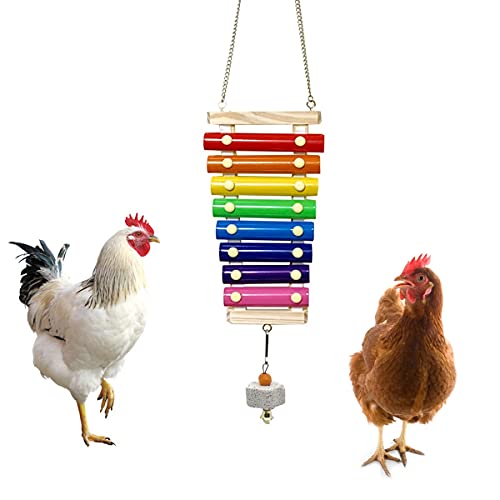
Vehomy Xylophone
Keepers in a wet climate whose birds spend whole days shut in and need something in the coop that reacts to them.
-
Best for a Hen Penned Away From the Flock

FlidRunest Mirror
Anyone with a hen penned separately to recover from an injury, a broody break or a quarantine period who wants her to feel less alone.
Compare every pick side by side
Swipe the table sideways to see every column on a phone.
| Product | Award | Price band | Toy Type | Material | Size | Mounting | Pack Contents | Treat Capacity | Best use case | Buy link |
|---|---|---|---|---|---|---|---|---|---|---|
| Omlet Poppy Peck Toy | Best Overall | Under $30 | Standing slow-feed treat dispenser for foraging | Not stated | Dispenser about 5.9 x 3.3 in with 27 holes of 0.1 in; assembled height about 1 ft 8.4 in | Installs in a coop or run, unscrews for refilling and cleaning | 1 toy, sold in 2 designs | About 300 g, half a litre, of feed, corn or grit | Keepers with a run or a walk-in coop who want one enrichment item that ke… | Check price for Omlet Poppy Chicken Peck Toy | Interactive Foraging & Pecking Enrichment Toy for Hens | Slow-Feed Treat Dispenser | Reduces Boredom & Feather Pecking | 300g Feed Capacity | 2 Designs on Amazon |
| Lixit Treat Ball | Best Budget | Under $30 | Treat-dispensing peck ball, slow feeder | Not stated | Listed dims 3 x 3 x 3 in | Not stated; pulls apart to refill | 1 pack | Not stated; fill with seeds, fruit, greens or mealworms | Anyone trying a foraging toy for the first time who does not want to spen… | Check price for Lixit® Chicken Feeder Treat Ball Toy - Chicken Coop Peck Toy - Chick Slow Feeder and Enrichment Ball (Yellow, 1 Pack) on Amazon |
| CHNB 8-Piece Toy Set | Best Set for Rotating Toys Weekly | Under $30 | 8-piece variety set: swing, xylophone, mirror with bells, peck toy, 2 veg hanging feeders, 2 fruit racks | Fir wood swing with stainless steel chains and corn bran, pine wood xylophone base with 8 metal keys, stainless steel veg forks with nylon mesh bags | Listed dims 16 x 4 x 20 in | Chains and hooks, hangs from a coop, branch or fence | 8 pieces | Not stated; forks and mesh bags hold cabbage, lettuce, carrots, corn and apples | Keepers who want a rotation of enrichment from day one and would rather s… | Check price for 8PCS Chicken Toys for Coop Accessories, Chicken Swing, Xylophone, Mirror, Vegetable Hanging Feeder, Fruit Rack for Poultry Rooster Large Bird Parrot Lovers’ Entertainment Gift on Amazon |
| BingegePet Mint Ball | Best Plastic-Free Toy for the Run Floor | Under $30 | Rolling ground pecking ball with a built-in rattle stone | 100% natural compressed mint grass, stated as free of plastics, dyes, glues and additives | 3.9 in / 10 cm ball, 253 g / 8.9 oz | None, drop it on the coop floor or run | Not stated, listed as Standard Ball | None, the ball itself is stated to be edible fibre | Keepers who want nothing plastic in the run and are happy with a toy that… | Check price for Mint Grass Chicken Toys 3.9 inch Rolling Pecking Ball with Built-in Rattle Stone – Natural Boredom Buster for Coop, Edible Fiber for Digestive Health, Chicken Enrichment Toy for Hens Chicks Roosters on Amazon |
| Vehomy Xylophone | Best Hanging Toy for Birds Shut In on Wet Days | Under $30 | Hanging 8-key xylophone with a floral grinding stone | Wood base with metal keys, mineral grinding stone | 9.4 x 4.7 x 1.2 in body, chains 11.8 in | Two chains with hooks, hangs in the coop | 1 xylophone with molar stone plus 2 chains | None, not a feeder | Keepers in a wet climate whose birds spend whole days shut in and need so… | Check price for Vehomy Chicken Xylophone Toy for Hens Suspensible Wood Xylophone Toy with 8 Metal Keys Chicken Coop Pecking Toy with Grinding Stone (Rainbow Color) on Amazon |
| FlidRunest Mirror | Best for a Hen Penned Away From the Flock | Under $30 | Hanging double-sided swing mirror | Acrylic, stated as chew resistant | 11.8 x 9.8 in (30 x 24 cm) | Adjustable rope with a metal hook, swings freely | Not stated, single mirror listed | None, not a feeder | Anyone with a hen penned separately to recover from an injury, a broody b… | Check price for FlidRunest Extra-Large Size Chicken Mirror Toys for Coop, 11.8'' x 9.8'' Hanging Chicken Enrichment Swing Mirror Acrylic, Double-Sided Coop Accessories for Hens Birds Parrots Roosters Red on Amazon |
The full reviews
Each review below follows the same order: what it is, why it won its category, how it behaves in real use, and who should buy something else.
1 Best Overall
Omlet Poppy Chicken Peck Toy | Interactive Foraging & Pecking Enrichment Toy for Hens | Slow-Feed Treat Dispenser | Reduces Boredom & Feather Pecking | 300g Feed Capacity | 2 Designs
The only toy here that publishes a capacity, about 300 g of feed released through 27 holes of 0.1 in, which is what turns a container into something a flock works at for hours instead of emptying in a minute.
What we liked
- The only toy in this guide with a stated treat capacity, about 300 g
- 27 holes of 0.1 in release feed slowly, so hens have to work at it
- Unscrews for refilling and for cleaning out damp or stale grain
- Takes feed, corn or grit, so you can use what you already have in the bin
- Stands on the coop or run floor rather than needing a fixing point
What we did not
- The 0.1 in holes suit small grain and mixed corn, so standard layer pellets are too large to feed through it
- At $22 it is the highest priced item on this page and costs more than the eight piece CHNB set
- The assembled unit stands about 1 ft 8.4 in, which is floor space a small coop or a tractor cannot spare
- Omlet states the toy reduces feather pecking, and feather pecking usually traces to crowding, low protein, bright light or mites, none of which a toy fixes
Key specifications
- Dimensions
- 5.9 x 3.3 x 5.9 in (L x W x H)
- Weight
- 0.24 pounds
- Colour
- Green
- Toy Type
- Standing slow-feed treat dispenser for foraging
- Material
- Not stated
- Size
- Dispenser about 5.9 x 3.3 in with 27 holes of 0.1 in; assembled height about 1 ft 8.4 in
- Mounting
- Installs in a coop or run, unscrews for refilling and cleaning
- Pack Contents
- 1 toy, sold in 2 designs
- Treat Capacity
- About 300 g, half a litre, of feed, corn or grit
Why the Omlet Poppy Peck Toy wins this category
Because it is the only product here that tells you how much food it holds, and because the number is a real one.
About 300 g, half a litre, is a meaningful amount of grain. Spread across 27 holes of 0.1 in it comes out slowly, a few pieces at a time, which is the difference between a dispenser and a bowl. Hens have to nudge, peck and revisit, and several birds can work at it at once.
That slow release is the whole design. Every other toy on this page either publishes no capacity, or is not a feeder at all. When the specification that decides a category is treat capacity, the one product that publishes it starts a long way ahead.
Living with the Omlet Poppy Peck Toy
It unscrews, which matters more than it sounds. Feed left in a dispenser through a damp week goes stale and can go mouldy, so a toy you can open, tip out and dry is a toy you will keep using. A sealed unit you have to shake clean gets abandoned.
It takes feed, corn or grit, so you are not buying anything special. A bag of scratch grain refills it many times over.
It stands on the floor rather than hanging, which means no hook, no chain and no height to adjust as birds grow. In a run it can sit anywhere. In a small coop it is one more thing on the floor.
Where the Omlet Poppy Peck Toy falls short
Hole size limits what you can put in it. At 0.1 in the holes suit small grain, mixed corn and grit. Standard layer pellets are larger than that, so if pellets are all you feed, you need a bag of grain to go with the toy.
Price is the other honest point. At $22 it is the dearest item on this page, and the CHNB set gives you eight pieces for $19.98. You are paying for one good mechanism rather than variety.
Then there is the feather pecking line in the listing. Omlet says the toy reduces feather pecking. Feather pecking in a backyard flock usually comes from crowding, protein that is too low, lighting that is too bright or too long, or a mite burden. Enrichment may take the edge off a bored flock, but it does not touch any of those causes, and a flock drawing blood needs the cause found rather than a toy added. If you cannot work out why, that is a conversation for a vet.
Research based, not hands-on
Assessed on the published 300 g capacity and 27 hole count, on the 0.1 in hole size against common feed particle sizes, and on assembled height against typical backyard coop floor space.
- Best for
- Keepers with a run or a walk-in coop who want one enrichment item that keeps several hens occupied for a long stretch.
- Skip it if
- You feed pellets only and do not want to buy grain, because the 0.1 in holes will not pass a standard layer pellet.
- The limitation to plan around
- It needs floor space. At about 1 ft 8.4 in assembled it stands like a small feeder, so measure the free floor in your run before you order.
2 Best Budget
Lixit® Chicken Feeder Treat Ball Toy - Chicken Coop Peck Toy - Chick Slow Feeder and Enrichment Ball (Yellow, 1 Pack)
A 3 in treat ball that pulls apart to refill, at $5.94 the cheapest item on this page and roughly a quarter of the Omlet price, which makes it the sensible way to find out whether your birds take to foraging toys at all.
What we liked
- The lowest price in this guide at $5.94, about a quarter of the Omlet Poppy
- Pulls apart to refill and to tip out damp or stale feed
- Takes seeds, fruit, greens or mealworms, so you can vary what is inside
- A 3 in ball rolls, so the food moves and the hens follow it
- Small enough for a tractor or a coop with no spare floor space
What we did not
- No treat capacity is stated anywhere, and a 3 in ball holds well under the Omlet's stated 300 g, so it empties fast
- The material is not stated, so you cannot tell what a determined hen is chipping pieces off
- A rolling ball on a bedded floor gets buried in shavings, and buried feed attracts rodents
- One ball suits one or two birds at a time, so a larger flock will squabble over it rather than share
Key specifications
- Dimensions
- 3 x 3 x 3 in (L x W x H)
- Weight
- 0.0125 pounds
- Colour
- Yellow
- Toy Type
- Treat-dispensing peck ball, slow feeder
- Material
- Not stated
- Size
- Listed dims 3 x 3 x 3 in
- Mounting
- Not stated; pulls apart to refill
- Pack Contents
- 1 pack
- Treat Capacity
- Not stated; fill with seeds, fruit, greens or mealworms
Why the Lixit Treat Ball earns its place
Price, and the specific job that low price does. At $5.94 this is the cheapest thing on this page by a good margin, and it is roughly a quarter of what the Omlet Poppy costs.
That matters because not every flock takes to a foraging toy at the same rate. Some hens work a dispenser out in an afternoon. Others ignore it for a week until one bird cracks it and the rest copy her. Spending $5.94 to find out which kind of flock you have is a better plan than spending $22.
Mechanically it does the same thing as the winner. Food goes in, the ball moves, food comes out in small amounts, and the bird works for it.
Living with the Lixit Treat Ball
It pulls apart, which is the feature that keeps it in use. You can tip out feed that has got damp, rinse it and dry it, and that is what stops a treat toy going mouldy in a wet week.
The fillings are open. Seeds, fruit, greens or mealworms all work, and mealworms in particular will get a flock interested fast on the first day.
At 3 x 3 x 3 in it takes up no room. In a chicken tractor or a small coop where the Omlet's 1 ft 8.4 in standing height is out of the question, this fits without displacing anything.
Where the Lixit Treat Ball falls short
Capacity is the real limit, and the listing does not state one. A 3 in ball holds well under the 300 g the Omlet Poppy publishes, so it empties fast. If you want it to hold attention, you are refilling it daily rather than every few days.
The material is not stated either. That is a gap worth noticing on an item hens will peck at repeatedly, because you cannot tell what they are chipping at or how it will hold up to a season outdoors.
The other practical issue is that it rolls, which is the point and also the problem. On deep bedding it disappears under the shavings, and feed buried in bedding is exactly what draws rats to a coop. Use it on a swept floor, on bare run ground or on a hard surface, and pick it up at the end of the day.
Research based, not hands-on
Assessed on the 3 in stated size against the Omlet's published 300 g capacity, on the refill mechanism, and on what the listing does and does not state about material and capacity.
- Best for
- Anyone trying a foraging toy for the first time who does not want to spend $22 to find out whether their hens engage with one.
- Skip it if
- You have more than three or four hens and want one item that keeps all of them busy, because a 3 in ball is a one bird job.
- The limitation to plan around
- It empties quickly. Expect to refill it daily if you want it to hold interest, and expect to fish it out of the bedding when it rolls into a corner.
3 Best Set for Rotating Toys Weekly
8PCS Chicken Toys for Coop Accessories, Chicken Swing, Xylophone, Mirror, Vegetable Hanging Feeder, Fruit Rack for Poultry Rooster Large Bird Parrot Lovers’ Entertainment Gift
Eight pieces for $19.98, about $2.50 each, which is the lowest price per item on this page by a distance. Four of the eight hold food, and those two veg forks and two fruit racks are the ones that will actually keep a flock working.
What we liked
- Eight pieces for $19.98 works out at about $2.50 each, the lowest price per item here
- Four food related pieces, two veg forks and two fruit racks, half the box
- Enough items to run a weekly rotation from the day it arrives
- Fir wood swing with stainless steel chains rather than plain steel that rusts
- Chains and hooks let you hang pieces from a coop, a branch or a fence
What we did not
- No treat capacity is stated for any piece, so how long each holds a flock is unknown before you buy
- The mirror and the bells give hens nothing back, so expect them to be ignored after the first couple of days
- Eight separate pieces with bells, chains and cord means eight things to check weekly for chewed parts and frayed loops
- Nylon mesh bags on the veg forks will tear once hens get at the cabbage inside them, and they are not obviously replaceable
Key specifications
- Dimensions
- 16 x 4 x 20 in (L x W x H)
- Weight
- 1.10231131 pounds
- Colour
- Multicolor
- Toy Type
- 8-piece variety set: swing, xylophone, mirror with bells, peck toy, 2 veg hanging feeders, 2 fruit racks
- Material
- Fir wood swing with stainless steel chains and corn bran, pine wood xylophone base with 8 metal keys, stainless steel veg forks with nylon mesh bags
- Size
- Listed dims 16 x 4 x 20 in
- Mounting
- Chains and hooks, hangs from a coop, branch or fence
- Pack Contents
- 8 pieces
- Treat Capacity
- Not stated; forks and mesh bags hold cabbage, lettuce, carrots, corn and apples
Why the CHNB 8-Piece Toy Set earns its place
Arithmetic. $19.98 for eight pieces is about $2.50 each, and there is no single item on this page anywhere near that. The cheapest thing here on its own is $5.94.
The set also happens to answer the thing that actually keeps a flock interested, which is not a better toy but a changing one. Put two or three items out, leave them a week, swap them for two or three others. Novelty comes back after a break, and eight pieces gives you a rotation without buying anything else.
Four of the eight hold food. Two veg forks and two fruit racks make up the useful half of the box, and a cabbage on a fork will out-earn the mirror every day of the week.
Living with the CHNB 8-Piece Toy Set
The materials are better than the price suggests in a few places. The swing is fir wood on stainless steel chains, which will not rust and stain the coop the way plain steel does, and the veg forks are stainless with nylon mesh bags.
Everything hangs on chains and hooks, so a coop, a run rail, a fence or a low branch all work as fixing points. Set the height so a standing bird reaches comfortably with her neck out. Anything a hen has to jump for gets abandoned.
Store the pieces you are not using somewhere dry. Wet wood goes mouldy, and a mouldy toy is worth throwing away rather than drying out.
Where the CHNB 8-Piece Toy Set falls short
No capacity figures anywhere. Not for the peck toy, not for the mesh bags. You cannot work out from the listing how long any of it occupies a flock, which is the specification that decides this category, so you are buying variety rather than a known payout.
The swing, the xylophone and the mirror with bells give hens nothing back. They get investigated hard for two days and then largely ignored, because a chicken learns quickly which objects produce food and which do not.
The parts count is a real chore. Eight items with bells, chains and cord means eight things to look over each week for chewed pieces and frayed loops, and a swallowed bead or a caught foot is the kind of problem you only get once. The nylon mesh bags in particular will not survive many rounds of hens tearing at a cabbage through them.
Research based, not hands-on
Assessed on price per item against every single product in this guide, on how many of the eight pieces actually dispense food, and on the published materials for the swing, xylophone and veg forks.
- Best for
- Keepers who want a rotation of enrichment from day one and would rather spread $20 across eight items than put it into one.
- Skip it if
- You want one dependable slow feeder with a known capacity, because nothing in this box publishes how much food it holds.
- The limitation to plan around
- Half the set is decorative. Judge it on the four food related pieces, and treat the swing, xylophone, mirror and peck toy as the extras rather than the reason to buy.
4 Best Plastic-Free Toy for the Run Floor
Mint Grass Chicken Toys 3.9 inch Rolling Pecking Ball with Built-in Rattle Stone – Natural Boredom Buster for Coop, Edible Fiber for Digestive Health, Chicken Enrichment Toy for Hens Chicks Roosters
A 3.9 in ball of compressed mint grass with a rattle stone inside, stated as free of plastics, dyes, glues and additives. The ball itself is the payout, so hens break it down rather than empty it, which is a different kind of enrichment to a dispenser.
What we liked
- Stated as 100% natural compressed mint grass with no plastics, dyes, glues or additives
- The ball itself is edible fibre, so pecking at it always produces something
- A built-in rattle stone makes the ball move and sound as birds push it
- At 253 g and 3.9 in it is heavy enough not to roll straight into a corner
- Needs no hanging point, no chain and no height adjustment
What we did not
- It is consumed as the hens work at it, so it is a repeat purchase rather than a fixture you refill
- Compressed grass on a wet run floor will soften and go mouldy, and mouldy fibre should be thrown out
- The listing claims the fibre accelerates intestinal motility and supports digestion, and gives no source for either claim
- The listed dimensions read 0.4 x 0.4 x 0.4 in against a stated 3.9 in ball, so the listing contradicts itself on size
Key specifications
- Dimensions
- 0.4 x 0.4 x 0.4 in (L x W x H)
- Colour
- Green
- Toy Type
- Rolling ground pecking ball with a built-in rattle stone
- Material
- 100% natural compressed mint grass, stated as free of plastics, dyes, glues and additives
- Size
- 3.9 in / 10 cm ball, 253 g / 8.9 oz
- Mounting
- None, drop it on the coop floor or run
- Pack Contents
- Not stated, listed as Standard Ball
- Treat Capacity
- None, the ball itself is stated to be edible fibre
- Listing Note
- Listing claims the fibre accelerates intestinal motility and supports digestion; no source is given
Why the BingegePet Mint Ball earns its place
It is the only toy here whose listing states outright that there is no plastic in it. The wording is 100% natural compressed mint grass, free of plastics, dyes, glues and additives, and for keepers who do not want plastic in the run that is the whole argument.
The mechanism is different to everything else on this page. A dispenser holds food and gives it out. This ball is the food, or close enough. A hen pecks at it, fibre comes away, and the ball slowly gets smaller. That means it never stops paying out until it is gone, which is a useful property.
The rattle stone inside gives it a second dimension. The ball moves when pushed, it makes a noise, and birds follow it around the floor.
Living with the BingegePet Mint Ball
At 3.9 in and 253 g it has some weight to it, so it does not skitter into a corner the moment a hen touches it. That is better than it sounds, because a light ball on an uneven run floor ends up under the coop within a day.
There is nothing to mount, nothing to hang and no height to get right as birds grow. It goes on the floor and that is the installation.
Keep it dry. Compressed grass fibre is not waterproof, and a soaked ball will soften, break apart and start to go mouldy. Bring it under cover when rain is coming, and throw it out rather than dry it if it has gone soft and grey.
Where the BingegePet Mint Ball falls short
It is a consumable, not a fixture. The Lixit ball at $5.94 and the Omlet at $22 are things you refill for years. This one gets eaten, so the real cost is however many balls a season takes.
The health claim needs care. The listing states that the fibre accelerates intestinal motility and supports digestion, and gives no source. We would not buy it for that reason, and we would not read it as anything a bird needs. A toy is not a supplement and a supplement is not a medicine. A hen with a genuinely swollen crop, persistent watery droppings or sudden weight loss needs a vet, not a fibre ball.
There is also a plain contradiction in the listing. The dimensions field reads 0.4 x 0.4 x 0.4 in while the description states a 3.9 in ball. The 3.9 in figure is consistent with the 253 g weight, but it is worth knowing that the listing does not agree with itself.
Research based, not hands-on
Assessed on the stated material and weight, on the fact that the ball is consumed rather than refilled, and on which listing claims carry a source and which do not.
- Best for
- Keepers who want nothing plastic in the run and are happy with a toy that gets used up rather than refilled.
- Skip it if
- Your run floor is wet or muddy for weeks at a time, because compressed grass fibre will not survive it.
- The limitation to plan around
- This is a consumable. Budget for replacing it, and take it indoors or under cover before rain rather than after.
5 Best Hanging Toy for Birds Shut In on Wet Days
Vehomy Chicken Xylophone Toy for Hens Suspensible Wood Xylophone Toy with 8 Metal Keys Chicken Coop Pecking Toy with Grinding Stone (Rainbow Color)
A hanging wooden xylophone with 8 metal keys and a grinding stone, at $9.99 one of the cheaper items here. It gives hens something that reacts when they peck it, which is worth having on the days birds cannot get out.
What we liked
- At $9.99 it is the second cheapest item in this guide
- Pecking a key produces an immediate sound, which is the feedback that holds attention
- Metal keys on a wood base will not shed small plastic pieces
- The floral grinding stone gives beaks something hard to work against
- Two chains with hooks make the hanging height easy to set and adjust
What we did not
- It dispenses no food at all, so most flocks investigate it hard for a day or two and then largely ignore it
- The 11.8 in chains fix the drop, so on a low coop ceiling it can end up above comfortable head height
- A wood base hanging in a coop will absorb moisture and droppings, and untreated wood in a damp coop goes mouldy
- Eight keys plus a stone plus two chains is a lot of small fixings to check weekly for loosening
Key specifications
- Size
- 9.4 x 4.7 x 1.2 in body, chains 11.8 in
- Colour
- Rainbow Color
- Toy Type
- Hanging 8-key xylophone with a floral grinding stone
- Material
- Wood base with metal keys, mineral grinding stone
- Mounting
- Two chains with hooks, hangs in the coop
- Pack Contents
- 1 xylophone with molar stone plus 2 chains
- Treat Capacity
- None, not a feeder
Why the Vehomy Xylophone earns its place
Feedback. A hen pecks a key and something happens straight away, and that immediate cause and effect is the only thing here other than food that reliably holds a chicken's attention.
It earns its spot for a specific situation, which is a stretch of wet weather when birds are shut in the coop for whole days. That is when boredom problems start, and a rotation of things to investigate is worth having.
At $9.99 it is the second cheapest item on this page, so it works as one piece of a rotation rather than the item you spend your enrichment budget on.
Living with the Vehomy Xylophone
The construction is sensible for a coop. A wood base with 8 metal keys and a mineral grinding stone means nothing brittle and no small plastic parts to chip off, and the grinding stone gives beaks something hard to work against.
The two chains with hooks are the right mounting for a coop, because you can shorten them and set the drop. Get the height so a standing bird reaches it comfortably with her neck out. Too high and hens will not bother.
The 9.4 x 4.7 x 1.2 in body is small enough to hang in a corner where it is out of the traffic between the roost, the feeder and the pop door.
Where the Vehomy Xylophone falls short
It pays out nothing. That is the honest headline. A chicken works out within a day or two whether an object produces food, and once she knows the answer is no, the xylophone stops being worth crossing the coop for. Buy it as part of a rotation you swap weekly, not as a standing fixture.
The chains are 11.8 in, which fixes the drop from whatever you hang it on. In a coop with a low ceiling or a beam in an awkward place, that can put the keys above comfortable head height, which is the one thing that guarantees hens ignore it.
Wood in a coop is also worth thinking about. It absorbs moisture and it will catch droppings from anything roosting above it, and untreated wood that stays damp goes mouldy. Hang it away from under the roost and bring it in to dry when the coop is wet.
Research based, not hands-on
Assessed on the fact that it dispenses no food, on the published body and chain dimensions against typical coop ceiling heights, and on the materials listed for the base, keys and stone.
- Best for
- Keepers in a wet climate whose birds spend whole days shut in and need something in the coop that reacts to them.
- Skip it if
- You are buying one enrichment item and want it to earn its place, because a toy with no food in it will not hold a flock.
- The limitation to plan around
- Treat this as a supporting item in a rotation rather than the main event. On its own it will be ignored inside a week.
6 Best for a Hen Penned Away From the Flock
FlidRunest Extra-Large Size Chicken Mirror Toys for Coop, 11.8'' x 9.8'' Hanging Chicken Enrichment Swing Mirror Acrylic, Double-Sided Coop Accessories for Hens Birds Parrots Roosters Red
An 11.8 x 9.8 in double-sided acrylic mirror on an adjustable rope. It gives a hen nothing to eat, so it is bought for one job only, which is company for a bird penned on her own while she heals or finishes a quarantine.
What we liked
- Large at 11.8 x 9.8 in, so a full sized hen sees a whole bird rather than a fragment
- Double-sided, so two birds can use it from either side at once
- Acrylic rather than glass, so a knock will not leave shards in the bedding
- Stated as chew resistant, which matters on a surface hens will peck at
- An adjustable rope with a metal hook lets you set the height for the bird using it
What we did not
- It dispenses no food, so a settled flock will lose interest in it within a few days
- A hen fixating on her reflection can stop eating and drinking properly, so it needs watching rather than leaving up permanently
- Acrylic scratches, and a scuffed, dusty mirror stops reflecting anything a bird recognises
- The listed dimensions read 1 x 1 x 0.5 in against a stated 11.8 x 9.8 in panel, so the listing contradicts itself on size
Key specifications
- Dimensions
- 1 x 1 x 0.5 in (L x W x H)
- Colour
- red
- Toy Type
- Hanging double-sided swing mirror
- Material
- Acrylic, stated as chew resistant
- Size
- 11.8 x 9.8 in (30 x 24 cm)
- Mounting
- Adjustable rope with a metal hook, swings freely
- Pack Contents
- Not stated, single mirror listed
- Treat Capacity
- None, not a feeder
Why the FlidRunest Mirror earns its place
For one narrow reason. Chickens are flock animals, and a bird penned on her own is under real stress, whether she is healing from a peck wound, sitting out a broody break or finishing a quarantine after coming from another keeper.
A reflection is a poor substitute for company, but it is a substitute. At 11.8 x 9.8 in this is large enough that a standard laying hen sees a whole bird rather than a slice of one, which is the thing the smaller coop mirrors get wrong.
Double-sided means it works from either approach, so it does not matter which way it swings on the rope.
Living with the FlidRunest Mirror
Acrylic is the right material choice here. A glass mirror in a coop is one hard knock away from shards in the bedding, and hens scratch through bedding all day. Acrylic cracks rather than shatters, and the listing states it as chew resistant, which matters on a surface birds will peck at repeatedly.
The adjustable rope and metal hook let you set the height properly. Hang it so the bird sees herself standing normally, at head height, not looking up at it.
Wipe it. Dust, feather down and droppings build on a coop mirror faster than you would expect, and a grey film on the surface stops it reflecting anything a hen responds to.
Where the FlidRunest Mirror falls short
It gives a hen nothing to eat, and that is the specification this whole category turns on. In a settled flock the mirror gets a hard look for two or three days and is then walked past, because a chicken learns quickly which objects produce food.
There is also a real behaviour risk to watch for. Some birds will stand at a mirror for long stretches, and a hen who is fixated on her reflection can spend less time at the feeder and the drinker than she should. That is worth checking on a bird already isolated and possibly unwell. If she is not eating and drinking properly, take the mirror out for a day and see whether that changes.
Acrylic also scratches, and it will, from beaks and from wiping dust off a dry surface. Expect it to lose clarity over a season.
One listing detail is simply wrong. The dimensions field reads 1 x 1 x 0.5 in while the description gives 11.8 x 9.8 in. The larger figure is the one the title and the photographs support.
Research based, not hands-on
Assessed on the stated panel size against the size of a laying hen, on the acrylic material and mounting, and on the fact that it dispenses no food at all.
- Best for
- Anyone with a hen penned separately to recover from an injury, a broody break or a quarantine period who wants her to feel less alone.
- Skip it if
- You are buying enrichment for a settled flock, because a mirror gives hens nothing back and gets ignored quickly.
- The limitation to plan around
- Watch how the bird uses it. A hen who stands at the mirror instead of eating and drinking should have it taken away for a while.
How we compared these chicken toys
Every toy here was scored against one question. Does it give a hen food, and how slowly?
That meant reading treat capacity first, and finding that only one listing publishes it. The Omlet Poppy states about 300 g through 27 holes of 0.1 in. Everything else either says nothing about capacity or is not a feeder at all, so we sorted the field into things that pay out, things that pay out a little, and things that pay out nothing.
After that we looked at price per usable item rather than price per box, because a set of eight at $19.98 is a different proposition to a single item at $16.88. We noted which claims come with evidence and which are simply the maker's wording, and we flagged the parts that need a weekly safety check.
Treat capacity is the whole specification
Why a hen ignores a toy that pays nothing
A chicken spends most of her waking day looking for food. That is not boredom, it is the default behaviour, and a coop toy either plugs into it or it does not.
Anything new gets investigated, because novelty is worth a look. Two days later the bird has learned that the shiny thing produces nothing, and she walks past it. This is the reason so many coop toys look untouched in photographs after the first week.
A dispenser breaks that pattern because the answer keeps changing. There is food in it today, so it is worth checking again tomorrow.
How slowly it should pay out
Capacity on its own is not enough. A container that dumps its contents in thirty seconds is a bowl.
Small holes are what make a dispenser slow. The Omlet Poppy uses 27 holes of 0.1 in, which suits small grain and mixed corn rather than large layer pellets, and that restriction is exactly the point. The bird works at it.
The same logic applies to a veg fork. A whole cabbage on a spike takes a flock most of a day, because they have to tear at it rather than swallow it. That is why the CHNB set includes two veg forks and two fruit racks, and why those four pieces are the ones worth having.
What the no-food toys are actually for
A mirror, a xylophone or a mint grass ball is a different tool, and it is worth being clear about that rather than pretending they compete.
A mirror has one specific use, which is a hen penned away from the flock while she recovers from an injury or finishes out a quarantine. Company matters to a chicken and a reflection is a poor but real substitute.
A xylophone gives birds shut in on a wet day something to make happen. A hen pecks a key, a noise comes out, and that connection holds attention for a while. Neither of these will hold a flock the way food does.
Rotate the toys instead of adding more
The cheapest way to keep a flock interested is not more toys, it is fewer toys in circulation at once.
Put two or three items out, leave them a week, then swap them for two or three different ones and store the first lot. Novelty comes back after a break, and you get most of the effect of a big collection without buying one.
This is the real argument for the CHNB eight piece set. At $19.98 for eight items you have a rotation from day one, and four of the eight are food related, so the rotation always has something with a payout in it.
Keep a small bag of scratch grain or dried mealworms for refilling the dispensers. The toy is the mechanism, the food is what makes it work.
Safety checks worth doing weekly
Any hanging toy needs to sit at head height for a standing bird, not above it, or hens will give up rather than jump for it.
Give beads, bells, mirrors and cords a look every week. Pull anything cracked, frayed or loose. A swallowed bead or a length of string is a genuine blockage risk, and a loop of cord can catch a foot.
Anything on the run floor should come out when it gets soaked. Wet fibre and wet wood both go mouldy, and mould in a coop is worth avoiding.
Final recommendation
The Omlet Poppy Peck Toy is the pick for most flocks. It is the only toy here with a stated capacity, about 300 g, it releases through 27 small holes so a hen has to work at it, and it unscrews for refilling and cleaning.
If you are not sure your birds will take to a foraging toy, start with the Lixit Treat Ball at $5.94. It does the same job in a 3 in ball, and it is the cheapest thing on this page by a wide margin. For the best value across a whole coop, the CHNB 8-Piece Toy Set is $19.98 for eight items, about $2.50 each, and the two veg forks and two fruit racks in it are worth more than the mirror and the bells. If you have a hen penned on her own while she heals, the FlidRunest Mirror is the one item here bought for company rather than for food.
Questions people ask before buying
Do chickens actually play with toys?
Not in the way a dog plays. A hen forages, and foraging is what a good coop toy taps into. Give her something that hides food and makes her work at it and she will spend real time on it, because that is close to what she would do all day in a field. Give her something that only looks interesting and she will inspect it for a day or two and then walk past it. That is why treat capacity, not novelty, is the specification that decides this category.
How long does a chicken toy hold a flock's interest?
It depends almost entirely on whether it pays out food. A dispenser with a stated 300 g capacity and small 0.1 in holes, like the Omlet Poppy, releases feed slowly enough to keep several hens at it for a long stretch. A 3 in ball like the Lixit empties much faster because it holds far less. Toys with no food in them, a mirror or a xylophone, get investigated for a couple of days and then largely ignored. Rotating toys weekly is the practical answer, which is what makes an eight piece set useful.
Will a toy stop my hens feather pecking?
Be careful with this one. The Omlet listing says the toy reduces feather pecking, and that is the maker's wording. Feather pecking usually traces back to something else, most often crowding, protein that is too low in the ration, lighting that is too bright or too long, or a mite burden making birds itchy and irritable. Enrichment can take the edge off a bored flock, but it does not fix any of those causes. If birds are drawing blood or a hen is going bare, check stocking density, feed and parasites first, and speak to a vet if you cannot find the cause.
Is the mint grass ball good for a chicken's digestion?
The BingegePet listing states that its compressed mint grass fibre accelerates intestinal motility and supports digestion, and it gives no source for that. We would not buy it for a health reason. Treat it as what it plainly is, a natural fibre ball that hens peck at and slowly break down on the run floor, with no plastic, dye or glue in it. A supplement or a toy is not a medicine, and a bird with a genuine digestive problem, a swollen crop or watery droppings that persist, needs a vet rather than a toy.
What height should a hanging chicken toy be?
At head height, not above it. A toy hung so a hen has to jump and grab at it is a toy she will give up on, and it is also a way for birds to bang into each other in a small coop. Set it so a standing bird can reach it comfortably with her neck extended. Check the hanging height again as pullets grow, and lower anything meant for chicks. Chains and hooks are easy to adjust, which is worth more than it sounds when you have birds of different sizes in one flock.
Are chicken toys with beads, bells or cord safe?
They need watching. Chickens peck at anything that moves or shines, and small parts come off eventually. Give anything with beads, bells, mirrors or loose cord a check every week, and pull it out the moment a piece is cracked or a cord is frayed. The specific risks are a swallowed bead or a length of string causing a blockage, and a foot or a wattle catching in a loop. Acrylic mirrors and sealed metal keys are safer than glued plastic parts, but nothing here is safe enough to fit and forget.
Why you can trust this guide
- Written by
- Sam Reddick, Lead gear reviewer, Chicken Geek. Specialist areas: Coop design and predator proofing, Feeding and watering systems, Cold-weather flock management, Incubation and brooding.
- Fact checked by
- Marta Voss
- Published
- August 8, 2026 · Last updated August 8, 2026 · Products and links rechecked August 8, 2026
- How we picked
- Toys were compared on whether they dispense food at all, on stated treat capacity where one is published, on how slowly the design releases it, on price per usable item rather than price per box, and on which listing claims are supported and which are simply the maker's wording.
- Evidence used
- None of the 6 products on this page were sent to us or bought for a hands-on test. Every recommendation here is research based: manufacturer specifications, listed dimensions and materials, owner feedback at volume, and comparison against equipment our team has owned. Each review states this again above the buy button so you are never guessing which kind of evidence sits behind a pick.
- Editorial standards
- No brand pays for placement, and no manufacturer sees this page before it goes live. Read our editorial policy and testing method.
- Affiliate disclosure
- Chicken Geek is reader supported. We earn a commission from qualifying purchases made through links on this page, at no extra cost to you, and no brand has paid for a placement or an award here.
About the author

Lead gear reviewer, Chicken Geek
Sam has kept a backyard laying flock for eleven years, through two coop rebuilds, one very determined raccoon and several winters cold enough to freeze a waterer solid overnight. He writes the buying guides at Chicken Geek and is responsible for how products get compared.
- Eleven years keeping a mixed laying flock of 8 to 14 birds
- Has built, bought and replaced six different coops
- Runs the product comparison framework used across Chicken Geek
- Reads manufacturer manuals, spec sheets and warranty terms before every recommendation