We Compared 6 Turkey Feeders on Opening Size and Height
We compared six turkey feeders on the opening a bird eats through and the height you can set them at, the two things port listings never publish.

By Marta Voss Editor and fact checker, Chicken Geek
Fact checked by Sam Reddick
Published Prices and stock checked 7 min read
Most turkey feeders are chicken feeders with the word turkey added to the title. That is usually fine for poults and it stops being fine the moment the birds grow.
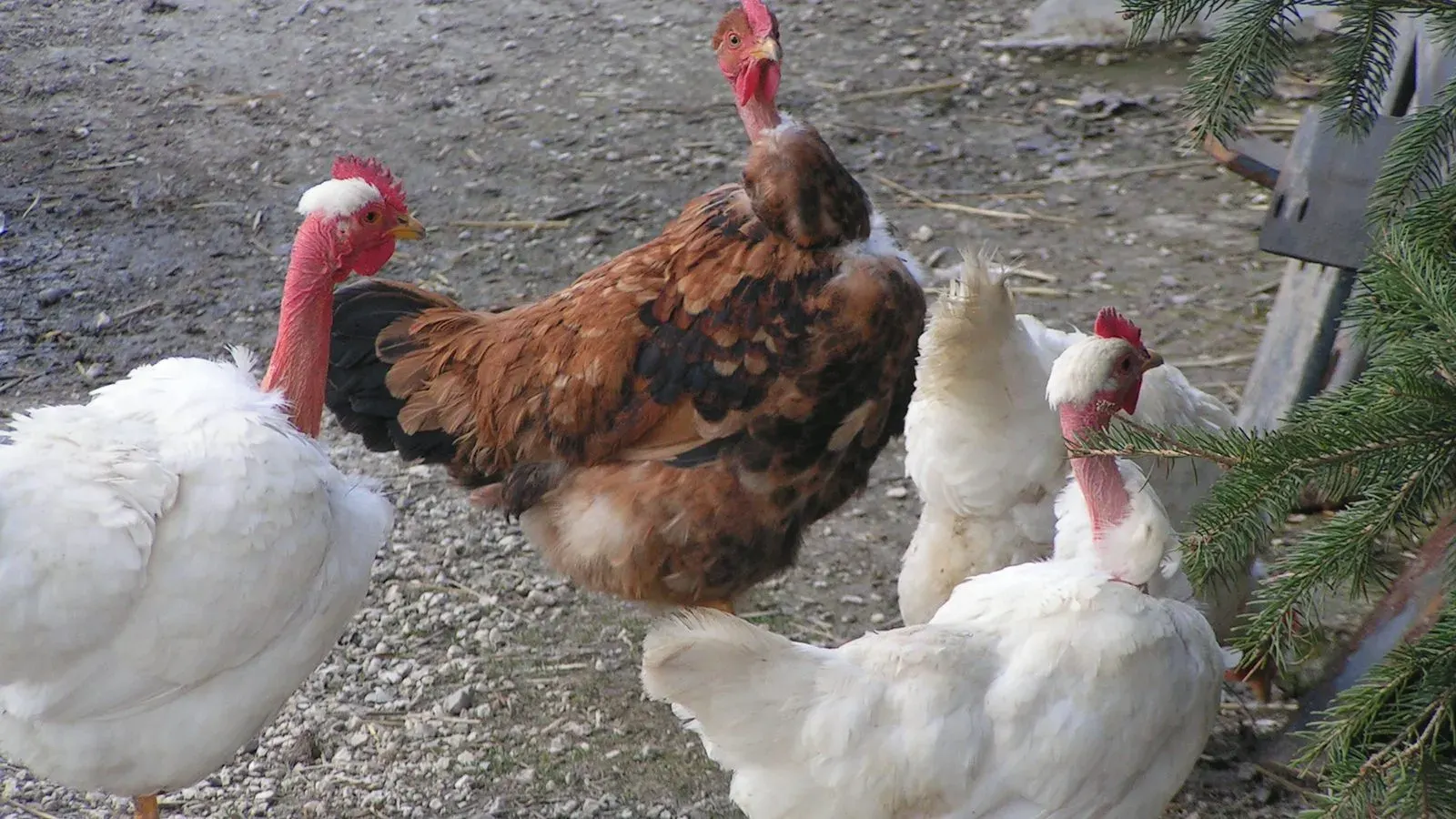
A grown turkey is taller than a hen and far wider in the head. A tom with a full snood and caruncles does not fit through an opening designed around a laying hen's beak, and if he cannot get his head in comfortably he will either stop using the feeder or wear the edges of the port trying.
So the deciding specification is the size of the opening a bird eats through, and then the height you can set the feeder at. Neither is published by the port feeders here. The 8 port Fewuto and the 10 port BUYYAH both count their ports and neither gives a port dimension, which means you are buying blind on the one measurement that decides whether the feeder works for your birds. That is the reason an open trough wins this page.
Our picks at a glance
Every product below wins one specific situation. Pick the row that matches your flock, your yard and your budget rather than reading top to bottom.
-
Best Overall

NAOEDEAH 30 lb
A mixed or growing flock where birds range from poults to full sized toms and you need one feeder that suits all of them.
-
Best for Long Gaps Between Refills

Fewuto 50 lb 8-Port
A larger flock of grown birds where refill trips are the main annoyance and eight feeding stations are worth more than a guaranteed head fit.
-
Best for Raising the Height as Poults Grow

FARM-TUFF Plastic 25
Anyone raising poults through to grown birds who wants one feeder that can be raised and slowed as the flock changes.
-
Best for a Barn Flock of Turkeys

BUYYAH 10-Port
A barn flock of turkeys under a permanent roof where the feeder is installed once and stays put for the season.
Check price on Amazon for BUYYAH 10-Port Turkey Feeder 50-100LB Capacity on AmazonAbout $170 checked Aug 8, 2026
-
Best for Washing Out Wet Feed

Plexon 17.6 lb
A covered pen where feed keeps getting damp and the feeder needs washing out often without rusting.
-
Best for Poults in the Brooder

LFM 5 lb Feeder
Raising a batch of poults in a brooder, where small amounts of fresh feed and easy daily cleaning matter more than capacity.
Compare every pick side by side
Swipe the table sideways to see every column on a phone.
| Product | Award | Price band | Capacity | Material | Feed Delivery | Weather Protection | Birds Listed | Waste Control | Best use case | Buy link |
|---|---|---|---|---|---|---|---|---|---|---|
| NAOEDEAH 30 lb | Best Overall | $30 to $60 | 30 to 35 lb, listed as 28 L | Galvanised metal trough with a rust-resistant coating | Gravity trough with a feeding port baffle you open by day and close at night | Waterproof port cover against rain | Chickens, ducks, turkeys and geese | Raised placement on 4.3 in adjustable legs or hung from the included kit | A mixed or growing flock where birds range from poults to full sized toms… | Check price for NAOEDEAH 30lb Metal Hanging Automatic Chicken Feeder Duck Feeder for Outside Gravity Trough Large Outdoor Duckling Feeders no Waste Raised Auto Turkey Poultry Feeder Chicken Food Dispenser for Coop on Amazon |
| Fewuto 50 lb 8-Port | Best for Long Gaps Between Refills | $60 to $120 | 50 lb | Heavy-duty galvanised metal with a clear acrylic level window | Gravity fed through 8 evenly spaced feeding ports | Rainproof lid and sealed ports, listed as rodent proof too | Chickens, ducks, turkeys, quails and other poultry | Feed dispenses only as needed and 8 ports cut crowding and spill | A larger flock of grown birds where refill trips are the main annoyance a… | Check price for Fewuto Automatic Chicken Feeder 8 Feeding Ports, 50lbs No-Waste Gravity Poultry Feeder 8 Feeding Ports with Rainproof Lid, Rodent-Proof Large Capacity Metal Chicken Feeder for Hens, Ducks, Birds on Amazon |
| FARM-TUFF Plastic 25 | Best for Raising the Height as Poults Grow | $30 to $60 | 25 lb | BPA-free heavy-duty polyethylene, semi-opaque so feed level shows | Gravity-fed pan with five flow levels set by three metal clips | Rust-proof plastic built for outdoor weather, no rain hood described | Large flocks, ducks and turkeys | Adjustable flow plus a 2.25 in feeding lip, hangs to stop tipping | Anyone raising poults through to grown birds who wants one feeder that ca… | Check price for FARM-TUFF Hanging Poultry Feeder, 25lb Capacity - Extra-Large BPA-Free Plastic Chicken Feeder with Adjustable Feed Flow - Semi-Opaque Gravity-Fed Design for Large Flocks, Ducks & Turkeys on Amazon |
| BUYYAH 10-Port | Best for a Barn Flock of Turkeys | $120 to $250 | Stated as 50 to 100 lb | Heavy-duty steel with a rust-resistant finish | 10 feeding ports so several turkeys eat at once | Not stated, listing only says suitable for outdoor and indoor use | Turkeys, birds and poultry | Port shape designed to stop feed being carried out, US patent pending | A barn flock of turkeys under a permanent roof where the feeder is instal… | Check price for BUYYAH 10-Port Turkey Feeder 50-100LB Capacity on Amazon |
| Plexon 17.6 lb | Best for Washing Out Wet Feed | $30 to $60 | 17.6 lb, listed as 7.9 kg | Food-grade 304 stainless steel | Gravity hopper that flows into an open tray as birds eat | Listing says the body resists rust and weather exposure, no lid described | Chickens, ducks, turkeys and other poultry | Hangs by a built-in handle to keep feed off the ground and cut scattering | A covered pen where feed keeps getting damp and the feeder needs washing… | Check price for Plexon 17.6 Lb Hanging Chicken Feeder Metal Chicken Feeder with Handle no Waste Food - Stainless Steel - Turkey Duck Poultry Feeder - Heavy Duty Feeding Equipment - Grade Large on Amazon |
| LFM 5 lb Feeder | Best for Poults in the Brooder | Under $30 | 5 lb, listed as 2.2 kg | Not stated, listing only says durable materials | Covered container with a removable lid and controlled access to the feed | Listing says it withstands various weather conditions, no rain hood described | Chickens, ducks, turkeys, quail and baby chicks | Controlled access design that the listing says reduces spillage | Raising a batch of poults in a brooder, where small amounts of fresh feed… | Check price for Little Family Members Large Chicken Feeder 5-Pound Capacity for All Poultry | Durable Feeding Container with Carrying Handle for Chickens, Ducks, Turkeys, Quail, Baby Chicks, Turkeys and More on Amazon |
The full reviews
Each review below follows the same order: what it is, why it won its category, how it behaves in real use, and who should buy something else.
1 Best Overall
NAOEDEAH 30lb Metal Hanging Automatic Chicken Feeder Duck Feeder for Outside Gravity Trough Large Outdoor Duckling Feeders no Waste Raised Auto Turkey Poultry Feeder Chicken Food Dispenser for Coop
An open galvanised trough fits any head from a poult to a full grown tom, and counted on its lower 30 lb figure it works out at about $1.53 for every pound of feed it holds, the lowest cost per pound on this page.
What we liked
- Open galvanised trough suits every head size, so it works from poults through to grown toms
- 30 to 35 lb is around a week of feed for six grown turkeys
- About $1.53 for every pound of capacity counted at 30 lb, the lowest cost per pound in this guide
- Waterproof port cover you open in the morning and close at night against rain and rodents
- Hangs from the included kit or stands on adjustable legs, so height can be set to the birds
What we did not
- The port cover only pays off if someone opens it every morning and shuts it every evening without fail
- The adjustable legs are only 4.3 in, so most people will still hang it or stand it on blocks to reach turkey height
- The only feeding figure given is 9 ducks for 4 to 5 days, with nothing stated for turkeys at all
- An open trough catches rain, bedding and droppings whenever the cover is open, so it needs emptying and drying after wet weather
Key specifications
- Dimensions
- 12.8 x 9.8 x 20.7 in (L x W x H)
- Colour
- Orange
- Capacity
- 30 to 35 lb, listed as 28 L
- Material
- Galvanised metal trough with a rust-resistant coating
- Feed Delivery
- Gravity trough with a feeding port baffle you open by day and close at night
- Weather Protection
- Waterproof port cover against rain
- Birds Listed
- Chickens, ducks, turkeys and geese
- Waste Control
- Raised placement on 4.3 in adjustable legs or hung from the included kit
- Listing Note
- The only feeding figure given is 9 ducks for 4 to 5 days, nothing for turkeys
Why the NAOEDEAH 30 lb wins this category
Because it answers the question the port feeders leave blank. A turkey has a wide head, and a tom carries a snood and caruncles that a hen-sized port will not clear. Neither the 8 port Fewuto nor the 10 port BUYYAH publishes a port dimension, so both are bought on trust.
An open galvanised trough removes the question. Any head fits, at any age, and it will still fit next season when the poults are toms.
The money supports it too. Thirty pounds at $45.98 is about $1.53 for every pound of feed it holds, and that uses the lower end of its stated 30 to 35 lb range. Nothing else here gets close: the Fewuto 50 lb is about $1.74 a pound held, and even the BUYYAH read at its top claimed figure of 100 lb only reaches about $1.70. For six grown turkeys eating roughly half to three quarters of a pound each per day, that is about a week between refills.
Living with the NAOEDEAH 30 lb
The design is a gravity trough behind a feeding port baffle. You open the baffle in the morning and close it at dusk, which turns an open trough into a closed box overnight. That is the oldest and most reliable rodent control in poultry keeping and it costs nothing but the habit.
The waterproof cover means rain stays off the feed while the birds are eating, and a galvanised body with a rust-resistant coating means the trough itself survives being hosed out regularly.
Mounting is flexible. It hangs from the included kit or stands on adjustable legs, and it is listed for chickens, ducks, turkeys and geese, which is genuinely useful in a mixed yard where one feeder has to suit several species.
Where the NAOEDEAH 30 lb falls short
The chore is the honest drawback. The cover only helps on the days it gets used. Miss a few evenings and you have an ordinary open trough sitting out all night, which is exactly the arrangement that keeps a rodent population fed.
The legs are the second issue. At 4.3 in they raise the trough off wet ground and they do not get anywhere near turkey back height, which is where a feeder lip should sit to cut billing out. In practice most people will hang it or stand it on blocks, so treat the legs as a wet ground fix rather than a height adjustment.
The missing turkey figure is the third. The only feeding duration on the listing is 9 ducks for 4 to 5 days, and a duck and a grown turkey eat very different amounts. Do the arithmetic yourself from about half to three quarters of a pound per bird per day.
Research based, not hands-on
Assessed on the open trough design against turkey head size, the published capacity, the cover and leg specification, and price per pound of capacity against the five other feeders here.
- Best for
- A mixed or growing flock where birds range from poults to full sized toms and you need one feeder that suits all of them.
- Skip it if
- Nobody will be there twice a day to open and close the cover, because an open trough left out overnight feeds rodents and wild birds.
- The limitation to plan around
- The daily routine is the thing to plan around. The cover is the feature that makes this feeder good and it does nothing at all unless it is actually opened and shut each day.
2 Best for Long Gaps Between Refills
Fewuto Automatic Chicken Feeder 8 Feeding Ports, 50lbs No-Waste Gravity Poultry Feeder 8 Feeding Ports with Rainproof Lid, Rodent-Proof Large Capacity Metal Chicken Feeder for Hens, Ducks, Birds
Fifty pounds is the largest firm capacity here, about eleven days for six grown turkeys, and the catch is that a port feeder never publishes the port dimension that decides whether a tom can use it.
What we liked
- 50 lb is the largest stated firm capacity in this guide
- Around eleven days between refills for six grown turkeys
- Eight ports let several birds feed at once without crowding a single trough
- Clear acrylic level window shows the feed level without opening the lid
- About $1.74 for every pound held, second only to the NAOEDEAH 30 lb among the feeders you can actually cost
What we did not
- No port dimension is published anywhere, so whether a grown tom with a snood can feed from it is unknown until the box arrives
- The listed dimensions of 3.93 by 3.14 by 1.96 in are smaller than a paperback and cannot describe a 50 lb feeder
- The rodent proof claim comes with no metal gauge, seal detail or closing mechanism behind it
- Fifty pounds takes weeks for a small flock to eat, and feed sitting that long absorbs damp and bridges in the hopper
Key specifications
- Dimensions
- 3.93700787 x 3.149606296 x 1.968503935 in (L x W x H)
- Colour
- Black
- Capacity
- 50 lb
- Material
- Heavy-duty galvanised metal with a clear acrylic level window
- Feed Delivery
- Gravity fed through 8 evenly spaced feeding ports
- Weather Protection
- Rainproof lid and sealed ports, listed as rodent proof too
- Birds Listed
- Chickens, ducks, turkeys, quails and other poultry
- Waste Control
- Feed dispenses only as needed and 8 ports cut crowding and spill
Why the Fewuto 50 lb 8-Port suits long gaps
Refilling is the real cost of keeping turkeys, because they eat two or three times what a laying hen does. Six grown birds get through roughly 3 to 4.5 lb a day, so a small feeder becomes a twice daily job very quickly.
Fifty pounds is the largest firm capacity on this page and works out at around eleven days for six grown turkeys. That is a genuinely different rhythm from the four days you get from the Plexon 17.6 lb.
The eight ports matter too. Feeding space decides which birds eat well in a flock, and eight openings means the lower ranked birds are not queueing behind the dominant ones at a single trough.
At $86.99 for 50 lb it works out at about $1.74 for every pound held, second only to the NAOEDEAH 30 lb at about $1.53. The BUYYAH is the one feeder that could undercut it, and only if its capacity is read at the very top of the 50 to 100 lb range it prints, which is not a number you can plan on.
Living with the Fewuto 50 lb 8-Port
Gravity does the work. Feed drops into the ports as birds empty them, so there is nothing to set up and nothing to power, and the only usual problem is damp feed bridging in the hopper.
The clear acrylic level window is a small feature with a real effect on routine. Being able to see the feed level from across the pen means it gets checked, rather than being remembered on the morning it runs out.
Heavy-duty galvanised metal with a rainproof lid means it can live outdoors, and the ports are described as sealed, which keeps the feed inside them dry.
Where the Fewuto 50 lb 8-Port falls short
The port dimension is missing and it is the specification that decides everything for turkeys. A mature tom has a wide head with a snood and caruncles, and a port designed around a chicken or a duck may not clear it. The listing names turkeys among the species and gives no measurement, so the claim cannot be checked before purchase.
The dimensions printed on the listing make that worse rather than better. Three point nine by 3.1 by 2.0 in is smaller than a paperback book. That is a placeholder, not a measurement of a 50 lb feeder, and a listing that gets its own overall size that wrong is not a listing to trust on port sizing either.
The rodent proof wording is the third gap. There is no metal gauge, no seal specification and no closing mechanism described, and open ports do not shut at night whatever the title says.
Capacity has a cost too. A small flock takes weeks to eat 50 lb, and feed sitting in a hopper that long picks up moisture and cakes. Fill it part way if you keep fewer than about six grown birds.
Research based, not hands-on
Assessed on the published capacity, port count, material and lid description, and on the absence of any port dimension, plus a check of the listing's own dimension figures against the stated capacity.
- Best for
- A larger flock of grown birds where refill trips are the main annoyance and eight feeding stations are worth more than a guaranteed head fit.
- Skip it if
- You keep heavy toms, because a port sized around chickens and ducks may not clear a mature turkey's head and nothing on the listing tells you either way.
- The limitation to plan around
- The unpublished port size is the thing to plan around. Check the ports against your biggest bird as soon as it arrives, while you can still send it back.
3 Best for Raising the Height as Poults Grow
FARM-TUFF Hanging Poultry Feeder, 25lb Capacity - Extra-Large BPA-Free Plastic Chicken Feeder with Adjustable Feed Flow - Semi-Opaque Gravity-Fed Design for Large Flocks, Ducks & Turkeys
It hangs, so the lip can be raised a few inches at a time as poults turn into grown birds, and five flow settings let you slow the feed down while they are still small.
What we liked
- Hangs, so the lip can be raised to back height as the birds grow
- Five flow levels set by three metal clips, so feed delivery matches the size of the birds
- A 2.25 in feeding lip is a real barrier against feed being billed out onto the floor
- Semi-opaque body shows the feed level without opening anything
- At 2.8 lb empty it is light enough to lift down and wash out one handed
What we did not
- No rain hood is described, so feed sitting in the open pan turns to paste in wet weather
- Polyethylene goes brittle after a few seasons of sun and frost, and a cracked hanging pan cannot be repaired
- 25 lb is only about six days for six grown turkeys, so it does not suit long gaps between refills
- About $1.92 for every pound held, more per pound than both the NAOEDEAH 30 lb and the Fewuto 50 lb
Key specifications
- Dimensions
- 15 x 15 x 13.5 in (L x W x H)
- Weight
- 2.8 pounds
- Colour
- Opaque, Red
- Capacity
- 25 lb
- Material
- BPA-free heavy-duty polyethylene, semi-opaque so feed level shows
- Feed Delivery
- Gravity-fed pan with five flow levels set by three metal clips
- Weather Protection
- Rust-proof plastic built for outdoor weather, no rain hood described
- Birds Listed
- Large flocks, ducks and turkeys
- Waste Control
- Adjustable flow plus a 2.25 in feeding lip, hangs to stop tipping
Why the FARM-TUFF Plastic 25 grows with the flock
Height is the second thing that decides a turkey feeder and it gets ignored because it is not a number on a box. Set the lip too low and the birds stand over the pan and sweep feed onto the floor. Set it near back height and most of it stays in.
The problem with turkeys is that back height keeps moving. A poult and a five month old bird are different animals, and a feeder fixed at one height is wrong for most of that period. Hanging solves it. Shorten the chain a few inches every few weeks and the lip stays where it should be.
The five flow levels do the same job for the feed itself. Three metal clips set how fast feed drops into the pan, so you can run it slow while the birds are small and open it up as they eat more. A pan filled only a third full gives them far less to sweep sideways.
Living with the FARM-TUFF Plastic 25
It is light. At 2.8 lb empty you can unhook it with one hand, tip it out and scrub it, which matters because a plastic pan needs washing more often than a stainless one.
The semi-opaque body is the small feature that changes the routine. You can see the level from a few feet away, so checking becomes a glance rather than a task.
The 2.25 in feeding lip is the part that earns the no waste description. It is a physical wall between a sweeping beak and the floor, which is a more honest anti-waste mechanism than most feeders manage.
Twenty five pounds is roughly six days for six grown turkeys and considerably longer while they are still growing.
Where the FARM-TUFF Plastic 25 falls short
There is no rain hood. The listing says the plastic is rust-proof and built for outdoor weather, which is a statement about the material rather than about the feed sitting in an open pan. Rain gets in, feed turns to paste, and paste cakes in the pan and goes mouldy. Under a barn roof this is a non-issue. Out in the open it is a daily problem.
Polyethylene is the second limit. It is fine for several seasons and it does go brittle with sun and frost, and a hanging pan that cracks at the suspension point is not something you repair. The Plexon 17.6 lb is 304 stainless and has no coating or polymer to degrade, which is what the higher price per pound held is buying.
Capacity is the third. Twenty five pounds is around six days for six grown birds, so this is a weekly refill rather than a fortnightly one, and it works out at about $1.92 per pound of capacity against $1.53 for the NAOEDEAH 30 lb.
Research based, not hands-on
Assessed on the hanging design and adjustable flow settings, the stated lip depth, the polyethylene construction and the absence of any described rain hood.
- Best for
- Anyone raising poults through to grown birds who wants one feeder that can be raised and slowed as the flock changes.
- Skip it if
- The feeder will live out in the open, because there is no rain hood and wet feed in an open pan cakes and moulds.
- The limitation to plan around
- Weather protection is the thing to plan around. Hang it under a barn roof or a covered run, or accept emptying and drying the pan after every proper downpour.
4 Best for a Barn Flock of Turkeys
BUYYAH 10-Port Turkey Feeder 50-100LB Capacity
The only feeder here designed and sold specifically for turkeys rather than adapted from a chicken product, with ten ports and a heavy steel body, and the most expensive thing on this page at $169.99.
What we liked
- Sold specifically as a turkey feeder rather than a chicken feeder with turkeys added to the title
- Ten feeding ports, the most feeding stations in this guide
- Heavy-duty steel with a rust-resistant finish and a 48 lb empty weight that will not get shoved around
- Large 31.5 by 15.9 by 28.4 in body suited to a barn or a permanent shelter
- Port shape designed to stop feed being carried out of the feeder
What we did not
- Capacity is given as a 50 to 100 lb range with no fill line, which is a doubling rather than a specification
- No port dimension is published, so whether a mature tom's head clears the opening is unknown before it arrives
- Weather protection is not stated at all, only that it suits outdoor and indoor use, so it needs a roof over it
- At 48 lb empty it cannot be moved for cleaning by one person, and a feeder that is hard to strip down gets cleaned less often
About $170 checked Aug 8, 2026
Key specifications
- Dimensions
- 31.5 x 15.9 x 28.4 in (L x W x H)
- Weight
- 48 pounds
- Colour
- Black
- Capacity
- Stated as 50 to 100 lb
- Material
- Heavy-duty steel with a rust-resistant finish
- Feed Delivery
- 10 feeding ports so several turkeys eat at once
- Weather Protection
- Not stated, listing only says suitable for outdoor and indoor use
- Birds Listed
- Turkeys, birds and poultry
- Waste Control
- Port shape designed to stop feed being carried out, US patent pending
- Listing Note
- Capacity is given as a 50 to 100 lb range with no fill line, and the 10 turkeys at once figure is the maker's claim
Why the BUYYAH 10-Port suits a barn flock
Almost every product in this category is a chicken feeder with the word turkey added somewhere in the title. This one is sold as a turkey feeder first, and for a barn flock that framing turns out to match the hardware.
Ten ports is the most feeding space on this page. In a flock of any size the birds at the bottom of the order eat last and eat least, and ten stations is the direct fix for that.
The build is barn scale. Thirty one and a half inches wide, 28.4 in tall and 48 lb empty in heavy-duty steel. That is a feeder that stays exactly where you put it and does not get tipped by a flock of birds working one side of it.
The port shape is described as designed to stop feed being carried out, with a US patent pending, which is at least a specific claim about a specific mechanism.
Living with the BUYYAH 10-Port
Once it is placed, it is placed. Forty eight pounds empty means installing it is a two person job and moving it later is not something you do casually, so choose the spot with drainage, access and the birds' traffic pattern in mind.
The steel body with a rust-resistant finish is specified for the humidity of a barn and the abrasion of birds working at the ports, which is more than the plastic and thin sheet options on this page can say.
Capacity is somewhere between 50 and 100 lb. At the low end, six grown turkeys eating roughly half to three quarters of a pound a day get about eleven days from it. At the high end that doubles. Without a fill line you will be judging by eye either way.
Where the BUYYAH 10-Port falls short
The capacity range is the first problem, and it is not a small one. Fifty to 100 lb is a doubling. No feeder is genuinely both, and with no fill line printed there is no way to know where in that range a normal fill lands. The 10 turkeys at once figure is the maker's claim too, not a measured one.
The missing port dimension is the second, and it matters more here than anywhere else on the page because this feeder is specifically sold for turkeys. If the whole pitch is that turkeys fit, publishing the opening size would settle it. The listing does not.
Weather protection is not stated at all. The listing says the feeder suits outdoor and indoor use, which is not the same as describing a lid or a rain hood, so plan on a roof over it.
Then there is the price. At $169.99 it is the most expensive feeder in this comparison, and it is the one whose capacity figure you can trust least.
Research based, not hands-on
Assessed on the published port count, body dimensions and material, and on the quality of the capacity figure and the absence of both a port dimension and any weather specification.
- Best for
- A barn flock of turkeys under a permanent roof where the feeder is installed once and stays put for the season.
- Skip it if
- You keep a handful of birds in a small pen, because a 48 lb steel feeder more than 31 in wide is far more equipment than that needs.
- The limitation to plan around
- The vague capacity is the thing to plan around. With a 50 to 100 lb range and no fill line, you cannot size refills properly, so plan on checking the level rather than counting days.
5 Best for Washing Out Wet Feed
Plexon 17.6 Lb Hanging Chicken Feeder Metal Chicken Feeder with Handle no Waste Food - Stainless Steel - Turkey Duck Poultry Feeder - Heavy Duty Feeding Equipment - Grade Large
Food-grade 304 stainless steel with a built-in handle, which is the only combination here built for unhooking and scrubbing out damp feed repeatedly, and it costs the most per pound of capacity in this guide.
What we liked
- Food-grade 304 stainless steel, so it can be scrubbed hard and repeatedly without corroding
- Built-in handle means unhooking it for a wash is a one handed job
- Hangs, so the lip can be raised to the birds' back height as they grow
- Open tray fed by a gravity hopper suits wide turkey heads with no port to squeeze through
- Steel rather than the polyethylene of the FARM-TUFF, so sun and frost cannot make the body brittle
What we did not
- At 17.6 lb it holds about four days of feed for six grown turkeys, the shortest run of any full sized feeder here
- About $3.41 for every pound held, the highest cost per pound in this guide
- No lid is described, so rain falls straight into the open tray and the feed underneath it
- A light stainless feeder on a hook swings when birds crowd it, which spills feed unless it is tied off or hung low
Key specifications
- Dimensions
- 14.36 x 9.25 x 10.43 in (L x W x H)
- Colour
- Metallic
- Capacity
- 17.6 lb, listed as 7.9 kg
- Material
- Food-grade 304 stainless steel
- Feed Delivery
- Gravity hopper that flows into an open tray as birds eat
- Weather Protection
- Listing says the body resists rust and weather exposure, no lid described
- Birds Listed
- Chickens, ducks, turkeys and other poultry
- Waste Control
- Hangs by a built-in handle to keep feed off the ground and cut scattering
Why the Plexon 17.6 lb wins on cleaning
Wet feed is the recurring problem in a turkey pen. Birds drink, they carry water back to the feeder on their faces, and a damp patch in a pan of crumble sets into a crust that goes mouldy rather than just going stale.
The answer is a feeder you can wash properly and often, and food-grade 304 stainless steel is the material that tolerates that. Hot water, a stiff brush and a scouring pad do not damage it, and there is no coating to scratch through into bare steel underneath.
The built-in handle is the detail that makes it happen. A feeder you can unhook with one hand gets washed. A feeder you have to unbolt does not.
The open tray helps in a turkey pen too. There is no port to squeeze a wide head through, so it suits grown birds as well as poults.
Living with the Plexon 17.6 lb
It hangs, which is the right arrangement for turkeys. Raising the lip toward the birds' back height is the single most effective thing you can do about billing out, and a hanging feeder lets you do it a few inches at a time as they grow.
At 14.36 by 9.25 by 10.43 in it is compact, and 17.6 lb of capacity fits into that small body because the hopper feeds a shallow tray rather than a deep pan.
The material is the other everyday difference. The polyethylene FARM-TUFF Plastic 25 costs less per pound of capacity and it is the one that eventually goes brittle in sun and frost, which is not a failure mode 304 stainless has.
Where the Plexon 17.6 lb falls short
Capacity is the honest limit. Seventeen point six pounds is about four days of feed for six grown turkeys, so this is a small flock feeder or a second feeding point rather than the only one in the pen.
The cost per pound follows from that. About $3.41 for every pound held is the highest figure in this guide, roughly double the $1.74 of the Fewuto 50 lb 8-Port.
No lid is described. The listing says the body resists rust and weather exposure, which is a statement about the steel and not about the feed sitting in an open tray. Rain goes straight in, which is a strange gap for a feeder whose main strength is dealing with wet feed.
The weight works against it too. A light feeder on a hook swings when several birds crowd one side, and a swinging tray throws feed. Hang it low, tie it off, or accept some spill.
Research based, not hands-on
Assessed on the stainless grade, the hanging design and handle, the open tray delivery, the absence of a described lid, and price per pound of capacity against the rest of this guide.
- Best for
- A covered pen where feed keeps getting damp and the feeder needs washing out often without rusting.
- Skip it if
- You want long gaps between refills, because 17.6 lb is roughly four days for six grown turkeys.
- The limitation to plan around
- Capacity is the thing to plan around. Under 18 lb means frequent refills for grown birds, so this suits a small flock or a second feeder rather than a sole feed point.
6 Best for Poults in the Brooder
Little Family Members Large Chicken Feeder 5-Pound Capacity for All Poultry | Durable Feeding Container with Carrying Handle for Chickens, Ducks, Turkeys, Quail, Baby Chicks, Turkeys and More
Five pounds is roughly one day of feed for six grown turkeys, which makes this a brooder feeder for poults and nothing more, and at $14.99 it is priced accordingly.
What we liked
- The cheapest feeder in this guide at $14.99
- Five pounds is a sensible amount to keep fresh in front of poults
- Removable lid with controlled access keeps poults from standing in the feed
- Carrying handle and a 0.53 lb empty weight make daily washing easy
- Small 10 by 10 by 8 in footprint fits inside a brooder without crowding the heat plate
What we did not
- Six grown turkeys eating roughly half a pound each would empty it in a single day, so it cannot serve mature birds
- The material is never stated, only durable materials, so there is no way to judge how it will handle repeated scrubbing
- No rain hood is described, so it belongs indoors or under cover rather than out in a pen
- The feeder cannot be raised, so it becomes a spill problem as soon as the poults grow past brooder size
Key specifications
- Dimensions
- 10 x 10 x 8 in (L x W x H)
- Weight
- 0.53 pounds
- Colour
- Red
- Capacity
- 5 lb, listed as 2.2 kg
- Material
- Not stated, listing only says durable materials
- Feed Delivery
- Covered container with a removable lid and controlled access to the feed
- Weather Protection
- Listing says it withstands various weather conditions, no rain hood described
- Birds Listed
- Chickens, ducks, turkeys, quail and baby chicks
- Waste Control
- Controlled access design that the listing says reduces spillage
Why the LFM 5 lb Feeder belongs in the brooder
Small capacity is a fault in a grown bird feeder and a feature in a brooder. Poults need feed in front of them all the time, and feed sitting in a brooder gets warm, dusty and fouled quickly, so a smaller amount turned over more often is fresher than a big hopper standing for a week.
Five pounds is about right for that. It is enough that you are not topping it up hourly and little enough that what is in there is always recent.
The covered container with a removable lid and controlled access is doing the same job a holed lid does in a chick brooder. Poults that cannot stand in the feed cannot scratch it out or foul it, and both are the main ways feed gets wasted in the first weeks.
At $14.99 it is the cheapest feeder in this comparison, and for the four to six weeks it is genuinely useful that is fair.
Living with the LFM 5 lb Feeder
At 0.53 lb empty and 10 by 10 by 8 in it is a small light box with a carrying handle. That is exactly what you want for something that gets emptied, washed and refilled every day or two.
Position it at the cool end of the brooder, away from the heat plate. Warm feed goes off faster, and putting the feed away from the heat also gives the poults a reason to move around and regulate their own temperature rather than sitting under the lamp.
It is listed for chickens, ducks, turkeys, quail and baby chicks, and that breadth is honest for a small covered feeder. Every young bird of every species has the same requirement at this stage.
Where the LFM 5 lb Feeder falls short
Capacity ends its usefulness abruptly. A grown turkey eats roughly half to three quarters of a pound a day, so six mature birds would empty this in a single day. It is not a small feeder for turkeys, it is a feeder for turkeys that are not grown yet. Plan on buying a second feeder before the poults are half grown.
The material is never stated. Durable materials is not a specification, and with no plastic type or metal named there is no way to judge whether it will survive repeated hot water and scrubbing, which is what a brooder feeder gets.
There is no rain hood described either, so this is an indoor or under cover item. The listing says it withstands various weather conditions, which is the same vague phrasing as the material claim.
It also cannot be raised. Height is what controls waste once birds grow, and a feeder that sits on the floor is a feeder they will stand over and sweep out.
Research based, not hands-on
Assessed on the stated 5 lb capacity set against grown turkey daily intake, the lid and access description, the dimensions, and the absence of any stated material.
- Best for
- Raising a batch of poults in a brooder, where small amounts of fresh feed and easy daily cleaning matter more than capacity.
- Skip it if
- You are feeding grown turkeys, because 5 lb is about a day for six birds and this is the wrong tool entirely.
- The limitation to plan around
- Capacity is the thing to plan around. Five pounds is a brooder quantity, so budget for a second larger feeder before the poults are half grown.
How we compared these turkey feeders
The first question was the size of the opening a bird eats through. A turkey is a different shape from a chicken at the head end, and that is where a feeder either works or does not.
That question separates this page immediately. Two feeders here sell themselves on port count, the 8 port Fewuto and the 10 port BUYYAH, and neither publishes a port dimension. Counting ports tells you how many birds can eat at once. It tells you nothing about whether any of them fit.
After that, height, because a feeder set too low is a feeder emptying onto the floor. Then capacity, measured against a grown turkey's daily intake rather than against a chicken's. Then weather protection, waste control at the lip, and whether the listing's numbers agree with each other, which in this category they often do not.
Nothing was set up in a barn for this comparison. This is published specification, listing wording and known failure modes.
What actually matters in a turkey feeder
The opening a turkey eats through
A laying hen has a narrow head and a small beak. A mature turkey has a wide skull, and a tom carries a snood and caruncles that add bulk around the whole front of the face.
A port shaped for a hen is a poor fit for that, and there are two outcomes. Either the bird gives up and eats elsewhere, or it forces its head in and out repeatedly and rubs the port edges against skin that is already prone to damage.
An open trough sidesteps the problem entirely. Any head fits, from a day old poult to a full grown tom, which is why the NAOEDEAH 30 lb takes the top slot here despite being neither the biggest nor the most sophisticated feeder on the page.
If you want ports, buy them with your eyes open. The Fewuto and the BUYYAH may well be sized generously. Neither listing gives you a way to find out before the box arrives.
Height, and why it decides waste
Set the lip near the height of the birds' backs. That one adjustment cuts billing out more than any no waste feature described in a bullet point.
The reason is mechanical. A feeder at floor level lets a turkey stand over it and sweep sideways, which is exactly what turkeys do, and everything swept goes onto the ground. Raise it and the bird has to reach in and lift its head, which keeps the feed inside the pan.
This is the real argument for a hanging feeder. The FARM-TUFF Plastic 25 and the Plexon 17.6 lb both hang, so you can raise them a few inches at a time as poults grow into birds. The NAOEDEAH has adjustable legs, and at 4.3 in they are short, so most people will end up hanging it or standing it on blocks anyway.
Capacity against what a turkey actually eats
A grown turkey eats roughly half to three quarters of a pound a day. That is two or three times a laying hen, and it changes every capacity figure on this page.
Run it for six birds. The LFM 5 lb Feeder holds about one day of feed, which makes it a brooder feeder and nothing else. The Plexon 17.6 lb is about four days. The FARM-TUFF Plastic 25 is around six days. The NAOEDEAH 30 lb is about a week. The Fewuto 50 lb 8-Port is around eleven days.
Cost per pound held sorts them the same way it sorts feeders anywhere. The NAOEDEAH works out at about $1.53 for every pound of capacity, the Fewuto about $1.74, the FARM-TUFF about $1.92, the LFM about $3.00 and the Plexon about $3.41, which is the dearest per pound here. The BUYYAH cannot be placed on that list, because its 50 to 100 lb range puts it anywhere between $1.70 and $3.40.
Read the listings against themselves
Two figures on this page do not stand up and both are worth knowing before you order.
The Fewuto lists dimensions of 3.93 by 3.14 by 1.96 in. That is smaller than a paperback and it cannot be a 50 lb feeder, so it is a placeholder rather than a measurement. Its rodent proof claim comes with no seal detail and no metal gauge either.
The BUYYAH gives its capacity as 50 to 100 lb with no fill line, which is a doubling rather than a specification, and its 10 turkeys at once figure is the maker's claim rather than anything measured.
Sizing and setting up a turkey feeder
Work out your daily feed first. Multiply the number of grown birds by about half to three quarters of a pound, then decide how many days you want between refills. That gives you a capacity, and it is a far better guide than the flock counts printed on boxes.
Then decide where it lives. Under a barn roof, an open pan is fine and easier to clean. Outdoors, you need a cover or a routine, because wet feed cakes and moulds rather than just going to waste.
Set the height on day one and plan to change it. Poults need a low lip and grown birds need a high one, and a feeder that cannot be raised will be wasting feed within a couple of months.
Finally, do not fill the pan to the brim. A third full gives the birds less to sweep sideways and costs you nothing, since the hopper refills the pan as they eat.
Final recommendation
The NAOEDEAH 30 lb is the pick. An open galvanised trough fits every bird you will ever put in front of it, 30 lb is about a week for six grown turkeys, the waterproof port cover lets you shut the feeder at night, and counted at its lower 30 lb figure it works out at about $1.53 for every pound it holds, the lowest cost per pound on this page.
If refill trips are the problem, the Fewuto 50 lb 8-Port holds the most feed of the firm capacity options, on the understanding that you are buying its ports unseen. If you are raising poults through to grown birds, the FARM-TUFF Plastic 25 hangs and has five flow settings, so you can raise it and slow it as they grow. And if the feeder needs washing out regularly because the feed keeps getting wet, the Plexon 17.6 lb is food-grade 304 stainless steel with a handle to lift it by.
Questions people ask before buying
Can turkeys use a normal chicken feeder?
Poults can and grown turkeys often cannot. The problem is head size rather than body size. A mature turkey has a much wider head than a laying hen, and a tom carries a snood and caruncles that a narrow port simply will not clear. An open trough or a wide pan works for every bird you will ever keep. A port feeder built around a hen may work fine for a few weeks and then quietly stop being usable as the birds mature.
How much feed does a turkey eat in a day?
A grown turkey eats roughly half to three quarters of a pound a day, which is two or three times what a laying hen eats. That single number reframes the whole capacity question. Six grown turkeys get through about 3 to 4.5 lb a day, so a 5 lb feeder is a single day, 30 lb is around a week and 50 lb is around eleven days. Poults eat far less, so a small feeder is genuinely fine in the brooder.
What height should a turkey feeder be set at?
The usual guidance is to set the lip roughly at the height of the birds' backs, and it does more for waste than any no waste badge on a box. A feeder that sits too low invites birds to stand in it, scratch and bill feed out onto the floor. A feeder at back height means they have to reach in and lift their heads to swallow, which keeps most of the feed inside. Raise it as the birds grow rather than setting it once.
Why is my turkey throwing feed all over the floor?
That sideways sweep is called billing out and it is normal turkey behaviour rather than a fault. Three things reduce it. Raise the feeder so the lip is near back height. Do not fill the pan more than about a third full, because a shallow layer gives them less to sweep. And choose a feeder with a lip or a flow adjustment, like the 2.25 in lip and five flow settings on the FARM-TUFF Plastic 25.
Do I need a covered feeder or will an open one do?
An open feeder is fine under a barn roof or a covered run and it is a problem outdoors. Rain turns feed into a paste that cakes in the corners and goes mouldy, and mouldy feed is a genuine health risk rather than just waste. If the feeder lives outside, buy a cover or accept that you will empty and dry it after wet weather. The NAOEDEAH has a waterproof port cover you close at night, and the Plexon and the FARM-TUFF describe no rain hood at all.
Should I take the feeder in at night?
If you can, yes. Turkeys do not eat after dark, so nothing is lost by shutting a cover or lifting a small feeder into a sealed store, and everything left out overnight feeds rodents and wild birds instead. The catch is that it only works if it actually happens every night. A feeder with a closing cover, like the NAOEDEAH, only earns its keep if someone opens it each morning and shuts it each evening without fail.
Why you can trust this guide
- Written by
- Marta Voss, Editor and fact checker, Chicken Geek. Specialist areas: Editorial fact checking, Chick brooding and starter nutrition, Small-flock husbandry, Feed labels and nutrition claims.
- Fact checked by
- Sam Reddick
- Published
- August 8, 2026 · Last updated August 8, 2026 · Products and links rechecked August 8, 2026
- How we picked
- Feeders were judged first on the opening a bird actually eats through and whether a port dimension is published at all, then on the height the feeder can be set or hung at, then on capacity measured against how much a grown turkey eats in a day, on weather protection, on waste control at the lip, and on how well each listing's own numbers hold together.
- Evidence used
- None of the 6 products on this page were sent to us or bought for a hands-on test. Every recommendation here is research based: manufacturer specifications, listed dimensions and materials, owner feedback at volume, and comparison against equipment our team has owned. Each review states this again above the buy button so you are never guessing which kind of evidence sits behind a pick.
- Editorial standards
- No brand pays for placement, and no manufacturer sees this page before it goes live. Read our editorial policy and testing method.
- Affiliate disclosure
- Chicken Geek is reader supported. We earn a commission from qualifying purchases made through links on this page, at no extra cost to you, and no brand has paid for a placement or an award here.
About the author

Editor and fact checker, Chicken Geek
Marta edits every guide on Chicken Geek and checks that each claim can be traced back to a manufacturer specification, a published standard or a stated first-hand observation. She keeps a small backyard flock of six hens and has raised chicks from day one for eight seasons.
- Eight seasons raising chicks from day-old to point of lay
- Checks every specification in a Chicken Geek guide against the manufacturer listing
- Removes any testing claim that cannot be backed up
- Keeps a flock of six hens in a suburban backyard