We Compared 6 Compost Bins on Volume Against a Cubic Yard
Chicken manure only composts hot when the pile holds enough mass, so we converted every stated gallon figure here into cubic feet and compared it to a cubic yard.

By Marta Voss Editor and fact checker, Chicken Geek
Fact checked by Sam Reddick
Published Prices and stock checked 7 min read

Chicken manure composts hot, which is exactly why people want a bin for it. But a pile only gets hot if it carries enough mass to hold its own heat, and extension guidance puts that threshold at about one cubic yard. That is 27 cubic feet, or roughly 202 gallons.
Almost nobody does this sum before buying. Bins are compared on doors, handles, seals and how tidy they look on a patio, and the number that decides whether the thing works is buried in the title. Divide any stated gallon figure by 7.48 and you get cubic feet. Do that across this field and only two bins clear the line.
So that is how we have ranked them. We have also been careful about what composting does and does not do to manure, because a bin does not sterilise anything, and a four to six week claim printed on a tumbler was not written with a coop clean-out in mind.
Our picks at a glance
Every product below wins one specific situation. Pick the row that matches your flock, your yard and your budget rather than reading top to bottom.
-
Best Overall
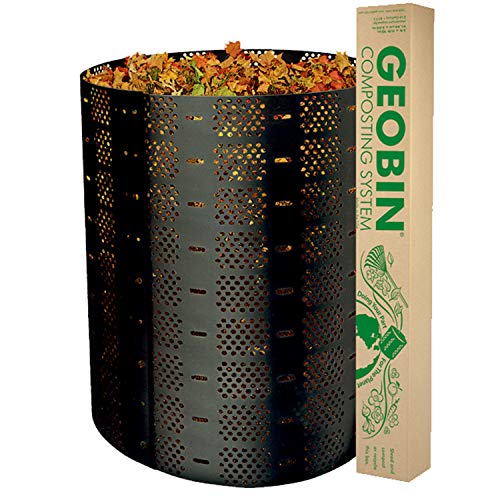
GEOBIN
Keepers who strip a coop out regularly and want the most composting volume per dollar in a spot where looks do not matter.
-
Best for a Big Flock and Weekly Deep Litter Clean-Outs

Trellume 285 gallon
Keepers with a large flock stripping deep litter weekly who need a permanent bin big enough to keep a pile hot.
-
Best Bottomless Bin to Set Straight on Soil

JupiterForce 120 gal
Keepers with a small flock who want a bin set straight on garden soil so worms can work up into the pile.
-
Best for a Bin Backed Against a Fence or Wall

Redmon 65 gallon
Keepers with a small flock and a narrow spot beside a fence or a shed where only one or two sides stay reachable.
-
Best Sealed Bin for a Patio or Deck
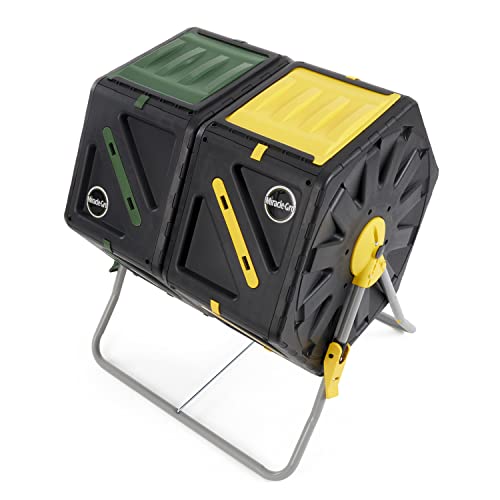
Miracle-Gro tumbler
Keepers with a tiny flock, a deck or patio, and a rodent problem that rules out an open pile on the ground.
-
Best Budget

JupiterForce 18.5 gal
Anyone with two or three hens and a balcony or patio who wants to compost kitchen scraps and the odd bucket of nest box waste.
Compare every pick side by side
Swipe the table sideways to see every column on a phone.
| Product | Award | Price band | Bin Type | Stated Capacity | Material | Access | Stated Compost Time | Best use case | Buy link |
|---|---|---|---|---|---|---|---|---|---|
| GEOBIN | Best Overall | $30 to $60 | Expandable ring bin, no lid or door listed | Title says 246 gallon, bullets say expandable to 3.75 feet and 237 gallon | Not stated, made in the USA | Closure keys make it easy to assemble, move and reassemble the ring, no lid or door listed | Not stated | Keepers who strip a coop out regularly and want the most composting volum… | Check price for Geobin Compost Bin - 246 Gallon, Expandable, Easy Assembly, Made in the USA, Outdoor & Backyard Composter on Amazon |
| Trellume 285 gallon | Best for a Big Flock and Weekly Deep Litter Clean-Outs | $120 to $250 | Static metal bin | 285 gallon | Metal with an anti-rust coating and painted finish | Bottom harvesting door, four-sided aeration vents | Not stated | Keepers with a large flock stripping deep litter weekly who need a perman… | Check price for Trellume Compost Bin Outdoor - 285 Gallon Composter with Rust-Proof Coating, Painted Finish, Large Compost Bin for Producing Fertilizer from Kitchen Waste and Fallen Leaves(Metal) on Amazon |
| JupiterForce 120 gal | Best Bottomless Bin to Set Straight on Soil | $30 to $60 | Static bin with no bottom, though the title calls it a tumbler | 120 gallon (450 L) | BPA free plastic, frost and rain proof | Top lid to load, sliding bottom door to harvest, four vents per side | Not stated | Keepers with a small flock who want a bin set straight on garden soil so… | Check price for JupiterForce 120 Gallon Large Compost Bin, BPA Free Outdoor Composting Tumblers for Garden Patio, Easy Assembling, Fast Creation of Fertile Soil, Lightweight on Amazon |
| Redmon 65 gallon | Best for a Bin Backed Against a Fence or Wall | $60 to $120 | Static bin | 65 gallon | 80 percent recycled materials | Lift-off lid plus 4-door access at the base, vent holes | Not stated | Keepers with a small flock and a narrow spot beside a fence or a shed whe… | Check price for Redmon Outdoor Compost Bin with Lift Off Lid, 4-Door Access & Vent Holes, 65 Gallon, Black - Composting Bin Container for Kitchen Food Waste Recycling on Amazon |
| Miracle-Gro tumbler | Best Sealed Bin for a Patio or Deck | $60 to $120 | Dual chamber rolling tumbler | 2 x 18.5 gallon (70 L) | BPA free food grade UV-protected plastic on a galvanised steel base | 2 sliding doors, side-locking mechanisms and tight seals against pests | 4 to 6 weeks | Keepers with a tiny flock, a deck or patio, and a rodent problem that rul… | Check price for Miracle-Gro Dual Chamber Compost Tumbler – Easy-Turn, Heavy-Duty Outdoor Bin Composter with 2 Sliding Doors (2x18.5 Gal/70L on Amazon |
| JupiterForce 18.5 gal | Best Budget | Under $30 | Tumbling composter on a support structure, one sliding door, no second chamber listed | 18.5 gallon | PP plastic | One sliding door | 4 to 6 weeks | Anyone with two or three hens and a balcony or patio who wants to compost… | Check price for JupiterForce Compost Bin Outdoor, 18.5 Gallon Heavy-Duty Tumbling Composter Tumbler with Sliding Door for All Season Gardens, Yards Waste, Black on Amazon |
The full reviews
Each review below follows the same order: what it is, why it won its category, how it behaves in real use, and who should buy something else.
1 Best Overall
Geobin Compost Bin - 246 Gallon, Expandable, Easy Assembly, Made in the USA, Outdoor & Backyard Composter
At 246 gallons, about 33 cubic feet, this $35.99 ring is one of only two bins here that clears a cubic yard, which is the mass a manure pile needs before it will heat.
What we liked
- About 33 cubic feet of volume, comfortably over the one cubic yard threshold for a pile that heats
- Roughly $1.10 per cubic foot, by a wide margin the cheapest volume in this guide
- Closure keys let you unwrap the ring, move the pile and reassemble it in minutes
- Ships flat as a 36.5 in roll, so there is nothing to assemble and nothing to store empty
- Expands to 3.75 feet across, so you can set the diameter to suit the space
What we did not
- It is an open ring with no lid and no door, so rain soaks straight into the pile in a wet season
- The listing never states what plastic it is made from, so you cannot judge how it will hold up to UV over several summers
- The title says 246 gallon while the bullets say 237 gallon and 3.75 feet across, so the headline capacity is not the number the maker stands behind in its own specification
Key specifications
- Dimensions
- Ships 36.5 x 5 x 5 in, expands to 3.75 ft across
- Weight
- 7 pounds
- Colour
- Black
- Bin Type
- Expandable ring bin, no lid or door listed
- Stated Capacity
- Title says 246 gallon, bullets say expandable to 3.75 feet and 237 gallon
- Material
- Not stated, made in the USA
- Access
- Closure keys make it easy to assemble, move and reassemble the ring, no lid or door listed
- Stated Compost Time
- Not stated
Why the GEOBIN wins this category
Volume, and nothing else needs to be said first. At 246 gallons the GEOBIN holds about 33 cubic feet, which clears the one cubic yard, 27 cubic foot, mass that a pile generally needs before it can hold its own heat.
Only one other bin here does that. Everything else in this guide is a container that stores coop litter neatly while it slowly does very little.
The price makes the point sharper. At $35.99 this works out near $1.10 a cubic foot. The sealed dual chamber tumbler in this guide costs three times as much and holds 18.5 gallons a chamber, about 2.5 cubic feet, so one deep litter strip-out from a small coop fills it on its own.
Living with the GEOBIN
Setup is the whole appeal. It ships as a 36.5 in roll, you wrap it into a circle up to 3.75 feet across, and the closure keys hold it there. There is no frame, no fasteners and no assembly session.
Those keys also change how you harvest. Instead of digging finished compost out of a door, you unclip the ring, lift it off, and the pile is standing there in the open with the good material at the bottom. Rebuild the ring next to it and fork the unfinished top back in. That is a faster way to turn a big pile than any door design here allows.
Where the GEOBIN falls short
It is a ring, not a bin. There is no lid and no door, so in a wet autumn rain goes straight in and a waterlogged pile goes anaerobic and starts to smell. A tarp or an old coop panel across the top fixes that for nothing, but you have to remember to do it.
It also looks like what it is, a pile of coop litter in a plastic hoop. In a small yard with neighbours close by, that matters.
Two things in the listing are worth knowing before you order. The material is never stated, only that it is made in the USA, so there is no way to judge how the plastic will handle several summers of UV. And the capacity does not agree with itself: the title says 246 gallon while the bullets say 237 gallon and 3.75 feet across. Both figures clear a cubic yard, so the recommendation stands, but do not treat the headline number as precise.
Research based, not hands-on
Assessed by converting the stated 246 gallon capacity to about 33 cubic feet at 7.48 gallons per cubic foot, then comparing that against the one cubic yard threshold and against every other bin in this guide on cost per cubic foot.
- Best for
- Keepers who strip a coop out regularly and want the most composting volume per dollar in a spot where looks do not matter.
- Skip it if
- The bin has to sit somewhere visible or tidy, because an open ring of litter is exactly what it looks like.
- The limitation to plan around
- There is no lid and no harvesting door, so you manage moisture yourself with a tarp and you empty it by unwrapping the ring rather than by opening anything.
2 Best for a Big Flock and Weekly Deep Litter Clean-Outs
Trellume Compost Bin Outdoor - 285 Gallon Composter with Rust-Proof Coating, Painted Finish, Large Compost Bin for Producing Fertilizer from Kitchen Waste and Fallen Leaves(Metal)
At 285 gallons, about 38 cubic feet, this is the largest bin in the guide and the only one that clears a cubic yard while still having a lid, vents on four sides and a harvesting door.
What we liked
- About 38 cubic feet, the most volume of any bin here and well over a cubic yard
- Bottom harvesting door lets you take finished compost from below while adding fresh litter on top
- Aeration vents on all four sides, which matters for a pile that heavy
- Metal body with an anti-rust coating and a painted finish, so it will not go brittle in UV like thin plastic
- A 41 in square footprint holds a full week of deep litter from a large flock
What we did not
- At $149.99 it works out near $3.95 a cubic foot, more than three times the cost per cubic foot of the open ring bin here
- A 36.4 lb assembled metal box is a fixed installation, so choosing the wrong spot in the garden is expensive to undo
- Metal panels conduct heat away at the edges, so the outside of a winter pile will be colder than the core and finish later
Key specifications
- Dimensions
- 41 in L x 41 in W x 39.4 in H
- Weight
- 36.4 pounds
- Colour
- black
- Bin Type
- Static metal bin
- Stated Capacity
- 285 gallon
- Material
- Metal with an anti-rust coating and painted finish
- Access
- Bottom harvesting door, four-sided aeration vents
- Stated Compost Time
- Not stated
Why the Trellume 285 gallon earns its place
It is the biggest bin here and it is a proper bin rather than a ring. 285 gallons converts to about 38 cubic feet, which is over 40 percent more than a cubic yard and the most composting volume in this guide.
For a large flock that gets a real coop strip-out every week, that headroom is the point. A pile you keep feeding never gets a chance to finish if the bin is small, and undersized bins are why so many keepers end up with a heap beside the bin as well as in it.
Living with the Trellume 285 gallon
The bottom harvesting door is what makes the size workable. Finished material sinks, so you take compost from the base while fresh litter still goes in at the top, and the pile keeps running as one continuous system rather than in batches.
Four-sided aeration vents matter more at this volume than they would on a small bin. A 38 cubic foot pile of bedding-heavy litter can pack down and go airless in the middle, and cross-ventilation on every face buys you a margin between turnings.
The metal body with an anti-rust coating and a painted finish is the right choice for something that will sit outside for years. Thin plastic bins go chalky and crack in UV. This will not.
Where the Trellume 285 gallon falls short
Cost per cubic foot. At $149.99 for 38 cubic feet, this is close to $3.95 a cubic foot, while the open ring bin in this guide delivers about 33 cubic feet for near $1.10. You are paying about three and a half times per unit of volume for a lid, a door and a tidier object.
It is also permanent in a way the ring is not. 36.4 lb of assembled metal at 41 in square does not get carried to a better corner of the garden after you have filled it, so decide on the spot first, ideally somewhere with drainage and a bit of shelter.
The last point is a winter one. Metal walls conduct heat out of the pile at the edges, so the outer layer finishes later than the core in cold weather. Turn the outside into the middle if you want the whole batch ready together, and do not judge the pile by poking a thermometer near the wall.
Research based, not hands-on
Assessed by converting the stated 285 gallon capacity to about 38 cubic feet at 7.48 gallons per cubic foot, then comparing volume, access and cost per cubic foot against the other five bins in this guide.
- Best for
- Keepers with a large flock stripping deep litter weekly who need a permanent bin big enough to keep a pile hot.
- Skip it if
- You want the cheapest possible composting volume, because an open ring gives you nearly as many cubic feet for a quarter of the price.
- The limitation to plan around
- Pick the spot carefully before you build it: at 41 in square and 36.4 lb this is not a bin you shuffle around the garden once it is full.
3 Best Bottomless Bin to Set Straight on Soil
JupiterForce 120 Gallon Large Compost Bin, BPA Free Outdoor Composting Tumblers for Garden Patio, Easy Assembling, Fast Creation of Fertile Soil, Lightweight
The title calls it a tumbler and the bullets describe what it actually is: a static bin with no bottom, which is the better product, because an open base lets worms and soil life move up into the pile.
What we liked
- No bottom, so the pile sits on soil and worms and soil organisms move up into it
- 120 gallons is about 16 cubic feet, the third largest volume in this guide
- Top lid to load and a sliding bottom door to harvest, so you can feed and take from the same pile
- Four vents per side keeps air moving through bulky bedding
- At about $2.70 a cubic foot it is the second cheapest volume here
What we did not
- At about 16 cubic feet it is well short of the 27 cubic feet usually needed for a pile to hold its own heat
- The listing title calls it a tumbler while its own description is a static bin, so you cannot rely on the title to tell you what arrives
- The open bottom means rodents can enter the pile from below, which matters when the material is coop litter with feed spill in it
Key specifications
- Dimensions
- 26.5 in L x 26.97 in W x 40 in H
- Weight
- 24.03 pounds
- Colour
- Black
- Bin Type
- Static bin with no bottom, though the title calls it a tumbler
- Stated Capacity
- 120 gallon (450 L)
- Material
- BPA free plastic, frost and rain proof
- Access
- Top lid to load, sliding bottom door to harvest, four vents per side
- Stated Compost Time
- Not stated
Why the JupiterForce 120 gal earns its place
The missing bottom. This bin sits directly on soil, and that changes what happens inside it. Worms, beetles and the fungal life already in your garden move up into the pile from below rather than having to be introduced, and excess moisture drains away instead of pooling on a plastic floor.
For coop litter that is a useful match. Bedding-heavy material is slow and dry, and a bin open to the soil gets biological help for free.
At 120 gallons it holds about 16 cubic feet, the third largest volume here, and at $43.69 it works out around $2.70 a cubic foot, the second cheapest volume in this guide.
Living with the JupiterForce 120 gal
The access design is sensible. A top lid to load and a sliding door at the base to harvest means you can keep adding fresh clean-outs on top while taking finished material from below.
Four vents per side is a reasonable amount of airflow for a bin this size, and the BPA free plastic body is described as frost and rain proof, so it should not go brittle in a hard winter. At 26.5 by 27 in it takes a modest footprint, which suits a small yard better than a 41 in metal box does.
Where the JupiterForce 120 gal falls short
Volume, honestly measured. 120 gallons divided by 7.48 is about 16 cubic feet, which is well under the 27 cubic feet a pile generally needs before it can hold its own heat. This is not a hot composting bin. It is a good slow bin, and slow means months and a long cure rather than the weeks people hope for.
The listing itself is the second problem. The title sells it as a tumbler, and the description says it is a static bin with no bottom. The description is right and the description is also the better product, but a title that contradicts its own bullets is a reason to read every other claim carefully.
The open base has a cost as well as a benefit. Coop litter carries spilled feed, and anything that can dig will find its way up into the pile from underneath. If you already have a rat problem, a sealed bin is the safer choice.
Research based, not hands-on
Assessed by converting the stated 120 gallon capacity to about 16 cubic feet at 7.48 gallons per cubic foot, and by recording the contradiction between the tumbler in the title and the static bottomless bin in the listing description.
- Best for
- Keepers with a small flock who want a bin set straight on garden soil so worms can work up into the pile.
- Skip it if
- You need a pile that heats properly, since 16 cubic feet is a long way under the one cubic yard threshold.
- The limitation to plan around
- It sits on open ground by design, which is what makes it work and also what makes it reachable from below by anything digging.
4 Best for a Bin Backed Against a Fence or Wall
Redmon Outdoor Compost Bin with Lift Off Lid, 4-Door Access & Vent Holes, 65 Gallon, Black - Composting Bin Container for Kitchen Food Waste Recycling
Four doors at the base mean you can harvest from whichever side is reachable, which is the practical answer for a bin that has to live tight against a fence, a shed wall or a hedge.
What we liked
- Four doors around the base, so you can harvest from any side that stays accessible
- Lift-off lid keeps rain out and comes away completely rather than swinging into a fence
- Made from 80 percent recycled materials
- At 15 lb and 26 in square it is light enough for one person to reposition when empty
- Vent holes on the body keep some air moving through a packed pile
What we did not
- At 65 gallons it holds about 8.7 cubic feet, less than a third of the cubic yard a pile needs to heat properly
- It costs $66.99 for that volume, which is close to $7.70 a cubic foot, one of the dearest volumes in this guide
- A lift-off lid has to be put down somewhere every time you load the bin, which is awkward in a tight gap beside a fence
Key specifications
- Dimensions
- 26 in L x 26 in W x 30.75 in H
- Weight
- 15 pounds
- Colour
- Black
- Bin Type
- Static bin
- Stated Capacity
- 65 gallon
- Material
- 80 percent recycled materials
- Access
- Lift-off lid plus 4-door access at the base, vent holes
- Stated Compost Time
- Not stated
Why the Redmon 65 gallon earns its place
Access from four sides. Most static bins give you one harvesting door, and if the bin ends up backed into a fence corner, that door has a habit of facing the wrong way.
The Redmon 65 gallon puts a door on each of the four faces at the base. Wherever the bin ends up, at least one door stays in front of you, and you can take finished compost out of the bottom without dragging the bin away from the wall first.
At 15 lb and 26 in square, it is also light enough to lift into a gap that a heavier bin will not go into.
Living with the Redmon 65 gallon
The lift-off lid seals the top against rain, which matters if the bin is somewhere it cannot be tarped. Vent holes on the body keep a little air moving through the pile between turnings, and turning a bin this size is a five minute job with a fork rather than an afternoon.
It is made from 80 percent recycled materials, which is a fair thing to want from a composter, and 26 by 26 by 30.75 in is a small enough object to disappear behind a shed.
Where the Redmon 65 gallon falls short
The volume is the whole problem. 65 gallons is about 8.7 cubic feet, less than a third of the roughly 27 cubic feet a pile needs before it can hold its own heat. Nothing in this bin will get hot, so treat it as a slow, cold pile that takes many months and needs a long cure before the compost goes anywhere near food crops.
The price sharpens that. At $66.99 for 8.7 cubic feet you are paying close to $7.70 a cubic foot, one of the dearest volumes in this guide, and the open ring bin here gives you nearly four times the volume for about half the money.
The lid design has a small daily cost too. A lift-off lid has to go somewhere while you tip a bucket in, and in a narrow gap beside a fence there is nowhere to put it.
Research based, not hands-on
Assessed by converting the stated 65 gallon capacity to about 8.7 cubic feet at 7.48 gallons per cubic foot, then comparing volume, access and cost per cubic foot against the other five bins in this guide.
- Best for
- Keepers with a small flock and a narrow spot beside a fence or a shed where only one or two sides stay reachable.
- Skip it if
- You want manure to compost hot, because 8.7 cubic feet is far too little mass to hold heat.
- The limitation to plan around
- Treat it as a slow, cold pile: at 8.7 cubic feet this will break litter down over many months rather than heating, so plan a long cure before the compost goes anywhere near food crops.
5 Best Sealed Bin for a Patio or Deck
Miracle-Gro Dual Chamber Compost Tumbler – Easy-Turn, Heavy-Duty Outdoor Bin Composter with 2 Sliding Doors (2x18.5 Gal/70L
Tight seals, side-locking doors and a galvanised steel base make this the one bin here that can sit on a deck without inviting rats, provided you accept 18.5 gallons a chamber.
What we liked
- Two sliding doors with side-locking mechanisms and tight seals against pests
- Dual chambers let one batch finish while you keep filling the other
- Turns by hand with no fork work, so it suits anyone who cannot dig a heavy pile
- BPA free food grade UV-protected plastic on a galvanised steel base, so it will not go chalky in a few summers
- Sealed and off the ground, which is why it works on a deck or patio where an open pile would not
What we did not
- Each chamber holds 18.5 gallons, about 2.5 cubic feet, so one deep litter strip-out from a small coop fills a side by itself
- At $109.87 for roughly 4.9 cubic feet across both chambers this is by far the dearest volume in the guide
- The stated 4 to 6 weeks is a manufacturer figure for chopped garden waste in warm weather, and bedding-heavy coop litter will not follow it
- Bulky bedding such as long straw tangles in a rotating drum and stops it mixing evenly
Key specifications
- Dimensions
- 25.6 in L x 32.3 in W x 23.6 in H
- Weight
- 17.63698096 pounds
- Colour
- Black
- Bin Type
- Dual chamber rolling tumbler
- Stated Capacity
- 2 x 18.5 gallon (70 L)
- Material
- BPA free food grade UV-protected plastic on a galvanised steel base
- Access
- 2 sliding doors, side-locking mechanisms and tight seals against pests
- Stated Compost Time
- 4 to 6 weeks
Why the Miracle-Gro tumbler earns its place
It is the only bin here you could reasonably put on a deck. Two sliding doors with side-locking mechanisms and tight seals, a sealed drum and a galvanised steel base off the ground add up to something rodents cannot get into, which no open pile can claim.
For a keeper with two or three hens in a suburban garden, that is a real problem solved. Coop litter carries spilled feed, feed draws rats, and rats near a coop are worse than a slow compost pile.
The dual chambers are the other genuine advantage. One side rests and finishes while you keep loading the other, so you always have somewhere to put today's bucket.
Living with the Miracle-Gro tumbler
Turning is a handle, not a fork, which matters a lot to anyone with a bad back or a small yard with no room to swing a tool. The BPA free food grade UV-protected plastic should stay flexible for years rather than going chalky and splitting the way cheap bins do.
Loading through a sliding door keeps everything contained, so there is no scattered litter around the base and no smell drifting to a neighbour's fence.
Where the Miracle-Gro tumbler falls short
Size, which for chicken keeping is decisive. Each chamber is 18.5 gallons, about 2.5 cubic feet. One deep litter strip-out from a small coop will fill a side on its own, and at 4.9 cubic feet across both chambers this bin holds less than a fifth of the roughly 27 cubic feet a pile needs to hold its own heat.
At $109.87 that is by far the dearest volume in this guide. The $35.99 open ring bin here holds about 33 cubic feet, more than six times as much, for a third of the money, and on coop clean-outs that is the comparison that counts.
Treat the stated 4 to 6 weeks as a manufacturer figure for chopped garden waste in warm weather. Coop litter is bulky and carbon-heavy and will not run to that schedule. Long straw and stringy bedding also tangle in a rotating drum and stop it mixing evenly, so chop or shorten anything long before it goes in.
Research based, not hands-on
Assessed by converting the stated 2 x 18.5 gallon capacity to about 2.5 cubic feet per chamber at 7.48 gallons per cubic foot, and by treating the stated 4 to 6 week compost time as a manufacturer claim for garden waste rather than coop litter.
- Best for
- Keepers with a tiny flock, a deck or patio, and a rodent problem that rules out an open pile on the ground.
- Skip it if
- You clean out a coop properly, because a single deep litter strip-out will fill one 18.5 gallon chamber on its own.
- The limitation to plan around
- This is a kitchen scrap composter that will take a bucket of coop litter, not a coop composter: at 2.5 cubic feet a chamber it can never carry enough mass to heat.
6 Best Budget
JupiterForce Compost Bin Outdoor, 18.5 Gallon Heavy-Duty Tumbling Composter Tumbler with Sliding Door for All Season Gardens, Yards Waste, Black
At $22.99 this is the cheapest bin in the guide, and it is honest about what it is: an 18.5 gallon tumbler, about 2.5 cubic feet, which is a kitchen scrap drum rather than a coop composter.
What we liked
- Cheapest bin in this guide at $22.99
- Turns by hand, so mixing needs no fork and no space to swing one
- PP plastic body on a support frame keeps the drum off the ground and away from damp
- A 23.62 by 19.29 in footprint fits a balcony, a patio corner or a narrow side return
- The 9.25 by 7.48 in sliding door is wide enough to tip a small bucket through
What we did not
- At 18.5 gallons it holds about 2.5 cubic feet, roughly a tenth of the mass a pile needs to hold heat
- There is only one chamber, so every fresh bucket restarts the batch and nothing ever finishes
- The stated 4 to 6 weeks is a manufacturer figure for chopped garden waste in warm weather, not for bedding-heavy coop litter
- One deep litter strip-out from a small coop will fill the whole drum in a single go
Key specifications
- Dimensions
- 23.62 in L x 19.29 in W x 29.13 in H, door 9.25 x 7.48 in
- Colour
- Black
- Bin Type
- Tumbling composter on a support structure, one sliding door, no second chamber listed
- Stated Capacity
- 18.5 gallon
- Material
- PP plastic
- Access
- One sliding door
- Stated Compost Time
- 4 to 6 weeks
Why the JupiterForce 18.5 gal earns its place
Price and footprint. At $22.99 it is the cheapest thing in this guide, and at 23.62 by 19.29 in it fits places no static bin will go, including a balcony or the narrow strip down the side of a house.
If your composting is mostly kitchen scraps, with the occasional bucket of nest box sweepings from two or three hens, this is a sensible object at a sensible price. Turning is a hand job on the drum rather than a fork job on a heap, and the drum sits on a support frame so nothing is standing in damp ground.
Living with the JupiterForce 18.5 gal
The sliding door is 9.25 by 7.48 in, which is wide enough to tip a small bucket through without spilling half of it down the side. PP plastic is a reasonable material for a drum this size, and there is no assembly complexity to speak of.
Because it turns easily when it is not full, mixing is genuinely effortless, and that is the one thing tumblers do better than any static bin here.
Where the JupiterForce 18.5 gal falls short
The volume is the honest problem, and it is a big one for chicken keepers. 18.5 gallons converts to about 2.5 cubic feet, which is roughly a tenth of the 27 cubic feet a pile needs before it can hold its own heat. Nothing in here will get hot, ever.
One deep litter strip-out from a small coop fills the drum in a single go, at which point you are done for the season unless you empty it half-composted. That is worse than it sounds, because there is only one chamber. Every fresh bucket resets the batch, so either you stop feeding it and wait, or you keep feeding it and never harvest anything finished.
Take the stated 4 to 6 weeks as a manufacturer figure for chopped garden waste in warm weather. Coop bedding is bulkier, drier and heavier on carbon, and it will run far slower than that even in a bin the right size, which this is not.
Research based, not hands-on
Assessed by converting the stated 18.5 gallon capacity to about 2.5 cubic feet at 7.48 gallons per cubic foot, and by treating the stated 4 to 6 week compost time as a manufacturer claim for garden waste rather than coop litter.
- Best for
- Anyone with two or three hens and a balcony or patio who wants to compost kitchen scraps and the odd bucket of nest box waste.
- Skip it if
- You clean out a coop on any regular schedule, because one strip-out fills the whole drum.
- The limitation to plan around
- One chamber means one batch: adding fresh litter resets the clock every time, so you either stop feeding it or you never harvest anything finished.
How we compared these compost bins
We converted every stated capacity into cubic feet, because gallons are how these are sold and cubic feet are how composting is discussed. The conversion is one figure: divide gallons by 7.48.
Then we set each bin against one cubic yard, 27 cubic feet, which is the mass usually cited as the point where a pile can hold its own heat. After that we looked at access, material, and how each design copes with bulky, carbon-heavy coop bedding rather than the soft kitchen scraps these bins are mostly marketed for.
We have recorded manufacturer compost time claims as claims, and we have not repeated any of them as a result you should expect from coop litter.
What actually matters in a chicken compost bin
Volume, measured against a cubic yard
Here is the whole field in cubic feet.
The Trellume 285 gallon is about 38 cubic feet. The GEOBIN at 246 gallons is about 33. Those two clear a cubic yard.
Then it drops off a cliff. The JupiterForce 120 gal is about 16 cubic feet. The Redmon 65 gallon is about 8.7. The JupiterForce 18.5 gal tumbler is about 2.5, and the Miracle-Gro tumbler holds 18.5 gallons per chamber, which is also about 2.5 cubic feet a side.
That is the reason the $35.99 GEOBIN outperforms the $109.87 Miracle-Gro tumbler for coop clean-outs. It is not a better made object. It is thirteen times the volume of one tumbler chamber, and volume is what makes a manure pile heat.
Cost per cubic foot
Price per cubic foot reorders the field the same way. The GEOBIN works out near $1.10 a cubic foot, easily the lowest here. The JupiterForce 120 gal is about $2.70, the Trellume about $3.95, the Redmon about $7.70, the JupiterForce 18.5 gal tumbler about $9.30, and the Miracle-Gro tumbler over $22 even counting both chambers together.
Nothing else in this guide is close to the GEOBIN on that measure, which is why it wins even though it is the least sophisticated product on the page.
Static bin or tumbler
A tumbler mixes without a fork, which is genuinely nice, and it seals against rodents. It is also small by design, because a full drum has to be turnable by hand.
Coop litter defeats that. It is bulky, it tangles, and one strip-out from a small coop fills a small tumbler chamber on its own. Static bins handle the volume and you turn them with a fork. For chicken keeping, static wins.
What the compost time claims mean
Both tumblers here state four to six weeks. Read that as a manufacturer figure for chopped garden waste in warm weather, not for bedding-heavy coop litter, which is a slower and more stubborn material.
One listing needs a note of its own. The JupiterForce 120 gal is titled a tumbler and then described in its own bullets as a static bin with no bottom. The description is the accurate part, and the bin is better for being static, but the title will mislead you.
Composting coop waste without kidding yourself
Two things are worth saying plainly.
First, carbon. A coop clean-out is mostly bedding, and shavings, hemp and straw are all carbon. The manure brings nitrogen but not enough to balance a deep litter strip-out. Add greens, wet it to the dampness of a wrung-out sponge, and turn it. Without that, a big bin stores litter rather than composting it.
Second, food safety. Composting is not sterilisation. A pile that heats properly reduces pathogens, but backyard piles heat unevenly and the outer edges often never get there. Use a compost thermometer instead of guessing, turn the outside into the middle, and give the finished heap a long cure. We would not put young coop compost on salad beds on any timetable. Fruit trees, shrubs and ornamentals are a safer home for it.
Final recommendation
The GEOBIN is the best chicken compost bin for most keepers. At $35.99 for about 33 cubic feet it is the only bin here that clears a cubic yard for under $40, and volume is the specification that decides whether coop litter composts or just sits.
If you have a big flock and strip deep litter weekly, the Trellume 285 gallon gives you the most volume in the guide, about 38 cubic feet, in a metal body with a bottom harvesting door and a lid. If you want a bin that sits straight on soil so worms can work up into it, the JupiterForce 120 gal is a static bottomless bin at 16 cubic feet. And if your compost has to look tidy on a deck or a patio, the Miracle-Gro tumbler seals against pests, provided you accept that at 18.5 gallons a chamber it is a kitchen scrap bin that will not take a coop clean-out.
Questions people ask before buying
How big does a compost bin need to be for chicken manure?
About one cubic yard is the figure worth aiming at, which is 27 cubic feet or roughly 202 gallons. Below that a pile loses heat to its own surface faster than the microbes make it, so it sits there rather than working. To check any bin, divide the stated gallons by 7.48 to get cubic feet. Only two bins in this guide clear the line: the GEOBIN at about 33 cubic feet and the Trellume at about 38.
Is composted chicken manure safe for a vegetable garden?
Composting is not sterilisation, and no bin makes manure safe on a timetable. Heat reduces pathogens when a pile actually reaches and holds a high temperature throughout, and home piles rarely heat evenly right to the edges. Give it a long cure, use a compost thermometer rather than guessing, turn the outside of the pile into the middle, and keep raw or young material away from crops you eat uncooked. If you are unsure, put it on ornamentals and fruit trees instead.
How long does chicken bedding take to compost?
Longer than the four to six weeks printed on a tumbler, because that figure is a manufacturer estimate for chopped garden waste in warm weather. Coop litter is bulky, dry and heavy on carbon, especially shavings and hemp. It needs nitrogen, moisture and turning to get moving, and then it needs a cure. Months rather than weeks is a realistic expectation for a backyard pile, and cold weather stops it more or less completely.
Is a compost tumbler good for chicken coop waste?
One deep litter strip-out from a small coop will fill an 18.5 gallon tumbler chamber by itself, so a tumbler is the wrong shape for this job. Tumblers are good at mixing small volumes of soft material with no effort, which suits kitchen scraps on a deck. They cannot carry the mass a manure pile needs to heat, and bulky bedding jams the drum. If you want a tumbler, use it alongside a big static pile, not instead of one.
Do I need to add anything to composting chicken bedding?
Usually nitrogen and water. Manure is nitrogen-rich, but the bedding it comes mixed with is not, and a coop clean-out arrives heavily weighted towards carbon in the form of shavings, hemp or straw. Add green material such as grass clippings, weeds or kitchen scraps, wet the pile until it feels like a wrung-out sponge, and turn it. Without those three things a big bin just stores litter in a neat shape.
Does a compost bin need a lid?
It depends on your rainfall and your neighbours. A lid keeps a pile from getting waterlogged in a wet climate, keeps the heat in and keeps flies and rodents less interested. An open bin like the GEOBIN takes rain straight in, which in a dry summer is helpful and in a wet autumn is not. If you go with an open ring, a tarp or an old coop panel over the top costs nothing and solves most of it.
Why you can trust this guide
- Written by
- Marta Voss, Editor and fact checker, Chicken Geek. Specialist areas: Editorial fact checking, Chick brooding and starter nutrition, Small-flock husbandry, Feed labels and nutrition claims.
- Fact checked by
- Sam Reddick
- Published
- August 8, 2026 · Last updated August 8, 2026 · Products and links rechecked August 8, 2026
- How we picked
- Every stated capacity was converted to cubic feet by dividing gallons by 7.48, then compared against the one cubic yard, 27 cubic foot, mass usually needed for a pile to heat. Bins were then judged on access, material and how each one handles bulky, carbon-heavy coop bedding rather than kitchen scraps.
- Evidence used
- None of the 6 products on this page were sent to us or bought for a hands-on test. Every recommendation here is research based: manufacturer specifications, listed dimensions and materials, owner feedback at volume, and comparison against equipment our team has owned. Each review states this again above the buy button so you are never guessing which kind of evidence sits behind a pick.
- Editorial standards
- No brand pays for placement, and no manufacturer sees this page before it goes live. Read our editorial policy and testing method.
- Affiliate disclosure
- Chicken Geek is reader supported. We earn a commission from qualifying purchases made through links on this page, at no extra cost to you, and no brand has paid for a placement or an award here.
About the author

Editor and fact checker, Chicken Geek
Marta edits every guide on Chicken Geek and checks that each claim can be traced back to a manufacturer specification, a published standard or a stated first-hand observation. She keeps a small backyard flock of six hens and has raised chicks from day one for eight seasons.
- Eight seasons raising chicks from day-old to point of lay
- Checks every specification in a Chicken Geek guide against the manufacturer listing
- Removes any testing claim that cannot be backed up
- Keeps a flock of six hens in a suburban backyard